Three parts of your body, working as oneTatlong bahagi ng iyong katawan, gumagana bilang isaTulo ka bahin sa imong lawas, nagtinabangay isip usaAtlung dake ning kekang katawan, magobra a metung
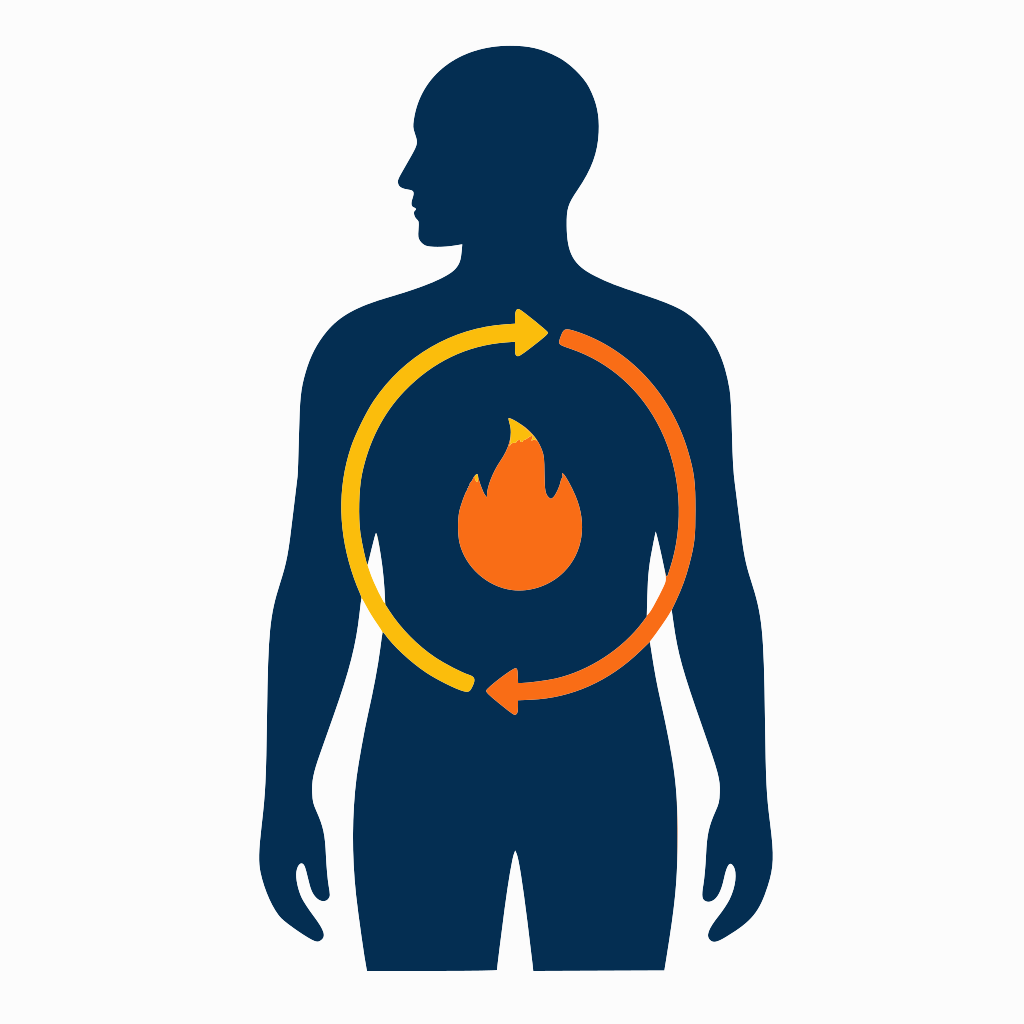
Cardio-Kidney-Metabolic syndrome — CKM for short — describes how three parts of your body are tightly linked: your heart (cardio), your kidneys (renal), and your metabolism (how your body handles sugar, fat, and weight).Ang Cardio-Kidney-Metabolic syndrome — CKM sa maikli — ay naglalarawan kung paano mahigpit na magkakaugnay ang tatlong bahagi ng iyong katawan: ang iyong puso (cardio), ang iyong mga bato (renal), at ang iyong metabolismo (kung paano pinangangasiwaan ng katawan ang asukal, taba, at timbang).Ang Cardio-Kidney-Metabolic syndrome — CKM sa mubo — naghulagway kung giunsa nga hugot nga nagdugtong ang tulo ka bahin sa imong lawas: ang imong kasingkasing (cardio), ang imong mga kidney (renal), ug ang imong metabolismo (kung giunsa pagdumala sa lawas ang asukar, tambok, ug timbang).Ing Cardio-Kidney-Metabolic syndrome — CKM king makuyad — ilalarawan na nu makananu la mikakabaltan a masiksik ing atlung dake ning kekang katawan: ing kekang pusu (cardio), reng kekang batu (renal), at ing kekang metabolismo (nu makananu asikasuan ning katawan ing asukal, taba, at timbang).
When one of these starts to struggle, it puts strain on the others. High blood sugar and extra weight stress the blood vessels; stressed blood vessels make the heart and kidneys work harder; struggling kidneys hold onto fluid, which strains the heart further. It becomes a cycle.Kapag nagsimulang mahirapan ang isa sa mga ito, naglalagay ito ng diin sa iba. Ang mataas na asukal sa dugo at labis na timbang ay nagpapahirap sa mga daluyan ng dugo; ang na-stress na mga daluyan ng dugo ay nagpapahirap sa puso at mga bato; ang nahihirapang mga bato ay nagpipigil ng likido, na lalong nagpapahirap sa puso. Nagiging isang siklo ito.Kon usa niini magsugod og kalisod, magbutang kini og bug-at sa uban. Ang taas nga asukar sa dugo ug sobra nga timbang magpahago sa mga ugat sa dugo; ang gikapoy nga mga ugat sa dugo maghatag og dugang trabaho sa kasingkasing ug mga kidney; ang naglisod nga mga kidney magpugong sa likido, nga makapahago pa sa kasingkasing. Mahimo kining usa ka siklo.Nung ing metung karela magumpisang mag-irap, maglagyu yang diin karing aliwa. Ing matas a asukal king daya at sobrang timbang pasakitan da la reng ugat ning daya; reng napagal a ugat ning daya paragulan da ing obra ning pusu at reng batu; reng mag-irap a batu tinaganan da ing likido, a lalung pasakitan ne ing pusu. Magi yang metung a siklo.
A way to picture it. Think of your heart, kidneys, and metabolism as three pumps connected by the same set of pipes. If pressure builds up in one pump, it travels through the shared pipes and wears down the others. That is why your doctor looks at all three together — fixing only one rarely solves the problem.Isang paraan para isipin ito. Isipin ang iyong puso, mga bato, at metabolismo bilang tatlong bomba na konektado sa iisang hanay ng tubo. Kung magkaroon ng presyon sa isang bomba, dumadaloy ito sa pinagsasaluhang mga tubo at pinapagod ang iba. Iyan ang dahilan kung bakit tinitingnan ng iyong doktor ang tatlo nang sabay — bihirang malutas ang problema kung isa lang ang aayusin.Usa ka paagi sa paghanduraw niini. Hunahunaa ang imong kasingkasing, mga kidney, ug metabolismo isip tulo ka bomba nga gidugtong sa managsama nga mga tubo. Kon motaas ang presyur sa usa ka bomba, moagi kini sa gipaambit nga mga tubo ug makapaluya sa uban. Mao nga tan-awon sa imong doktor ang tanang tulo nga dungan — panagsa ra masulbad ang problema kon usa ra ang ayohon.Metung a paralan ba yang isipan. Isipan me ing kekang pusu, batu, at metabolismo antimong atlung bomba a mikakakawing king mikakabaltan a tubu. Nung ating presyon a mikamu king metung a bomba, dumalan ya king mikakabaltan a tubu at pagalan da la reng aliwa. Ita ing sangkan a lawen ne ning kekang doktor ing atlu a sabay — malagwa lang malutas ing problema nung metung mu ing ayusan.
The good news: because these systems are connected, the right treatment can protect all three at once. That is the central idea of this guide.Ang magandang balita: dahil magkakaugnay ang mga sistemang ito, kayang protektahan ng tamang paggamot ang tatlo nang sabay. Iyan ang pangunahing ideya ng gabay na ito.Ang maayong balita: tungod kay nagdugtong kining mga sistema, ang husto nga pagtambal makapanalipod sa tanang tulo nga dungan. Mao kana ang sentro nga ideya niini nga giya.Ing mayap a balita: uling mikakakawing la reng sistemang ini, ing tamang lunas apiprotektan na la ing atlu a sabay. Ita ing pekamaulagang ideya ning giyang ini.
Where am I on the path?Nasaan ako sa landas?Asa ko sa dalan?Nokarin ku king dalan?
CKM is described in stages, from 0 to 4. The stages are a ladder — they tell you and your doctor how far things have progressed and, just as importantly, what you can do to stay where you are or step back down.Ang CKM ay inilalarawan sa mga antas, mula 0 hanggang 4. Ang mga antas ay parang hagdan — sinasabi ng mga ito sa iyo at sa iyong doktor kung gaano na kalayo ang narating ng mga bagay-bagay at, gayundin kahalaga, kung ano ang magagawa mo para manatili sa kinaroroonan mo o bumaba muli.Ang CKM gihulagway sa mga ang-ang, gikan 0 hangtod 4. Ang mga ang-ang usa ka hagdanan — gisultihan ka niini ug ang imong doktor kung unsa na kalayo ang naabtan sa mga butang ug, sama ka importante, unsa ang imong mahimo aron magpabilin kung asa ka o mobalik paubos.Ing CKM ilalarawan king stages, manibat 0 anggang 4. Reng stages metung lang hagdan — sasabian da ka at ing kekang doktor nu makananu na kalaut ing kalagayan at, makanian mu rin kaulaga, nu nanu ing agyu mung daptan ba kang manatili nokarin ka o mibaba pasibayu.
Lower stages are about risk (extra weight, blood pressure, blood sugar). Higher stages mean the heart, kidneys, or blood vessels have started to show changes. The earlier you act, the more you can protect.Ang mas mababang mga antas ay tungkol sa panganib (labis na timbang, presyon ng dugo, asukal sa dugo). Ang mas mataas na mga antas ay nangangahulugang nagsimula nang magpakita ng mga pagbabago ang puso, mga bato, o mga daluyan ng dugo. Kung mas maaga kang kumilos, mas marami ang maipoprotekta mo.Ang ubos nga mga ang-ang mahitungod sa risgo (sobra nga timbang, presyur sa dugo, asukar sa dugo). Ang taas nga mga ang-ang nagpasabot nga ang kasingkasing, mga kidney, o mga ugat sa dugo nagsugod na og pagpakita og mga kausaban. Kon mas sayo ka molihok, mas daghan ang imong mapanalipdan.Reng mababang stages tungkul la king peligru (sobrang timbang, presyon ning daya, asukal king daya). Reng matas a stages ibat da nu ing pusu, batu, o ugat ning daya migumpisa nang magpakit karing pamibayu. Nung mas maranun kang kumilos, mas dakal ing apiprotektan mu.
Wherever you land, the message is hopeful: at every stage there are concrete steps that protect your heart, kidneys, and metabolism together. The next sections explain them.Saan ka man mapunta, umaasa ang mensahe: sa bawat antas ay may mga konkretong hakbang na nagpoprotekta sa iyong puso, mga bato, at metabolismo nang sabay. Ipinapaliwanag ito ng mga susunod na seksyon.Bisan asa ka mahulog, ang mensahe puno sa paglaom: sa matag ang-ang adunay mga konkreto nga lakang nga manalipod sa imong kasingkasing, mga kidney, ug metabolismo nga dungan. Ang sunod nga mga seksyon magpasabot niini.Nokarin ka man munta, matula ing mensahe: king balang stage ating konkretung dalan a mamiprotektan king kekang pusu, batu, at metabolismo a sabay. Ipaliwanag da la reng tutuking seksyon.
Why your kidneys sit at the center of thisBakit nasa gitna ng lahat ng ito ang iyong mga batoNganong ang imong mga kidney ang naa sa sentro niiniBakit atyu la king libutad ning eganaganang ini reng kekang batu
It is easy to think of kidney disease as one more item on a list of risks, sitting alongside high blood pressure and diabetes. That is not quite right. Once the kidneys are damaged, they stop being only a victim of the process and start becoming a driver of it — pushing back on the heart and blood vessels in ways the other risk factors cannot.Madaling isipin ang sakit sa bato bilang isa pang bagay sa listahan ng mga panganib, katabi ng altapresyon at diabetes. Hindi iyan tama. Kapag nasira na ang mga bato, hindi na lang sila biktima ng proseso — nagiging sanhi na rin sila nito, na sumasakit pabalik sa puso at mga ugat sa paraang hindi kayang gawin ng ibang panganib.Sayon huna-hunaon ang sakit sa kidney isip usa pa ka butang sa listahan sa mga risgo, tapad sa taas nga presyon ug diabetes. Dili kana husto. Kon madaot na ang mga kidney, dili na lang sila biktima sa proseso — mahimo na sab silang hinungdan niini, nga mobalik og daot sa kasingkasing ug mga ugat sa paagi nga dili mahimo sa ubang risgo.Malagua yang isipan ing sakit king batu antimong metung pang bage king listahan da reng peligru, kasiping ning altapresyon at diabetes. E ya iyan tama. Nung mesira na la reng batu, ali na la mu biktima ning proseso — maging sangkan na la naman kaniti, a pasakitan de pasibayu ing pusu at reng ugat king paralan a e agyu da reng aliwang peligru.
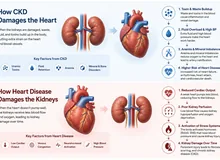
What damaged kidneys do to the heart. They hold on to salt and water, so the heart has more volume to move. They make less of the hormone that tells the bone marrow to build red blood cells, so anemia develops and the heart must beat faster to deliver the same oxygen. They lose control of calcium and phosphate, and those minerals settle in artery walls and stiffen them. They allow waste products the body normally clears to accumulate, and some of those are directly toxic to heart muscle. And the low-grade inflammation that runs through kidney disease speeds up the furring of the arteries. None of this is felt early — which is exactly the problem.Ano ang ginagawa ng sirang bato sa puso. Pinipigil nila ang asin at tubig, kaya mas maraming dugo ang kailangang ikilos ng puso. Kaunti na lang ang nagagawa nilang hormone na nag-uutos sa utak ng buto na gumawa ng pulang selula, kaya nagkaka-anemia at kailangang bumilis ang tibok ng puso para maghatid ng parehong oxygen. Nawawalan sila ng kontrol sa calcium at phosphate, at dumidikit ang mga mineral na ito sa dingding ng ugat at pinapatigas ang mga ito. Naiipon ang mga dumi na dapat ay naaalis, at may ilan sa mga ito na direktang nakakalason sa kalamnan ng puso. At ang mahinang pamamaga na dala ng sakit sa bato ay nagpapabilis ng pagbabara ng mga ugat. Wala sa mga ito ang nararamdaman sa umpisa — iyan mismo ang problema.Unsa ang buhaton sa nadaot nga kidney sa kasingkasing. Ginapugngan nila ang asin ug tubig, mao nga mas daghan ang dugo nga kinahanglan ipalihok sa kasingkasing. Gamay na lang ang ilang mahimo nga hormone nga nagsugo sa utok sa bukog nga maghimo og pula nga selula, mao nga motungha ang anemia ug kinahanglan mopaspas ang pitik sa kasingkasing aron makahatod sa samang oxygen. Mawad-an silag kontrol sa calcium ug phosphate, ug motapot kining mga mineral sa bungbong sa ugat ug mopagahi niini. Motigom ang mga hugaw nga angay unta makuha, ug ang uban niini direktang makahilo sa kaunoran sa kasingkasing. Ug ang hinay nga hubag nga dala sa sakit sa kidney mopadali sa pagbara sa mga ugat. Walay usa niini ang mabati sa sinugdanan — mao gyud kana ang problema.Nanu ing daraptan da reng mesirang batu king pusu. Tataganan da ing asin at danum, inya mas dakal a daya ing kailangan galoan ning pusu. Ditak na mu ing agyu dang gawan a hormone a mag-utus king utak ning butul a gumawa lang malutung selula, inya ating anemia at kailangan mabilis ing kutkutak ning pusu ba yang mag-atad ning parehung oxygen. Mawala ing kontrol da king calcium at phosphate, at dumikit la reng mineral a deni king diding da reng ugat at pasiasan da la. Mitipun la reng dumi a dapat maalis, at ating mapilan kareti a direktang makalasun king laman ning pusu. At ing mababang pamamaga a dala ning sakit king batu pabilisan na ing pamamara da reng ugat. Ala kareti ing marasan king kaumpisan — ita mismu ing problema.
This is not just theory. In the largest analysis of its kind — more than 27 million people pooled across dozens of studies — both a lower eGFR and a higher urine albumin level were independently associated with death, heart attack, stroke, heart failure, atrial fibrillation, peripheral artery disease, hospitalization, and kidney failure. Each measure added risk information the other did not carry, which is why your doctor needs both.Hindi ito teorya lamang. Sa pinakamalaking pag-aaral ng ganitong uri — mahigit 27 milyong tao mula sa dose-dosenang pananaliksik — ang mas mababang eGFR at ang mas mataas na albumin sa ihi ay parehong malayang nauugnay sa kamatayan, atake sa puso, stroke, heart failure, hindi regular na tibok ng puso, sakit sa ugat ng binti, pagkaka-ospital, at kidney failure. Bawat sukat ay nagdadala ng impormasyon tungkol sa panganib na wala sa isa — kaya kailangan pareho ng iyong doktor.Dili kini teoriya lamang. Sa kinadak-ang pagtuon niini nga matang — kapin sa 27 ka milyon ka tawo gikan sa dosena ka pagtuon — ang mas ubos nga eGFR ug ang mas taas nga albumin sa ihi parehong gawasnong nalambigit sa kamatayon, atake sa kasingkasing, stroke, heart failure, dili regular nga pitik sa kasingkasing, sakit sa ugat sa paa, pagka-ospital, ug kidney failure. Ang matag sukod nagdala og impormasyon bahin sa risgo nga wala sa lain — mao nga kinahanglan sa imong doktor ang duha.E ya ini teoriya mu. King pekamaragul a pamanigaral a antini — labis 27 milyun a tau manibat karing dakal a pamanigaral — ing mas mababang eGFR at ing mas matas a albumin king mie parehu lang malayang mikakabaltan king kamatayan, atake king pusu, stroke, heart failure, e regular a kutkutak ning pusu, sakit king ugat ning bitis, pamag-ospital, at kidney failure. Balang sukad mag-atad yang impormasyon tungkul king peligru a alang king aliwa — inya kailangan na la ngan ning kekang doktor.
The useful way to hold thisAng kapaki-pakinabang na paraan para tandaan itoAng mapuslanon nga paagi sa paghinumdom niiniIng makabaldugang paralan ba yang tandanan
Protecting your kidneys is heart protection. When your doctor works to slow kidney damage, they are not treating a separate organ — they are removing one of the strongest forces pushing your heart toward failure.Ang pagprotekta sa iyong mga bato ay pagprotekta sa puso. Kapag pinapabagal ng iyong doktor ang pinsala sa bato, hindi siya gumagamot ng hiwalay na organ — inaalis niya ang isa sa pinakamalakas na puwersang nagtutulak sa iyong puso patungo sa pagpalya.Ang pagpanalipod sa imong mga kidney mao ang pagpanalipod sa kasingkasing. Kon paspason sa imong doktor ang paghinay sa kadaot sa kidney, dili siya nagtambal og lahi nga organ — gikuha niya ang usa sa kinakusgan nga puwersa nga nagduso sa imong kasingkasing paingon sa pagpalya.Ing pamiprotekta karing kekang batu ya ing pamiprotekta king pusu. Nung papabagalan ning kekang doktor ing pamanyira king batu, e ne lulunasan ing bukud a organ — ilako ne ing metung karing pekamasikan a puersang tutulak king kekang pusu papunta king pamagpalya.
Do not judge kidney health by creatinine aloneHuwag husgahan ang kalusugan ng bato sa creatinine lamangAyaw hukmi ang panglawas sa kidney pinaagi lang sa creatinineE me uusigan ing katulid da reng batu king creatinine mu
Kidney health needs two tests, not one. A single blood creatinine — or the eGFR calculated from it — answers only half the question, and the half it misses is often the half that shows up first.Kailangan ng dalawang pagsusuri ang kalusugan ng bato, hindi isa. Ang creatinine sa dugo — o ang eGFR na kinukuha mula rito — ay sumasagot lamang sa kalahati ng tanong, at ang kalahating hindi nito nakikita ang madalas na unang lumilitaw.Nagkinahanglan og duha ka pagsusi ang panglawas sa kidney, dili usa. Ang creatinine sa dugo — o ang eGFR nga gikuha gikan niini — motubag lamang sa katunga sa pangutana, ug ang katunga nga wala niini makita mao ang kasagarang unang motungha.Kailangan na ning adwang pamanigaral ing katulid da reng batu, ali metung. Ing creatinine king daya — o ing eGFR a makuha kaniti — mikakabatan ya mu king kapitna ning kutang, at ing kapitna a e na akakit ita ing dalasang minunang lumitaw.
| TestPagsusuriPagsusiPamaniyasat | What it actually measuresAno talaga ang sinusukat nitoUnsa gyud ang gisukod niiniNanu talaga ing sinusukad na | What it can missAno ang hindi nito nakikitaUnsa ang dili niini makitaNanu ing e na akakit |
|---|---|---|
| eGFR from a blood testmula sa dugogikan sa dugomanibat king daya |
An estimate of how fast the kidneys are filtering blood.Tantiya kung gaano kabilis nasasala ng mga bato ang dugo.Banabana kung unsa ka paspas gisala sa mga kidney ang dugo.Metung a tantya nung makananu kabilis sasalain da reng batu ing daya. | Early damage. Filtration can look normal — or even high — while the filters are already injured.Maagang pinsala. Puwedeng mukhang normal — o kahit mataas — ang pagsasala kahit sira na ang mga salaan.Sayo nga kadaot. Mahimong morag normal — o bisan taas — ang pagsala bisan nadaot na ang mga salaan.Maranun a pamanyira. Malyaring maging normal — o anggang matas — ing pamanyala anggiaman mesira na la reng salaan. |
| UACR (urine albumin-to-creatinine ratio) from a urine samplemula sa ihigikan sa ihimanibat king mie |
Whether protein is leaking through the filters — a direct sign of damage.Kung may protina na tumatagas sa mga salaan — direktang tanda ng pinsala.Kon adunay protina nga nagtulo sa mga salaan — direktang timaan sa kadaot.Nung ating protina a tutulu karing salaan — direktang tanda ning pamanyira. | Some kidney diseases lower filtration without leaking much protein — so it cannot stand alone either.May mga sakit sa bato na binabawasan ang pagsasala nang hindi gaanong tumatagas ang protina — kaya hindi rin ito puwedeng mag-isa.Adunay mga sakit sa kidney nga mokunhod ang pagsala nga dili kaayo motulo ang protina — mao nga dili sab kini mahimong mag-inusara.Ating mapilan a sakit king batu a pababa da ing pamanyala anggiaman e masyadung tutulu ing protina — inya e ya naman malyaring mag-isa. |
Because each test can be abnormal while the other still looks reassuring, they are ordered together. Urine albumin, in particular, is the earlier and more sensitive signal, and it predicts heart problems as well as kidney ones. Despite that, it remains the test most often skipped — even in well-resourced health systems, most people at risk never have it done.Dahil puwedeng abnormal ang isa habang mukhang maayos pa ang isa, magkasama silang ipinapasuri. Ang albumin sa ihi ang mas maaga at mas sensitibong senyales, at hinuhulaan nito ang problema sa puso gayundin sa bato. Sa kabila nito, ito ang pinakamadalas na nalalaktawan — kahit sa mayayamang sistema ng kalusugan, karamihan ng nasa panganib ay hindi ito naipapasuri.Tungod kay mahimong abnormal ang usa samtang morag maayo pa ang lain, dungan silang ipasusi. Ang albumin sa ihi mao ang mas sayo ug mas sensitibo nga timaan, ug matagna niini ang problema sa kasingkasing ug sa kidney. Bisan pa niini, kini ang kasagarang malaktawan — bisan sa dato nga sistema sa panglawas, kadaghanan sa naa sa risgo wala gyud kini mapasusi.Uling malyaring abnormal ing metung kabang maganaka pa ing aliwa, kayabe lang pasuriin. Ing albumin king mie ing mas maranun at mas sensitibung tanda, at pipahulaan na ing problema king pusu antimo mu naman king batu. Anggiaman kaniti, iti ing pekadalasang malakwan — anggang karing mabandi a sistema ning katulid, karakalan da reng atyu king peligru e da ini apasuri.
Two things that can fool the blood testDalawang bagay na puwedeng makalito sa pagsusuri ng dugoDuha ka butang nga makalibog sa pagsusi sa dugoAdwang bage a malyaring makalitu king pamaniyasat king daya
A high eGFR is not always good news. In obesity and in early diabetic kidney disease, the surviving filters can be forced to overwork — a state called hyperfiltration. The number looks excellent while damage is quietly accumulating. Big changes in muscle or weight distort the test too, because creatinine comes from muscle. If you have lost a lot of weight, or your result does not fit the clinical picture, your doctor may add a second blood marker called cystatin C — but only when the answer would actually change a decision.Hindi laging magandang balita ang mataas na eGFR. Sa sobrang timbang at sa maagang diabetic kidney disease, napipilitang mag-overtime ang natitirang mga salaan — tinatawag itong hyperfiltration. Maganda ang numero habang tahimik na naiipon ang pinsala. Nakakabago rin ng resulta ang malaking pagbabago sa laman o timbang, dahil sa kalamnan nanggagaling ang creatinine. Kung malaki ang ibinaba ng timbang mo, o hindi tugma ang resulta sa nakikita ng doktor, puwede siyang magdagdag ng ikalawang marker na tinatawag na cystatin C — ngunit kapag talagang magbabago nito ang desisyon.Dili kanunay maayong balita ang taas nga eGFR. Sa sobra nga timbang ug sa sayo nga diabetic kidney disease, mapugos og overtime ang nahibiling mga salaan — gitawag kining hyperfiltration. Nindot ang numero samtang hilom nga motigom ang kadaot. Mausab sab ang resulta sa dako nga kausaban sa unod o timbang, kay sa kaunoran naggikan ang creatinine. Kon dako ang imong nihubas nga timbang, o dili mohaum ang resulta sa nakita sa doktor, mahimo siyang magdugang og ikaduhang marker nga gitawag og cystatin C — apan kon tinuod nga mausab niini ang desisyon.E ya pane mayap a balita ing matas a eGFR. King sobrang timbang at king maranun a diabetic kidney disease, mapilitan lang mag-overtime reng mitagang salaan — ausan yang hyperfiltration. Masanting ing numeru kabang tahimik yang mitipun ing pamanyira. Pababayuan da naman ing resulta reng maragul a pamagbayu king laman o timbang, uling king laman ya manibat ing creatinine. Nung maragul ing kekang mebabang timbang, o e ya tugma ing resulta king akakit ning doktor, malyari yang magdagdag ning kaduang marker a ausan dang cystatin C — dapot nung talagang pababayuan na niti ing desisyon.
One more practical point: a single abnormal result is not a diagnosis. Albumin in the urine rises temporarily with fever, heavy exercise, urinary infection, and poorly controlled blood sugar. An unexpected abnormal result should be repeated before anyone concludes you have chronic kidney disease.Isa pang praktikal na punto: hindi diagnosis ang isang abnormal na resulta. Pansamantalang tumataas ang albumin sa ihi kapag may lagnat, mabigat na ehersisyo, impeksyon sa ihi, at hindi kontroladong asukal. Dapat ulitin ang hindi inaasahang abnormal na resulta bago sabihing may chronic kidney disease ka.Usa pa ka praktikal nga punto: dili diagnosis ang usa ka abnormal nga resulta. Temporaryong motaas ang albumin sa ihi kon adunay hilanat, bug-at nga ehersisyo, impeksiyon sa ihi, ug dili kontrolado nga asukar. Angay usbon ang wala damha nga abnormal nga resulta sa dili pa isulti nga aduna kay chronic kidney disease.Metung pang praktikal a punto: e ya diagnosis ing metung a abnormal a resulta. Pansamantalang tutuas ing albumin king mie nung ating pamipali, masakit a ehersisyo, impeksyon king mie, at e kontroladung asukal. Dapat ulitan ing e inaasahang abnormal a resulta bayu sabian dang atin kang chronic kidney disease.
Do not assume diabetes or high blood pressure caused itHuwag basta ipagpalagay na diabetes o altapresyon ang sanhiAyaw dayon dahuma nga diabetes o taas nga presyon ang hinungdanE mu basta isipan a diabetes o altapresyon ing sangkan
Diabetes and long-standing high blood pressure are the two most common causes of chronic kidney disease worldwide, so when someone with both is found to have reduced kidney function, it is tempting to stop looking. That shortcut is one of the most consequential mistakes in kidney care — because having a common cause in the room does not prove it is the cause in front of you.Ang diabetes at matagal nang altapresyon ang dalawang pinakakaraniwang sanhi ng chronic kidney disease sa buong mundo, kaya kapag may parehong kondisyon ang isang taong lumabas na mahina ang bato, madaling tumigil na sa paghahanap. Ang shortcut na iyon ay isa sa mga pinakamabigat na pagkakamali sa pag-aalaga ng bato — dahil ang pagkakaroon ng karaniwang sanhi ay hindi patunay na ito nga ang sanhi sa harap mo.Ang diabetes ug dugay na nga taas nga presyon mao ang duha ka labing komon nga hinungdan sa chronic kidney disease sa tibuok kalibotan, mao nga kon adunay duha kini nga kondisyon ang tawo nga nakit-ang huyang ang kidney, sayon undangon ang pagpangita. Kana nga shortcut usa sa pinakabug-at nga sayop sa pag-atiman sa kidney — kay ang pagbaton og komon nga hinungdan dili pamatuod nga kini gyud ang hinungdan sa imong atubangan.Ing diabetes at matagal nang altapresyon ing adwang pekakaraniwan a sangkan ning chronic kidney disease king mabilug a yatu, inya nung atin lang parehung kondisyon ing metung a taung meyakit a mayna ing batu, malagua yang tumuknang ing pamanintun. Ing shortcut a ita metung ya karing pekamabayat a kamalian king pamanamdaman king batu — uling ing atin kang karaniwan a sangkan e ne patune a ita ing sangkan king arapan mu.
Kidney disease from diabetes usually follows a recognizable script: years of diabetes first, protein appearing in the urine gradually, filtration falling slowly, and often changes in the eyes at the same time. When the story does not fit that script, another diagnosis may be hiding underneath — and some of those other diagnoses have specific treatments that do not work if nobody looks for them.Ang sakit sa bato mula sa diabetes ay karaniwang sumusunod sa isang kilalang balangkas: taon muna ng diabetes, unti-unting paglabas ng protina sa ihi, dahan-dahang pagbaba ng pagsasala, at madalas ay may kasabay na pagbabago sa mata. Kapag hindi tumutugma ang kuwento sa balangkas na iyon, may ibang diagnosis na maaaring nakatago sa ilalim — at may mga diagnosis na iyon na may tiyak na lunas na hindi maibibigay kung walang naghanap.Ang sakit sa kidney gikan sa diabetes kasagarang mosunod sa nailhan nga sumbanan: mga tuig una sa diabetes, hinay-hinay nga pagtungha sa protina sa ihi, hinay nga pagkunhod sa pagsala, ug kasagarang adunay dungan nga kausaban sa mata. Kon dili mohaum ang istorya nianang sumbanan, adunay laing diagnosis nga mahimong nagtago sa ilalom — ug ang uban niini adunay piho nga tambal nga dili mahatag kon walay nangita.Ing sakit king batu manibat king diabetes karaniwan yang tuturuk king metung a kilalang balangkas: banwa mumuna ning diabetes, dinat-dinat a pamaglual ning protina king mie, marimla a pamababa ning pamanyala, at dalasan ating kayabe a pamagbayu king mata. Nung e ya tugma ing salita king balangkas a ita, ating aliwang diagnosis a malyaring makasalikut king lalam — at ating mapilan kareti a atin lang tune a lunas a e mibie nung ala kang meninun.
Findings that mean the cause deserves a closer lookMga natuklasan na nangangahulugang kailangang tingnang mabuti ang sanhiMga nakit-an nga nagpasabot nga angay tan-awon pag-ayo ang hinungdanReng meyakit a maliaring kailangan lawen a mayap ing sangkan
Blood in the urine that keeps coming back · kidney function falling faster than expected · very large amounts of protein in the urine · an abnormal urine microscope finding · kidney disease appearing at a young age with no clear reason · a strong family history of kidney disease · rashes, joint pain, or fever suggesting an inflammatory illness · an unusual shape or size on ultrasound · salt or potassium abnormalities out of proportion to the kidney numbers.Paulit-ulit na dugo sa ihi · mas mabilis kaysa inaasahang pagbaba ng gana ng bato · napakaraming protina sa ihi · abnormal na nakikita sa mikroskopyo ng ihi · sakit sa bato sa murang edad na walang malinaw na dahilan · malakas na kasaysayan ng sakit sa bato sa pamilya · pantal, sakit ng kasukasuan, o lagnat na nagpapahiwatig ng inflammatory na sakit · kakaibang hugis o laki sa ultrasound · abnormal na asin o potasa na hindi tugma sa mga numero ng bato.Balik-balik nga dugo sa ihi · mas paspas kay sa gipaabot nga pagkunhod sa gana sa kidney · daghan kaayo nga protina sa ihi · abnormal nga nakit-an sa mikroskopyo sa ihi · sakit sa kidney sa batan-ong edad nga walay klaro nga hinungdan · kusog nga kasaysayan sa sakit sa kidney sa pamilya · katol, sakit sa lutahan, o hilanat nga nagpasabot og inflammatory nga sakit · lahi nga porma o gidak-on sa ultrasound · abnormal nga asin o potasa nga dili haom sa mga numero sa kidney.Paulit-ulit a daya king mie · mas mabilis kesa king inaasahang pamababa ning gana ning batu · dakal a dakal a protina king mie · abnormal a akakit king mikroskopyo ning mie · sakit king batu king anak a edad a alang malino a sangkan · masikan a kasaysayan ning sakit king batu king pamilya · pantal, sakit da reng kasukasuan, o pamipali a maliaring inflammatory a sakit · aliwang anyu o laki king ultrasound · abnormal a asin o potasa a e tugma karing numeru ning batu.
If any of these apply to you, it does not mean something frightening is happening. It means the reason your kidneys are struggling has not been fully settled yet, and settling it can change what treatment you are offered. A kidney specialist may repeat the urine tests, arrange an ultrasound, run blood tests for inflammatory conditions, or — when the answer would genuinely change the plan — recommend a kidney biopsy.Kung may tumutugma sa iyo rito, hindi ibig sabihin ay may nakakatakot na nangyayari. Ibig sabihin, hindi pa lubusang natutukoy kung bakit nahihirapan ang iyong mga bato, at ang pagtukoy dito ay puwedeng magbago sa lunas na iaalok sa iyo. Puwedeng ulitin ng espesyalista sa bato ang pagsusuri ng ihi, magpa-ultrasound, magpa-blood test para sa inflammatory na kondisyon, o — kapag talagang magbabago nito ang plano — magrekomenda ng kidney biopsy.Kon adunay mohaom kanimo niini, dili kini nagpasabot nga adunay makahadlok nga nahitabo. Nagpasabot kini nga wala pa hingpit matino kung nganong naglisod ang imong mga kidney, ug ang pagtino niini mahimong makausab sa tambal nga itanyag kanimo. Mahimong usbon sa espesyalista sa kidney ang pagsusi sa ihi, magpa-ultrasound, magpa-blood test alang sa inflammatory nga kondisyon, o — kon tinuod nga mausab niini ang plano — morekomendar og kidney biopsy.Nung ating tugma keka kareti, e na buri sabian a ating makatakut a malyari. Buri nang sabian, e pa lubus a meyakit nung bakit mag-irap la reng kekang batu, at ing pamanakit kaniti malyari nang bayuan ing lunas a mialok keka. Malyari nang ulitan ning espesyalista king batu ing pamaniyasat king mie, magpa-ultrasound, magpa-blood test para karing inflammatory a kondisyon, o — nung talagang bayuan na niti ing plano — magrekomenda yang kidney biopsy.
Three pillars that work togetherTatlong haligi na gumagana nang sabayTulo ka haligi nga nagtinabangayAtlung haligi a magobra a sabay
Treatment rests on three pillars. They reinforce each other — medicines work better alongside food and movement, and vice versa.Nakasalalay ang paggamot sa tatlong haligi. Pinagtitibay ng bawat isa ang isa't isa — mas gumagana ang mga gamot kasabay ng pagkain at galaw, at gayundin sa kabaligtaran.Ang pagtambal nagsalig sa tulo ka haligi. Nagpalig-on sila sa usag-usa — mas maayo ang epekto sa mga tambal inubanan sa pagkaon ug lihok, ug sukwahi usab.Ing lunas maka-sandal ya king atlung haligi. Pasikanan da ing metung at metung — mas magobra la reng gamot a kayabe ning pamangan at galo, at makanian mu rin king kabaligtaran.
💊 Targeted medicines💊 Nakatuon na mga gamot💊 Gipunting nga mga tambal💊 Nakatung a gamot
Several modern medicines protect the heart and kidneys at the same time. One important family helps the kidney release extra sugar and salt, easing pressure on the whole system. Your doctor chooses based on your kidney function and your specific situation. Never stop these on your own — even if a lab value wobbles, that is often expected (see below).Ilang makabagong gamot ang nagpoprotekta sa puso at mga bato nang sabay. May isang mahalagang pamilya na tumutulong sa bato na maglabas ng labis na asukal at asin, na nagpapagaan sa presyon sa buong sistema. Pumipili ang iyong doktor batay sa paggana ng iyong bato at sa iyong partikular na sitwasyon. Huwag itong ihinto nang mag-isa — kahit na medyo mag-iba ang isang resulta ng lab, madalas inaasahan iyon (tingnan sa ibaba).Pipila ka moderno nga tambal manalipod sa kasingkasing ug mga kidney dungan. Adunay usa ka importante nga pamilya nga motabang sa kidney sa pagpagawas og sobra nga asukar ug asin, nga makapagaan sa presyur sa tibuok sistema. Ang imong doktor mopili base sa function sa imong kidney ug sa imong espesipiko nga kahimtang. Ayaw gyud kini hunonga sa imong kaugalingon — bisan pa og mausab-usab ang usa ka lab value, kasagaran gidahom kana (tan-awa sa ubos).Pilang bayung gamot ing mamiprotektan king pusu at batu a sabay. Ating metung a maulagang pamilya a saup king batu ba yang maglabas sobrang asukal at asin, a papagaan ne ing presyon king mabilug a sistema. Ing kekang doktor mamili ya base king pamagobra ning kekang batu at king kekang espesipikung kalagayan. E mu la itigil king sarili mu — maski mag-iba ing metung a resulta ning lab, kalimitan asahan ya ita (lawen king lalam).
🥗 Nutrition🥗 Nutrisyon🥗 Nutrisyon🥗 Nutrisyon
Eating patterns matter more than any single "miracle food." A plate built around vegetables, whole grains, and lean protein — adjusted to your kidney stage — supports all three systems. Salt is worth being mindful of, but the goal is a sustainable, enjoyable pattern, not extreme restriction.Mas mahalaga ang mga pattern ng pagkain kaysa sa anumang iisang "milagrong pagkain." Ang isang pinggan na binuo sa paligid ng gulay, whole grains, at lean protein — na iniangkop sa antas ng iyong bato — ay sumusuporta sa tatlong sistema. Sulit na bantayan ang asin, ngunit ang layunin ay isang napapanatili at kasiya-siyang pattern, hindi labis na pagbabawal.Mas importante ang mga sumbanan sa pagkaon kaysa sa bisan unsang usa ka "milagrosong pagkaon." Ang usa ka plato nga gitukod palibot sa utanon, whole grains, ug lean protein — gi-adjust sa ang-ang sa imong kidney — mosuporta sa tanang tulo ka sistema. Angay bantayan ang asin, apan ang tumong usa ka malungtaron ug malingaw nga sumbanan, dili grabe nga pagdili.Mas maulaga la reng pattern ning pamangan kesa king nanumang metung a "milagrung pamangan." Ing metung a pinggan a gawa king paligid ning gule, whole grains, at lean protein — a inangkup king stage ning kekang batu — susuportan na la ing atlung sistema. Sulit yang bantayan ing asin, dapot ing tudtud metung a matibe at makatula a pattern, e ing sobrang pamagbawal.
Important for kidney patients: avoid star fruit (balimbing) entirely — it can be dangerous in kidney disease.Mahalaga para sa mga pasyente ng bato: ganap na iwasan ang star fruit (balimbing) — maaari itong mapanganib sa sakit sa bato.Importante para sa mga pasyente sa kidney: likayi gyud ang star fruit (balimbing) — mahimo kining delikado sa sakit sa kidney.Maulaga para karing pasyente king batu: iwasan mu nang tutu ing star fruit (balimbing) — malyaring makarok ya king sakit king batu.
🏃 Movement & your body's own healing🏃 Galaw & ang sariling paggaling ng iyong katawan🏃 Lihok & ang kaugalingong pagkaayo sa imong lawas🏃 Galo & ing sariling pamagaling ning kekang katawan
Regular activity is genuinely medicine here — it improves blood vessel health, blood sugar, and mood. The aim is steady, achievable movement most days, matched to what your body can do. Even modest activity counts.Ang regular na aktibidad ay tunay na gamot dito — pinapabuti nito ang kalusugan ng mga daluyan ng dugo, asukal sa dugo, at mood. Ang layunin ay tuloy-tuloy at kayang gawing galaw sa halos araw-araw, na iniangkop sa kaya ng iyong katawan. Kahit katamtamang aktibidad ay may bisa.Ang regular nga kalihokan tinuod nga tambal dinhi — mopauswag kini sa panglawas sa mga ugat sa dugo, asukar sa dugo, ug kahimtang sa buot. Ang tumong usa ka makanunayon ug makab-ot nga lihok sa kadaghanan sa mga adlaw, gipahaum sa mahimo sa imong lawas. Bisan gamay nga kalihokan may bili.Ing regular a aktibidad tune yang gamot keni — papagaling na la ing kalusugan da reng ugat ning daya, asukal king daya, at mood. Ing tudtud metung a tuluy-tuluy at agyung daptan a galo king kalimitan aldo, a inangkup king agyu ning kekang katawan. Maski katamtaman a aktibidad ating alkance.

The three pillars of CKM treatment shown side by side — targeted medicines, an eating pattern built around plants and right-sized protein, and regular movement. They are drawn as mutually reinforcing rather than sequential: each medicine works better against a background of adequate nutrition and activity, and activity is easier to sustain when blood pressure and glucose are controlled.
- CKM
- Cardiovascular-kidney-metabolic
Where this usually beginsKung saan karaniwang nagsisimula itoAsa kini kasagarang magsugodNokarin ya karaniwang mag-umpisa iti
For most people, the CKM story starts with body fat — not simply how much, but what kind and where. Fat stored deep in the abdomen and inside organs behaves very differently from fat under the skin. It is metabolically active tissue that releases inflammatory signals and hormones into the bloodstream, and those signals are what set insulin resistance, high blood pressure, and abnormal cholesterol in motion.Para sa karamihan, nagsisimula ang kuwento ng CKM sa taba ng katawan — hindi lang kung gaano karami, kundi anong klase at saan. Ang tabang nakaimbak sa loob ng tiyan at sa loob ng mga organ ay ibang-iba sa taba sa ilalim ng balat. Ito ay aktibong tisyu na naglalabas ng mga senyales ng pamamaga at hormone sa dugo, at ang mga senyales na iyon ang nagpapasimula ng insulin resistance, altapresyon, at abnormal na kolesterol.Para sa kadaghanan, magsugod ang istorya sa CKM sa tambok sa lawas — dili lang kung pila, kondili unsang klase ug asa. Ang tambok nga natipig sulod sa tiyan ug sulod sa mga organ lahi kaayo sa tambok ilalom sa panit. Kini aktibo nga tisyu nga nagpagawas og mga timaan sa hubag ug hormone sa dugo, ug kadto nga mga timaan mao ang nagsugod sa insulin resistance, taas nga presyon, ug abnormal nga kolesterol.Para karing karakalan, mag-umpisa ya ing salita ning CKM king taba ning katawan — ali mu nung makananu karakal, nune nanung klase at nokarin. Ing tabang mitipun king kilub ning atian at king kilub da reng organ, aliwa yang aliwa king taba king lalam ning balat. Ini metung yang aktibung tisyu a maglual king mga tandang pamamaga at hormone king daya, at reng tandang deta ing mag-umpisa king insulin resistance, altapresyon, at abnormal a kolesterol.
Filipinos and other Asians reach risk at lower numbersMas mababang numero na ang panganib para sa mga Pilipino at AsyanoMas ubos nga numero na ang risgo para sa mga Pilipino ug AsyanoMas mababang numeru ne ing peligru para karing Pilipinu at Asyanu
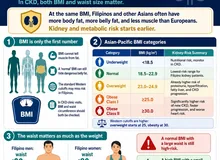
At the same body-mass index (BMI) and the same waist size, people of Asian ancestry tend to carry more visceral fat and show more insulin resistance than people of European ancestry. This is why lower thresholds are used here — and why a Filipino patient whose BMI reads "only slightly overweight" may already be carrying real metabolic risk. If your BMI looks reassuring but your waist does not, trust the waist.Sa parehong body-mass index (BMI) at parehong laki ng baywang, mas maraming visceral fat at mas maraming insulin resistance ang mga taong may lahing Asyano kaysa sa may lahing Europeo. Kaya mas mababang threshold ang ginagamit dito — at kaya ang Pilipinong ang BMI ay "bahagyang sobra lang sa timbang" ay maaaring may tunay nang metabolic na panganib. Kung mukhang maayos ang BMI mo pero hindi ang baywang, ang baywang ang paniwalaan.Sa samang body-mass index (BMI) ug samang gidak-on sa hawak, mas daghan ang visceral fat ug mas daghan ang insulin resistance sa mga tawong Asyano kay sa mga taga-Europa. Mao nga mas ubos nga threshold ang gigamit dinhi — ug mao nga ang Pilipino nga ang BMI "gamay ra ka sobra sa timbang" mahimong adunay tinuod nga metabolic nga risgo. Kon morag maayo ang imong BMI apan dili ang hawak, ang hawak ang tuohi.King parehung body-mass index (BMI) at parehung laki ning bewang, mas dakal ing visceral fat at mas dakal ing insulin resistance da reng taung Asyanu kesa karing taga-Europa. Inya mas mababang threshold ing gagamitan keni — at inya ing Pilipinung ing BMI na "ditak mu sobra king timbang" malyaring atin neng tune a metabolic a peligru. Nung maganaka ing kekang BMI dapot ali ing bewang, ing bewang ing paniwalan mu.
Two further points matter for the kidney specifically. First, how long excess weight has been carried appears to matter as much as how much — obesity that begins in childhood and persists carries the highest risk of later kidney disease, which is why childhood obesity is a kidney problem as well as a heart one. Second, excess weight can push the kidney filters into overwork before any test looks abnormal, and the first measurable sign is often a small amount of albumin in the urine.Dalawa pang punto ang mahalaga para sa bato. Una, ang tagal ng sobrang timbang ay tila kasinghalaga ng dami nito — ang labis na timbang na nagsisimula sa pagkabata at nagpapatuloy ang may pinakamataas na panganib ng sakit sa bato, kaya ang obesity sa bata ay problema rin ng bato at hindi lang ng puso. Ikalawa, kayang piliting mag-overtime ng sobrang timbang ang mga salaan ng bato bago pa man may abnormal na resulta, at ang unang masusukat na senyales ay madalas na kaunting albumin sa ihi.Duha pa ka punto ang importante alang sa kidney. Una, ang gidugayon sa sobra nga timbang morag sama ka importante sa gidaghanon — ang sobra nga timbang nga magsugod sa pagkabata ug magpadayon adunay pinakataas nga risgo sa ulahi nga sakit sa kidney, mao nga ang obesity sa bata problema sab sa kidney dili lang sa kasingkasing. Ikaduha, mahimong pugson sa sobra nga timbang ang mga salaan sa kidney nga mag-overtime sa dili pa adunay abnormal nga resulta, ug ang unang masukod nga timaan kasagarang gamay nga albumin sa ihi.Adwa pang punto ing maulaga para king batu. Mumuna, ing katagalan ning sobrang timbang mistulang kayaulaga ning karakal na — ing sobrang timbang a mag-umpisa king kayanakan at mituluy ing atin pekamatas a peligru ning sakit king batu, inya ing obesity karing anak problema ne naman ning batu ali mu ning pusu. Kadua, agyu nang pilitan ing sobrang timbang a mag-overtime la reng salaan ning batu bayu pa man ating abnormal a resulta, at ing minunang masukad a tanda dalasan ditak a albumin king mie.
The same fat that stresses the kidney also collects in the liver. When it does, the condition is called metabolic dysfunction–associated steatotic liver disease (MASLD) — the current name for what used to be called fatty liver. It is not a harmless incidental finding on an ultrasound: it travels with higher cardiovascular and kidney risk, and it is a reasonable prompt to look harder at the rest of the CKM picture.Ang parehong taba na nagpapahirap sa bato ay naiipon din sa atay. Kapag nangyari iyon, tinatawag itong metabolic dysfunction–associated steatotic liver disease (MASLD) — ang kasalukuyang pangalan ng dating tinatawag na fatty liver. Hindi ito walang saysay na nadiskubre lang sa ultrasound: kasama nito ang mas mataas na panganib sa puso at bato, at makatuwirang senyales ito para tingnang mabuti ang buong larawan ng CKM.Ang samang tambok nga naghago sa kidney motigom sab sa atay. Kon mahitabo kana, gitawag kining metabolic dysfunction–associated steatotic liver disease (MASLD) — ang karon nga ngalan sa gitawag kaniadto nga fatty liver. Dili kini walay bili nga nakit-an lang sa ultrasound: kauban niini ang mas taas nga risgo sa kasingkasing ug kidney, ug makatarunganon nga timaan kini aron tan-awon pag-ayo ang tibuok hulagway sa CKM.Ing parehung taba a pasakitan na ing batu mitipun ya naman king ate. Nung malyari ita, ausan yang metabolic dysfunction–associated steatotic liver disease (MASLD) — ing kasalukuyang lagyu ning datiling ausan dang fatty liver. E ya alang kabaldugan a meyakit mu king ultrasound: kayabe na ing mas matas a peligru king pusu at batu, at makatuliran yang tanda ba yang lawen a mayap ing mabilug a larawan ning CKM.
What actually helpsAno ang talagang nakakatulongUnsa ang tinuod nga makatabangNanu ing talagang makasaup
Diet and activity remain the foundation, and modest, sustained changes matter more than dramatic ones. Where lifestyle alone is not enough, medicines in the GLP-1 (glucagon-like peptide-1) receptor agonist family produce meaningful weight loss and have demonstrated kidney and cardiovascular benefit in randomized trials. Metabolic and bariatric surgery is an option in selected people and reduces albumin leakage. A caution that is easy to miss: in advanced kidney disease, losing muscle is dangerous, so weight loss at that stage must be supervised and paired with protein and resistance work. Ask before starting any weight-loss product — several sold over the counter are toxic to the kidneys.Nananatiling pundasyon ang diyeta at aktibidad, at mas mahalaga ang katamtaman at tuloy-tuloy na pagbabago kaysa sa madramang pagbabago. Kung kulang ang lifestyle, may mga gamot sa pamilyang GLP-1 receptor agonist na nagbibigay ng makabuluhang pagbaba ng timbang at napatunayan sa mga randomized na pag-aaral na may benepisyo sa bato at puso. Ang metabolic at bariatric surgery ay opsyon sa piling tao at binabawasan ang pagtagas ng albumin. Isang babala na madaling makalimutan: sa malalang sakit sa bato, delikado ang pagkawala ng kalamnan, kaya kailangang may gabay ang pagpapapayat sa yugtong iyon at kasabay ng protina at resistance exercise. Magtanong bago uminom ng anumang pampapayat — may ilan na nabibili nang walang reseta na nakakalason sa bato.Nagpabilin nga pundasyon ang diyeta ug kalihokan, ug mas importante ang kasarangan ug padayon nga kausaban kay sa dramatiko. Kon kulang ang lifestyle, adunay mga tambal sa pamilyang GLP-1 receptor agonist nga naghatag og mahinungdanon nga pagkunhod sa timbang ug napamatud-an sa mga randomized nga pagtuon nga adunay kaayohan sa kidney ug kasingkasing. Ang metabolic ug bariatric surgery usa ka opsiyon sa pipila ka tawo ug mokunhod sa pagtulo sa albumin. Usa ka pasidaan nga sayon kalimtan: sa grabe nga sakit sa kidney, delikado ang pagkawala sa kaunoran, mao nga kinahanglan giyahan ang pagniwang nianang ang-anga ug ikuyog sa protina ug resistance exercise. Pangutana una sa dili pa moinom og bisan unsang pampaniwang — adunay uban nga mapalit nga walay reseta nga makahilo sa kidney.Manatili yang pundasyon ing diyeta at aktibidad, at mas maulaga ing katamtaman at tuluy-tuluy a pamagbayu kesa king madramang pamagbayu. Nung kulang ing lifestyle, ating gamut king pamilyang GLP-1 receptor agonist a mag-atad ning makabaldugang pamababa ning timbang at mepatune karing randomized a pamanigaral a atin lang benepisyu king batu at pusu. Ing metabolic at bariatric surgery opsyon ya karing pilinang tau at pababa na ing pamanulu ning albumin. Metung a babala a malagua yang malingwan: king malubhang sakit king batu, delikadu ing pamawala ning laman, inya kailangan mikagabay ing pamagpayat king yugtu a ita at kayabe ning protina at resistance exercise. Mangutang ka bayu ka minum ning nanumang pampapayat — ating mapilan a maliaring saliwan alang reseta a makalasun king batu.
Daily weights & fluid — a simple routineAraw-araw na timbang & likido — isang simpleng gawainAdlaw-adlaw nga timbang & likido — usa ka simpleng rutinaAldo-aldo a timbang & likido — metung a simpleng rutina
When the heart and kidneys are under strain, the body can hold onto extra fluid. The earliest sign is often weight that creeps up quickly — before you even feel swollen or breathless. Catching it early lets your team adjust treatment before it becomes serious.Kapag nasa ilalim ng diin ang puso at mga bato, maaaring magpigil ang katawan ng labis na likido. Ang pinakaunang palatandaan ay kadalasang timbang na mabilis na tumataas — bago mo pa maramdaman na namamaga ka o hinihingal. Ang maagang pagtukoy nito ay nagbibigay-daan sa iyong team na iakma ang paggamot bago ito maging malubha.Kon ang kasingkasing ug mga kidney anaa sa bug-at, ang lawas mahimong magpugong og sobra nga likido. Ang pinakauna nga timailhan kasagaran timbang nga paspas nga mosaka — sa dili pa nimo bation nga naghubag ka o gikapoy sa gininhawa. Ang sayo nga pagtukib niini makatugot sa imong team sa pag-adjust sa pagtambal sa dili pa kini modako.Nung ating diin ing pusu at reng batu, malyaring taganan ning katawan ing sobrang likido. Ing pekamunang tanda kalimitan timbang a masikan a tutuas — bayu mu pa daramdaman a mamamaga ka o hihinga ka a masakit. Ing maranun a pamanuklas kaniti magpayaus king kekang team a i-adjust de ing lunas bayu ya maging malubha.
⚖️ How to weigh yourself⚖️ Paano magtimbang ng sarili⚖️ Unsaon pagtimbang sa kaugalingon⚖️ Makananu magtimbang sarili
Weigh every morning, after using the bathroom, before eating, in similar clothing, on the same scale. Write it down. Bring the record to your appointments.Magtimbang tuwing umaga, pagkatapos gumamit ng banyo, bago kumain, sa magkakatulad na damit, sa parehong timbangan. Isulat ito. Dalhin ang tala sa iyong mga appointment.Timbanga matag buntag, human mogamit sa banyo, sa dili pa mokaon, sa managsama nga sinina, sa parehas nga timbangan. Isulat kini. Dad-a ang rekord sa imong mga appointment.Magtimbang ka balang abak, kaibat mung gamitan ing banyu, bayu ka mangan, king mikakatulad a imalan, king parehung timbangan. Isulat me. Daralan me ing tala king kekang appointment.
Call your doctor if you noticeTawagan ang iyong doktor kung mapansin moTawagi ang imong doktor kon imong mamatikdanAusan me ing kekang doktor nung apansin mu
- Sudden weight gain — about 2–3 lbs (1–1.5 kg) in a day, or 5 lbs (~2–3 kg) in a few daysBiglaang pagtaas ng timbang — mga 2–3 lbs (1–1.5 kg) sa isang araw, o 5 lbs (~2–3 kg) sa loob ng ilang arawKalit nga pagsaka sa timbang — mga 2–3 lbs (1–1.5 kg) sa usa ka adlaw, o 5 lbs (~2–3 kg) sulod sa pipila ka adlawBiglang pagtuas ning timbang — manga 2–3 lbs (1–1.5 kg) king metung aldo, o 5 lbs (~2–3 kg) king pilang aldo
- New or worsening swelling in the legs, ankles, or bellyBago o lumalalang pamamaga sa mga binti, bukung-bukong, o tiyanBag-o o nagkagrabe nga hubag sa mga bitiis, buolbuol, o tiyanBayu o lumalalang pamamaga karing bitis, bukubuku, o atian
- Shortness of breath — especially lying flat, or waking up breathless at nightHirap sa paghinga — lalo na kapag nakahiga nang patag, o paggising na hinihingal sa gabiKalisod sa pagginhawa — labi na kon naghigda nga patag, o pagmata nga gikapoy sa gininhawa sa gabiiKairapan king pamaginawa — lalu na nung mekaraga a patag, o pamigising a hihinga king bengi
- Needing more pillows to sleep comfortablyPangangailangan ng mas maraming unan para makatulog nang komportablePanginahanglan og daghang unlan aron makatulog nga komportablePangangailangan mas dakal a ulunan ba mung makatudtud a komportable
- A noticeable drop in how much you are urinatingKapansin-pansing pagbaba sa dami ng iyong pag-ihiMakita nga pagkunhod sa gidaghanon sa imong pagpangihiApansing pababa king dakal ning kekang pamag-ihi
The most important rule. If a lab result or weight changes, do not stop your medicines on your own. Some changes are expected and even a sign the medicine is working. Always talk to your doctor first — stopping suddenly can do more harm than the change itself.Ang pinakamahalagang tuntunin. Kung magbago ang isang resulta ng lab o timbang, huwag ihinto ang iyong mga gamot nang mag-isa. May ilang pagbabago na inaasahan at maging tanda pa na gumagana ang gamot. Kausapin muna palagi ang iyong doktor — ang biglaang paghinto ay maaaring magdulot ng mas malaking pinsala kaysa sa mismong pagbabago.Ang labing importante nga lagda. Kon mausab ang usa ka lab result o timbang, ayaw hunonga ang imong mga tambal sa imong kaugalingon. Ang uban nga kausaban gidahom ug bisan usa ka timailhan nga naglihok ang tambal. Kanunay pag-una og estorya sa imong doktor — ang kalit nga paghunong makahatag og mas dako nga kadaot kaysa sa kausaban mismo.Ing pekamaulagang patakaran. Nung mibayu ing metung a resulta ning lab o timbang, e mu la itigil reng kekang gamot king sarili mu. Ating mapilang pamibayu a asahan at maging tanda pa a magobra ing gamot. Makanian ka mu munang makisabi king kekang doktor — ing biglang pamigtigil malyaring magdala mas maragul a pinsala kesa king mismung pamibayu.

How fluid overload closes the loop between the two organs. Struggling kidneys retain sodium and water; the extra volume raises pressure in the veins draining the kidney, which reduces the pressure gradient across it and worsens filtration further. Daily weight is the earliest thing that moves, which is why catching a rising weight breaks the cycle before symptoms appear.
When to seek helpKailan humingi ng tulongKanus-a mangayo og tabangKapilan manyad saup
Seek care urgently forHumingi ng agarang pangangalaga para saPangita og dinalian nga pag-atiman alang saManyad kang agad a pamaniagkas para king
- Chest pain or pressure, especially with sweating, nausea, or pain spreading to the arm or jawSakit o paninikip ng dibdib, lalo na kasama ang pagpapawis, pagduduwal, o sakit na kumakalat sa braso o pangaKasakit o kapit-os sa dughan, labi na uban sa singot, kaluya sa tiyan, o kasakit nga mikaylap sa bukton o apapangigSakit o panyikip ning salu, lalu na a kayabe ning pamanyawa, alibadbad, o sakit a kumakalat king takde o pangi
- Severe or sudden shortness of breathMatindi o biglaang hirap sa paghingaGrabe o kalit nga kalisod sa pagginhawaMasiknang o biglang kairapan king pamaginawa
- Fainting, or a racing/irregular heartbeat that won't settlePanghihimatay, o mabilis/di-regular na tibok ng puso na hindi humuhupaPagkalipong, o paspas/dili regular nga pitik sa kasingkasing nga dili mohupayPamanlipung, o masikan/e-regular a tibuk ning pusu a e magpayapa
- Sudden weakness, drooping face, or trouble speaking (signs of stroke)Biglaang panghihina, nakalaylay na mukha, o hirap sa pagsasalita (mga palatandaan ng stroke)Kalit nga kaluya, nagbitay nga nawong, o kalisod sa pagsulti (mga timailhan sa stroke)Biglang panyawa, mekalaylay a lupa, o kairapan king pamagsalita (reng tanda ning stroke)
📅 Your follow-up rhythm📅 Ang ritmo ng iyong follow-up📅 Ang ritmo sa imong follow-up📅 Ing ritmo ning kekang follow-up
Keep regular appointments even when you feel well — much of CKM is silent. Bring your home blood-pressure and weight records. Keep an up-to-date medication list. Ask before starting any new over-the-counter medicine or herbal supplement, as some can harm the kidneys.Panatilihin ang regular na mga appointment kahit maganda ang iyong pakiramdam — karamihan sa CKM ay tahimik. Dalhin ang iyong tala ng presyon ng dugo at timbang mula sa bahay. Panatilihing napapanahon ang listahan ng iyong mga gamot. Magtanong bago magsimula ng anumang bagong over-the-counter na gamot o herbal supplement, dahil ang ilan ay maaaring makapinsala sa mga bato.Padayona ang regular nga mga appointment bisan maayo ang imong pamati — kadaghanan sa CKM hilom. Dad-a ang imong rekord sa presyur sa dugo ug timbang gikan sa balay. Padayona nga bag-o ang listahan sa imong mga tambal. Pangutana sa dili pa magsugod og bisan unsang bag-o nga over-the-counter nga tambal o herbal supplement, kay ang uban makadaot sa mga kidney.Panatilian mu la reng regular a appointment maski mayap ing pakiramdam mu — kalakalan king CKM tahimik ya. Daralan mu la reng kekang tala ning presyon ning daya at timbang manibat bale. Panatilian mung bayu ing listahan da reng kekang gamot. Mangutang ka bayu kang mag-umpisa nanumang bayung over-the-counter a gamot o herbal supplement, uling ating mapilan a makapinsala karing batu.
The complication that links the two most closelyAng komplikasyong pinakamalapit na nag-uugnay sa dalawaAng komplikasyon nga labing suod nga nagdugtong sa duhaIng komplikasyon a pekamalapit a mag-ugne karing adwa
Heart failure means the heart cannot move blood forward well enough for the body's needs at normal filling pressures. It does not mean the heart has stopped, and it is not a death sentence — but it is the point where kidney disease and heart disease stop being two stories and become one.Ang heart failure ay nangangahulugang hindi kayang maipadaloy nang maayos ng puso ang dugo para sa pangangailangan ng katawan sa normal na presyon. Hindi ibig sabihin nito na tumigil na ang puso, at hindi ito hatol ng kamatayan — ngunit ito ang punto kung saan hindi na dalawang magkahiwalay na kuwento ang sakit sa bato at sakit sa puso, kundi isa na lang.Ang heart failure nagpasabot nga dili maayo nga mapadagayday sa kasingkasing ang dugo alang sa panginahanglan sa lawas sa normal nga presyur. Wala kini nagpasabot nga mihunong na ang kasingkasing, ug dili kini hukom sa kamatayon — apan mao kini ang punto diin dili na duha ka bulag nga istorya ang sakit sa kidney ug sakit sa kasingkasing, kondili usa na lang.Ing heart failure buri nang sabian a e ne agyung palakwan a mayap ning pusu ing daya para king pangailangan ning katawan king normal a presyon. E na buri sabian a tinuknang ne ing pusu, at e ya ini atul ning kamatayan — dapot ita ing punto nung nu e na la adwang misasarili a salita ing sakit king batu at ing sakit king pusu, nune metung ne mu.
The two travel together closely. Roughly 10–40% of people with chronic kidney disease also have heart failure, and about half of people with heart failure also have chronic kidney disease. The overlap is not coincidence — the same metabolic drivers, and then the fluid retention that damaged kidneys produce, feed directly into it.Malapit silang magkasama. Humigit-kumulang 10–40% ng may chronic kidney disease ay may heart failure din, at mga kalahati ng may heart failure ay may chronic kidney disease din. Hindi aksidente ang pagsasapawan — ang parehong metabolic na pinagmumulan, at ang pagpigil ng likido ng sirang bato, ang direktang nagpapalala nito.Suod silang magkauban. Mga 10–40% sa adunay chronic kidney disease adunay heart failure sab, ug mga katunga sa adunay heart failure adunay chronic kidney disease sab. Dili aksidente ang pagsapaw — ang samang metabolic nga tinubdan, ug ang pagpugong sa likido sa nadaot nga kidney, mao ang direktang nagpagrabe niini.Malapit lang mikakayabe. Manga 10–40% da reng atin chronic kidney disease atin lang naman heart failure, at manga kapitna da reng atin heart failure atin lang naman chronic kidney disease. E ya aksidente ing pamisapo — ing parehung metabolic a pikuanan, at ing pamagtagan king likido da reng mesirang batu, ita ing direktang pasakit kaniti.
Two things make this harder to diagnose than it sounds. The symptoms overlap almost completely — breathlessness, swelling, and fatigue are what both conditions produce. And the blood test used to detect heart failure, the natriuretic peptide, rises on its own when kidney function falls and is lower than expected in obesity, so the number has to be read against your own previous values rather than a single cutoff.Dalawang bagay ang nagpapahirap sa pagtukoy nito. Halos magkapareho ang sintomas — hingal, pamamaga, at pagkapagod ang inilalabas ng parehong kondisyon. At ang blood test na ginagamit para matukoy ang heart failure, ang natriuretic peptide, ay kusang tumataas kapag bumababa ang gana ng bato at mas mababa kaysa inaasahan sa sobrang timbang, kaya kailangang ihambing ang numero sa dati mong resulta at hindi sa iisang cutoff.Duha ka butang ang naghimo niini nga lisod matino. Halos parehas ang sintomas — kakapoy sa ginhawa, hubag, ug kaluya ang gipagawas sa duha ka kondisyon. Ug ang blood test nga gigamit aron matino ang heart failure, ang natriuretic peptide, kusang motaas kon mokunhod ang gana sa kidney ug mas ubos kay sa gipaabot sa sobra nga timbang, mao nga kinahanglan itandi ang numero sa imong nauna nga resulta ug dili sa usa lang ka cutoff.Adwang bage ing pasakit king pamanakit kaniti. Halus mikakapareho la reng sintomas — pamangasal, pamamaga, at pamangapagal ing lulual da reng adwa a kondisyon. At ing blood test a gagamitan ba yang meyakit ing heart failure, ing natriuretic peptide, kusang tutuas ya nung mababa ing gana ning batu at mas mababa kesa king inaasahan king sobrang timbang, inya kailangan mikatandi ing numeru king datiling resulta mu at ali king metung mung cutoff.
The encouraging partAng nakakapagpalakas-loob na bahagiAng makapadasig nga bahinIng makapasikan-lub a dake
Several of the treatments used for heart failure are the same ones used to protect the kidney — the SGLT2 (sodium–glucose cotransporter-2) inhibitors most clearly, and the medicines that block the renin–angiotensin system. Being on both conditions' treatment list is not double medication; it is often one medication doing two jobs.Marami sa mga gamot na ginagamit sa heart failure ang siya ring ginagamit para protektahan ang bato — pinakamalinaw ang SGLT2 inhibitors, at ang mga gamot na humaharang sa renin–angiotensin system. Ang pagiging nasa listahan ng gamot ng dalawang kondisyon ay hindi dobleng gamot; madalas ay isang gamot na gumagawa ng dalawang trabaho.Daghan sa mga tambal nga gigamit sa heart failure mao gihapon ang gigamit aron panalipdan ang kidney — pinakaklaro ang SGLT2 inhibitors, ug ang mga tambal nga nagbabag sa renin–angiotensin system. Ang pagkaanaa sa listahan sa tambal sa duha ka kondisyon dili doble nga tambal; kasagaran usa ka tambal nga naghimo og duha ka trabaho.Dakal karing gamut a gagamitan king heart failure ing gagamitan mu naman ba yang maprotektan ing batu — pekamalino ing SGLT2 inhibitors, at reng gamut a maglaban king renin–angiotensin system. Ing atyu ka king listahan da reng gamut ning adwang kondisyon e ya dobleng gamut; dalasan metung mung gamut a mag-obra ning adwang trabahu.
One engine, one set of healthy choicesIsang makina, isang hanay ng malulusog na pagpipilianUsa ka makina, usa ka hugpong sa himsog nga mga pagpiliMetung a makina, metung a grupu ning masalese a pamipili
The single most encouraging fact about CKM is this: because the three systems share one engine, the right treatment helps all of them at once. Below, see how one important medicine family acts on every corner.Ang pinakanakaka-engganyong katotohanan tungkol sa CKM ay ito: dahil ang tatlong sistema ay may iisang makina, ang tamang paggamot ay tumutulong sa lahat ng ito nang sabay. Sa ibaba, tingnan kung paano kumikilos ang isang mahalagang pamilya ng gamot sa bawat sulok.Ang labing makapadasig nga kamatuoran mahitungod sa CKM mao kini: tungod kay ang tulo ka sistema adunay usa ka makina, ang husto nga pagtambal motabang sa tanan kanila dungan. Sa ubos, tan-awa kung giunsa paglihok sa usa ka importante nga pamilya sa tambal sa matag suok.Ing pekamakapasigla a katutuan tungkul king CKM iti: uling reng atlung sistema atin lang metung a makina, ing tamang lunas saup ya karela ngan a sabay. King lalam, lawen mu nu makananung kumilos ing metung a maulagang pamilya ning gamot king balang suluk.
Intervention → Organ MapperInterbensyon → Mapa ng mga OrganInterbensyon → Mapa sa mga OrganInterbensyon → Mapa da reng Organ
Tap a therapy to see which corners of the CKM triad it acts on.Pindutin ang isang terapiya para makita kung aling mga sulok ng CKM triad ang kinikilusan nito.I-tap ang usa ka terapiya aron makita kung asa nga mga suok sa CKM triad kini molihok.Pitikan me ing metung a terapiya ba mung akit nu ing aliwang suluk ning CKM triad ing kikilusan na.
Select a therapy above.Pumili ng isang terapiya sa itaas.Pagpili og usa ka terapiya sa ibabaw.Mamili ka metung a terapiya king babo.

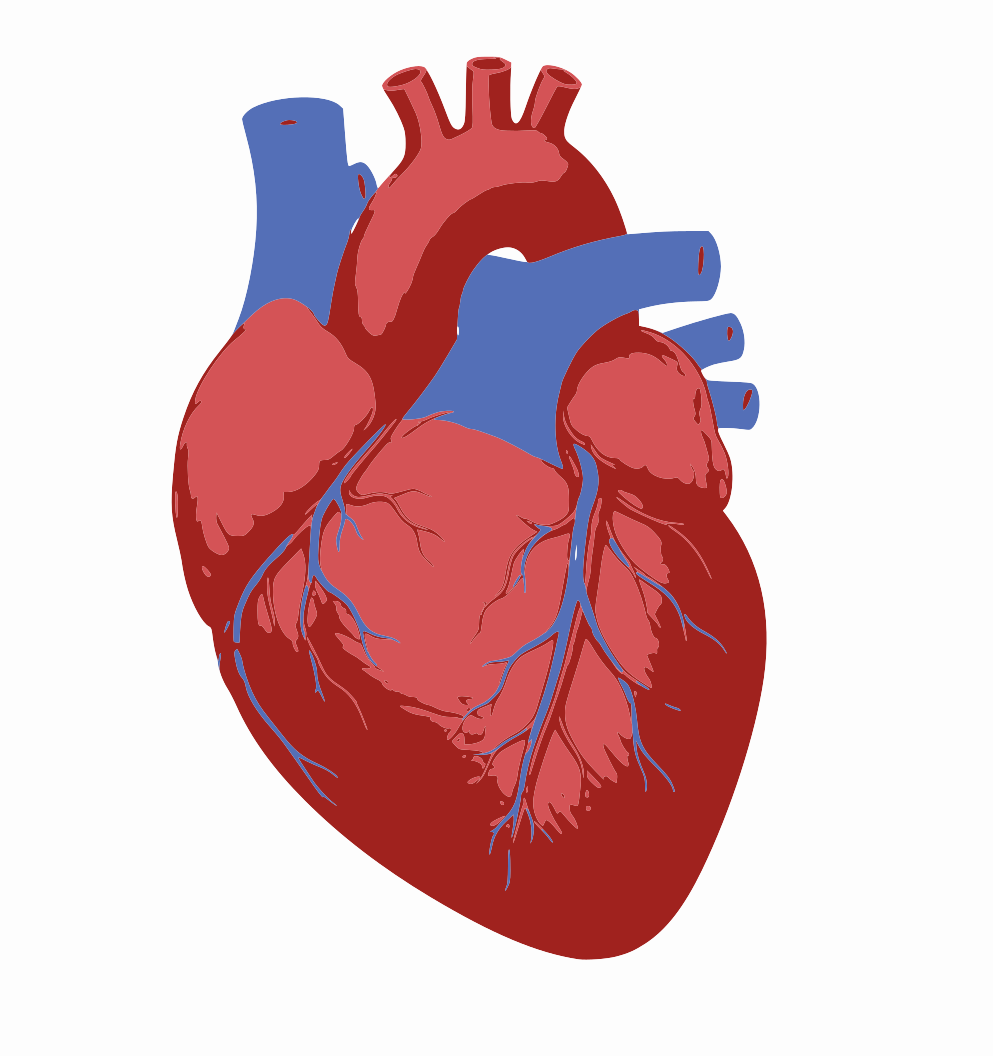
One drug class acting at three points of the CKM triad. SGLT2 inhibitors reduce sodium and glucose reabsorption in the proximal tubule; the resulting effects on intraglomerular pressure, volume and metabolism produce cardiac, kidney and metabolic benefit from a single agent. The breadth of effect is established; the size of benefit still depends on the individual indication and the trial population it came from.
- SGLT2
- Sodium–glucose cotransporter-2
- CKM
- Cardiovascular-kidney-metabolic
A note from Dr. Rivero. CKM syndrome can sound overwhelming when it is described as heart disease and kidney disease and a metabolic problem all at once. But seeing it as one connected system is actually freeing: every healthy choice and every well-chosen treatment works on all three. You are never working on just one organ — you are caring for the whole, and small consistent steps genuinely add up. Your care team is here to walk it with you.Isang paalala mula kay Dr. Rivero. Ang CKM syndrome ay maaaring maging nakababahala kapag inilarawan ito bilang sakit sa puso at sakit sa bato at problema sa metabolismo nang sabay-sabay. Ngunit ang pagtingin dito bilang isang magkakaugnay na sistema ay talagang nagpapagaan: bawat malusog na pagpili at bawat piling paggamot ay gumagana sa lahat ng tatlo. Hindi ka kailanman gumagawa sa isang organ lamang — inaalagaan mo ang kabuuan, at ang maliliit at tuloy-tuloy na hakbang ay tunay na nagdaragdag. Nariyan ang iyong care team para samahan ka rito.Usa ka pahibalo gikan ni Dr. Rivero. Ang CKM syndrome mahimong makapalisang kon gihulagway kini isip sakit sa kasingkasing ug sakit sa kidney ug problema sa metabolismo nga dungan. Apan ang pagtan-aw niini isip usa ka nagdugtong nga sistema makapagaan gyud: matag himsog nga pagpili ug matag maayong napili nga pagtambal molihok sa tanang tulo. Wala ka gyud naglihok sa usa lang ka organ — giatiman nimo ang tibuok, ug ang gagmay ug makanunayon nga mga lakang tinuod nga madugang. Ania ang imong care team aron mokuyog kanimo niini.Metung a paalala manibat kang Dr. Rivero. Ing CKM syndrome malyaring makapangamba nung ilalarawan ya antimong sakit king pusu at sakit king batu at problema king metabolismo a sabay-sabay. Dapot ing pamanakit kaniti antimong metung a makasese a sistema tune yang makapagaan: balang masalese a pamipili at balang mapiling lunas magobra ya king atlu ngan. E ka man kayangan magobra king metung mung organ — aasikasu mu ing mabilug, at reng malating tuluy-tuluy a dalan tune lang midaragdag. Atyu ing kekang care team ba na kang samban keni.
CKM syndrome as one progressive disorder — with the kidney in the middle
The American Heart Association (AHA) 2023 cardiovascular-kidney-metabolic (CKM) framework reframes excess or dysfunctional adiposity, insulin resistance, chronic kidney disease (CKD), and cardiovascular disease (CVD) as one progressive disorder with shared pathophysiology, rather than as coincident diagnoses managed in parallel clinics. The construct was published as an AHA presidential advisory together with a companion scientific statement; it is an AHA framework, not a joint AHA–ASN (American Society of Nephrology) one.
Kidney Disease: Improving Global Outcomes (KDIGO) has now mapped its own guideline portfolio onto that framework. The 2026 review by Levin and colleagues in Kidney International is the anchor document for this update: it aligns the KDIGO guidelines on CKD, blood pressure, diabetes, and lipids — plus the controversies conference reports on obesity and on CKD prevention — against AHA CKM stages 0–4, and argues that the CKM construct under-specifies the kidney. Two gaps in particular: CKM staging identifies CKD as a component but does not require albuminuria to assess risk, and no CKM framework asks for a precise cause of the kidney disease.
Get the chronology right
The KDIGO Controversies Conference on Kidney Disease and Heart Failure was held in 2024; its conclusions were published in 2026, co-published in Kidney International and JACC: Heart Failure. Likewise, the obesity–CKD conference convened in October 2024 and reported in 2026. A dedicated KDIGO clinical practice guideline on heart failure in CKD has been announced but is not yet published — nothing on this page should be read as quoting graded recommendations from a guideline that does not yet exist. Earlier versions of this guide conflated conference year with publication year; that has been corrected.
| Figure | What it describes |
|---|---|
| 10–40% | of people with CKD have heart failure (HF), any ejection fraction |
| ~50% | of people with HF have concomitant CKD |
| 850 million | people living with CKD worldwide |
| 588.7 million | adults aged 20–79 living with diabetes worldwide |
| 3rd | fastest-growing cause of death globally — kidney disease, and the only non-communicable disease with a sustained rise in age-adjusted mortality |
Kidney disease is the only non-communicable disease with a sustained rise in age-adjusted mortality, and its disability-adjusted life-year burden rose from roughly 35.8 million in 2017 to 44.5 million in 2021. The practical implication for a cardiometabolic clinic is not rhetorical: the organ least likely to be measured properly is the one carrying the steepest trajectory.

The CKM triad. Excess or dysfunctional adipose tissue releases adipokines and cytokines that drive inflammation, oxidative stress, insulin resistance and vascular dysfunction; these injure the heart and the kidney in parallel, and each damaged organ then amplifies injury in the other.
- CKM
- Cardiovascular-kidney-metabolic
- CKD
- Chronic kidney disease
- MASLD
- Metabolic dysfunction–associated steatotic liver disease
CKM stage answers a different question from KDIGO C–G–A
These are not competing systems and neither replaces the other. AHA CKM staging describes the overall cardiovascular-metabolic-kidney trajectory and sets the intensity of prevention. KDIGO classification describes the kidney disease itself and drives kidney diagnosis, prognosis, and management. Conflating them is the single most common error in applying CKM at the bedside.
| AHA CKM staging | KDIGO CKD classification |
|---|---|
| Describes the whole CKM trajectory | Describes the kidney disease |
| Stages 0–4 | Cause – GFR category (G1–G5) – albuminuria category (A1–A3) |
| Sets prevention intensity and CVD risk framing | Sets kidney diagnosis, prognosis, monitoring interval, and referral |
| Includes metabolic and cardiovascular disease | Requires kidney-specific evaluation, including cause |
| Does not establish why the kidney is failing | Cause is the first of its three axes |
The KDIGO 2024 CKD guideline defines CKD as abnormalities of kidney structure or function present for at least three months with implications for health — and the definition is deliberately inclusive of markers beyond glomerular filtration rate (GFR) and urine albumin-to-creatinine ratio (UACR): hematuria, tubular dysfunction, and structural abnormality on imaging or biopsy all count. Where clinical suspicion is high, the diagnosis need not wait three months.
| AHA CKM stage | Defining feature | Where the effort goes |
|---|---|---|
| 0 | No CKM risk factors — normal weight, glucose, blood pressure (BP), lipids, kidney function; no subclinical or clinical CVD | Primordial prevention; preserve cardiovascular health |
| 1 | Excess or dysfunctional adipose tissue — by weight, abdominal obesity, impaired glucose tolerance, or hyperglycemia | Structured weight management; prevent diabetes and hypertension |
| 2 | Metabolic risk factors (hypertriglyceridemia, hypertension, metabolic syndrome, type 2 diabetes [T2D]) or moderate- to high-risk CKD | Treat BP, lipids, glycemia; assess eGFR + UACR; establish CKD cause; start organ-protective therapy where indicated |
| 3 | Subclinical CVD overlapping CKM risk factors — or the stated risk equivalents: very-high-risk CKD (G4–G5 or by the KDIGO heat map) or high predicted CVD risk | Intensify cardiovascular prevention; optimize kidney protection; consider coordinated specialty care |
| 4 | Clinical CVD — coronary heart disease, HF, stroke, peripheral artery disease, or atrial fibrillation — with CKM risk factors | Full guideline-directed therapy and secondary prevention; adjust for kidney function, potassium, albuminuria, dialysis status |
Four qualifications worth stating out loud
1. Assign the highest stage the patient meets. 2. Earlier-stage abnormalities still require treatment — a higher stage does not retire the lower-stage tasks. 3. CKM stage is not CKD stage; a patient can be CKM 4 with G2A1 kidneys, or CKM 2 with G4A3. 4. Stage 4 is subdivided into 4a (without kidney failure) and 4b (with kidney failure). Note also that hypertension and CKD usually sit downstream of metabolic risk, but the AHA staging diagram explicitly allows non-metabolic etiologies of both — with similar risk implications and treatment approaches.

The CKM staging ladder, from Stage 0 (no risk factors) through Stage 4 (established cardiovascular disease with CKM risk factors). The rungs describe an increasing absolute cardiovascular risk, not increasing kidney-disease severity — a patient can sit high on this ladder with near-normal kidneys, or low on it with advanced CKD. Stages 0–2 are the highest-yield intervention window.
- CKM
- Cardiovascular-kidney-metabolic
- CKD
- Chronic kidney disease
- CVD
- Cardiovascular disease
- T2D
- Type 2 diabetes
Four converging pathways of parallel injury
Obesity, diabetes/insulin resistance, and hypertension constitute the shared substrate. They converge on four mechanistic pathways that injure heart and kidney in parallel — several of which terminate in end-organ fibrosis.
Common-Soil Pathophysiology
Hemodynamic
- Salt/water retention
- Venous congestion
- Hypoperfusion
- ↑ Abdominal pressure
Neurohormonal
- SNS (sympathetic nervous system) activation
- RAAS (renin–angiotensin–aldosterone system) activation
- ↑ AVP (arginine vasopressin)
- ↑ ANP (atrial natriuretic peptide) / BNP (B-type natriuretic peptide)
Inflammatory
- Oxidative stress
- Immune activation
- Endothelial dysfunction
- Gut dysbiosis · uremic toxins
Fibrotic
- Aldosterone-driven
- Myocardial fibrosis
- Tubulointerstitial fibrosis
- Vascular remodeling
This framing rewards integrative targets: endothelial dysfunction, gut dysbiosis, and uremic toxin handling are legitimate intervention nodes alongside hemodynamic and neurohormonal blockade. Note the obesity association is more pronounced in HFpEF than HFrEF — relevant to phenotype-tailored therapy.

The common-soil model. Obesity, insulin resistance and hypertension feed four converging pathways — hemodynamic, neurohormonal, inflammatory and fibrotic — that injure heart and kidney in parallel rather than in sequence. Each damaged organ then feeds back into the others, which is why organ-siloed treatment underperforms.
- RAAS
- Renin–angiotensin–aldosterone system
- SNS
- Sympathetic nervous system
- AVP
- Arginine vasopressin
- ANP
- Atrial natriuretic peptide
- BNP
- B-type natriuretic peptide
Order eGFR and UACR together
Combined eGFR + UACR remains under-utilized — in a large US analysis, ~80% of at-risk patients did not receive guideline-concordant assessment, and where testing occurred, eGFR was checked in ~90% but UACR in only ~20%. Order both.
| Measure | Note for CKM / cardiorenal context |
|---|---|
| eGFR | CKD-EPI 2021. Use cystatin C–based estimates when GLP-1 RA / significant weight loss confounds creatinine (lean-mass shifts inflate apparent eGFR change) |
| UACR | Independent predictor of incident HFpEF; predictive value for HF hospitalization comparable to BNP. Marker of systemic congestion as well as renal injury |
| Natriuretic peptides | Rise with declining eGFR (reduced clearance) and are lower in obesity. In CKD: a high natriuretic peptide (NP) rules in HF; normal NP helps exclude it. No validated CKD-specific thresholds — obtain an ambulatory baseline when possible |
| ApoB (apolipoprotein B) / Lp(a) (lipoprotein(a)) | ApoB for discordance (high TG, DM); measure Lp(a) once per 2026 ACC/AHA dyslipidemia guidance |
| TyG (triglyceride–glucose index) · HOMA-IR (homeostatic model assessment of insulin resistance) | Quantify the insulin-resistance substrate driving the common soil |
In advanced CKD (G4–G5/G5D): NP levels are markedly elevated and LVH (left ventricular hypertrophy) is near-universal — lean on objective filling-pressure evidence (echo E/e′, IVC, RHC) rather than NP thresholds alone. Image dialysis patients on non-dialysis days.

The combined CKM assessment panel. Filtration (eGFR) and damage (UACR) answer different questions and are frequently discordant, so neither substitutes for the other. In practice eGFR is checked in the large majority of at-risk patients and UACR in a small minority — the single most correctable gap in CKM assessment. Glycated hemoglobin (HbA1c) and the lipid panel sit alongside them in the same request.
- eGFR
- Estimated glomerular filtration rate
- UACR
- Urine albumin-to-creatinine ratio
- HbA1c
- Glycated hemoglobin
- CKM
- Cardiovascular-kidney-metabolic
Cardiovascular risk and kidney-failure risk are separate questions
KDIGO recommends applying risk prediction to inform absolute individual risk and to tailor visit frequency, laboratory cadence, education, and escalation of care. The failure mode to avoid is using one instrument to answer a question it was never built for.
| Instrument | What it predicts | Where it applies |
|---|---|---|
| PREVENT (Predicting Risk of cardiovascular disease EVENTs) AHA, 2024 |
10- and 30-year risk of total CVD, and separately of atherosclerotic CVD and of heart failure | General adult risk assessment. eGFR is in the base model; UACR and HbA1c (glycated hemoglobin) are optional add-ons. It does not estimate kidney failure. |
| KFRE (Kidney Failure Risk Equation) |
2- and 5-year risk of kidney failure requiring kidney replacement therapy | KDIGO recommends an externally validated risk equation to estimate absolute kidney-failure risk in CKD G3–G5 (1A). It does not estimate total cardiovascular risk. |
| KDIGO GFR–albuminuria heat map | Relative risk across ten outcomes — all-cause and cardiovascular mortality, myocardial infarction, stroke, peripheral artery disease, HF, atrial fibrillation, acute kidney injury (AKI), kidney failure, hospitalization | Any CKD assessment. Derived from the CKD Prognosis Consortium individual-participant meta-analysis of 27.5 million people. |
The heat map deserves a specific caveat that is easy to miss. The published grid omits the eGFR ≥105 mL/min/1.73 m² band, because creatinine-based eGFR has a J-shaped relationship with several outcomes at the high end — and because hyperfiltration is a recognized concern in obesity and early diabetic kidney disease. A supranormal eGFR is not evidence of a healthy kidney in a CKM patient.
Metabolic disease is common — it is not a diagnosis of exclusion for everything else
This is where the CKM framework needs nephrology rather than replaces it. The Levin review is explicit that the precise diagnosis of CKD is absent from every CKM framework, and that nephrology input is needed to establish etiology "given the diverse possibilities, which may further inform treatment strategies." A patient with diabetes and a reduced eGFR has a plausible cause, not an established one.
Diabetic kidney disease has a recognizable natural history — a sufficient duration of diabetes, albuminuria typically preceding GFR decline, gradual progression, and frequent concurrent retinopathy in type 1 and often in type 2 diabetes. Departures from that script should prompt evaluation rather than reassurance, because several alternative diagnoses carry disease-specific therapy that is only useful if the diagnosis is made.
Triggers for further evaluation or nephrology referral
Persistent hematuria (particularly dysmorphic red cells or red-cell casts) · rate of eGFR decline exceeding what the presumed cause explains · nephrotic-range proteinuria · active urinary sediment · CKD at a young age without an adequate explanation · significant family history of kidney disease · systemic features suggesting inflammatory or autoimmune disease (rash, serositis, arthritis, unexplained fever) · structural abnormality on imaging · tubular or electrolyte derangements disproportionate to the GFR · absence of retinopathy where diabetic kidney disease is being assumed.
KDIGO positions kidney biopsy as an acceptable, safe diagnostic test to evaluate cause and guide treatment decisions when clinically appropriate (2D) — a low-certainty suggestion, correctly reflecting that biopsy has never been randomized, not that biopsy is discouraged. The threshold in practice is whether the histologic answer would plausibly change management, weighed against bleeding risk in a patient who is frequently anticoagulated or antiplatelet-treated.
There is no CKM regimen — there are indications
"Triple therapy" and "four pillars" are useful shorthand in a heart-failure clinic and actively misleading in a CKM one. The agents below are frequently complementary, but each carries its own indication, its own eGFR floor, and its own evidence grade; several are inappropriate — or simply unstudied — in patients who nonetheless sit squarely inside the CKM construct. What follows is the KDIGO graded position, quoted in KDIGO's own grading vocabulary. 1 = "we recommend", 2 = "we suggest"; A–D = certainty of evidence, high to very low; PP = ungraded practice point.
| Agent | KDIGO indication and grade | Qualification that changes practice |
|---|---|---|
| RASi (renin–angiotensin system inhibitor) renin–angiotensin system inhibitor — angiotensin-converting enzyme inhibitor (ACEi) or angiotensin receptor blocker (ARB) |
CKD G1–G4 with A3, without diabetes — 1B CKD G1–G4 with A2, without diabetes — 2C CKD G1–G4 with A2 or A3, with diabetes — 1B Diabetes + hypertension + albuminuria: titrate to the highest approved tolerated dose — 1B |
The indication is albuminuria category, not "any proteinuria" and not "all diabetes". A1 albuminuria is not, by itself, a RASi indication. Avoid any combination of ACEi, ARB and direct renin inhibitor (1B). Monitor creatinine and potassium after initiation and titration. |
| SGLT2 inhibitor sodium–glucose cotransporter-2 inhibitor |
T2D + CKD + eGFR ≥20 — 1A CKD with eGFR ≥20 and UACR ≥200 mg/g, or heart failure irrespective of albuminuria — 1A eGFR 20–45 with UACR <200 mg/g — 2B |
Start above the eGFR threshold, then continue as eGFR falls. Meta-analysis of the large placebo-controlled trials found no excess serious AKI even in G4, with reductions in serious AKI, hospitalization and death. Absolute rates of mycotic genital infection remain modest. Sick-day guidance and euglycemic ketoacidosis counselling are mandatory. |
| nsMRA (nonsteroidal mineralocorticoid receptor antagonist) nonsteroidal mineralocorticoid receptor antagonist — finerenone |
T2D, eGFR >25, normal serum potassium, and albuminuria >30 mg/g despite maximum tolerated RASi — 2A | Every clause is load-bearing. It is an add-on after RASi optimization, not a parallel first-line agent, and it is not indicated in CKD without diabetes on current KDIGO wording. Potassium and kidney function must be monitored on a defined schedule. |
| GLP-1 receptor agonist glucagon-like peptide-1 |
T2D + CKD not meeting individualized glycemic targets despite metformin and an SGLT2i (sodium–glucose cotransporter-2 inhibitor), or unable to use them — long-acting GLP-1 RA, 1B | The graded indication is glycemic. Since that guideline, randomized trials have demonstrated kidney and cardiovascular benefit in T2D with CKD, and cardiovascular benefit in people with overweight or obesity without diabetes; KDIGO anticipates broadened indications as guidelines are updated. Product indications and tolerability differ between agents. |
| Metformin | T2D + CKD + eGFR ≥30 — 1B | Dose-reduce below eGFR 45 and hold during acute illness with volume depletion. |
| Statin ± ezetimibe | Age ≥50 with eGFR <60, not on chronic dialysis or transplanted — statin or statin/ezetimibe, 1A Age ≥50 with eGFR ≥60 (G1–G2) — statin, 1B Age 18–49 with known coronary disease, diabetes, prior ischemic stroke, or estimated 10-year coronary death / non-fatal myocardial infarction >10% — 2A |
Dialysis is the explicit exception: trials in prevalent dialysis patients did not demonstrate a cardiovascular benefit, and the non-dialysis recommendation must not be extrapolated across that boundary — initiation is not recommended for most prevalent hemodialysis patients. The graded statements above now sit in the KDIGO 2024 CKD guideline, but the approach originates in the KDIGO 2013 lipid guideline, which also deliberately abandoned low-density lipoprotein (LDL) cholesterol targets: higher statin doses have not been shown to be safe in CKD, so treat-to-target dose escalation and routine follow-up lipid measurement are not recommended. Fire-and-forget, not titrate-to-number. KDIGO 2024 additionally suggests considering a PCSK9 inhibitor where an indication exists. |
| Aspirin | Low-dose oral aspirin for secondary prevention in CKD with established ischemic cardiovascular disease — 1C | There is no corresponding recommendation for routine primary prevention in CKD, and bleeding risk rises as GFR falls. Do not let a CKM stage substitute for an actual secondary-prevention indication. |
| Anticoagulation | Non–vitamin K antagonist oral anticoagulants in preference to vitamin K antagonists for thromboprophylaxis in atrial fibrillation, CKD G1–G4 — 1C | The recommendation stops at G4; G5 and dialysis remain an area of genuine uncertainty rather than an oversight. |
| Diuretics | No CKM-wide recommendation — indicated for clinical congestion | They improve symptoms and volume. They are not disease-modifying and should not be presented as a CKM pillar alongside agents with hard-outcome data. |
Preserve the therapy rather than the potassium number
Current guidance addresses RASi- and nsMRA-associated hyperkalemia with dietary modification, diuretics, correction of acidosis, medication review, and potassium binders — in order to avoid down-titrating or stopping the agent. Observational evidence indicates that outcomes are worse in people with CKD whose RASi is reduced or discontinued than in matched people who continue unchanged. That is an association rather than a randomized comparison, and confounding by indication is plausible; even so, the direction of the signal argues against reflexive withdrawal.
Two further safety notes that the CKM framing tends to obscure. Drug–drug interactions and pill burden escalate steeply with CKD stage, and polypharmacy is itself a modifiable harm. And during acute illness — vomiting, diarrhea, sepsis, dehydration — the risk of AKI and impaired metabolite clearance rises, which is the situation in which sick-day rules, not stage-based algorithms, govern.
Phenotype- and eGFR-tailored therapy
Therapy selection in cardiorenal CKM is governed by eGFR, HF phenotype (HFrEF vs HFpEF), and potassium. The matrix below adapts the KDIGO 2026 conceptual framework (their Figure 4 / Table 2).
The eGFR "dip" is expected — don't discontinue reflexively
RAASi, ARNI, MRA (mineralocorticoid receptor antagonist), and SGLT2i all produce an acute, hemodynamic decline in eGFR on initiation, driven by reduced intraglomerular pressure. These declines are not associated with adverse outcomes and reverse on cessation. Treating to serum creatinine rather than to symptoms, volume, and hemodynamics is a common, harmful error.
Hyperkalemia mitigation (to preserve GDMT): concomitant SGLT2i, potassium binders, correction of acidosis, dietary potassium moderation, medication review, diuretics.

The expected eGFR trajectory after starting a renin–angiotensin inhibitor or an SGLT2 inhibitor: an acute dip over the first weeks, then a slope that is flatter than it would have been without the drug. The dip reflects reduced pressure inside the glomerulus, not injury, and it reverses on stopping. Treating the creatinine rather than the patient is a common and harmful error.
- eGFR
- Estimated glomerular filtration rate
- SGLT2i
- Sodium–glucose cotransporter-2 inhibitor
- RAASi
- Renin–angiotensin–aldosterone system inhibitor
Nutrition — integrative clinical-nutrition lens
Sodium, reframed: SODIUM-HF and subsequent meta-analyses show strict restriction (<1500–2500 mg/d) does not reliably reduce mortality or HF hospitalization, with signals of possible harm. Individualize for quality of life rather than mandating aggressive restriction.
Protein titrated to CKD stage; potassium contextualized to serum levels and concurrent RAASi; Mediterranean/DASH-pattern adaptation. Star fruit (balimbing): absolute contraindication in CKD ≥ Stage 3.
Physical activity — Class 1, both conditions
Exercise carries a Class 1 recommendation in HF (ACC/AHA/HFSA, ESC) and is recommended in the KDIGO 2024 CKD guideline (moderate-intensity, 1D). Mechanistically it acts on the same engine — endothelial function, insulin sensitivity, autonomic balance. Account for social determinants and environmental barriers (heat, neighborhood safety) when prescribing.
Lipids: apply 2026 ACC/AHA targets — LDL-C (low-density lipoprotein cholesterol) <55 (very-high-risk ASCVD) or <70; statin → ezetimibe/bempedoic acid → PCSK9i (proprotein convertase subtilisin/kexin type 9 inhibitor) → inclisiran. Iron: IV (not oral) iron for symptomatic iron-deficient HF; symptom/functional benefit, though hard-outcome RCT (randomized controlled trial) data are mixed.
The inciting condition, and the liver that travels with it
Obesity defines CKM stage 1 and initiates the pathological processes that produce the later stages, CKD among them. The KDIGO 2024 controversies conference on obesity and CKD — reported in 2026 — makes three points that change how the problem is framed.
First, duration and age of onset matter: long-term, early-onset obesity and prolonged cumulative exposure carry the highest risk of developing CKD, which makes childhood obesity a nephrology concern and not only a pediatric-cardiology one. Second, GFR assessment is itself unreliable in obesity and during large weight change — creatinine-based estimates are distorted by lean-mass shifts, so a falling eGFR during effective weight loss may be an artifact and a reassuring eGFR may be hyperfiltration. Refining assessment in this setting is named as a research priority precisely because current tools are inadequate. Third, the conference notes that the linear CKM staging diagram under-represents a potentially causal obesity → CKD relationship, treating obesity as an upstream risk factor rather than as a direct cause of a specific kidney phenotype.
Management rests on diet, physical activity, and the behaviors around both — with the honest acknowledgement in the conference report that these frequently fail to achieve or maintain weight loss. GLP-1 receptor agonists are effective for weight reduction and have demonstrated kidney-protective and cardiovascular benefit. Metabolic and bariatric surgery reduces obesity-related complications and has been shown to reduce albuminuria — a marker of kidney damage, and one whose reduction has repeatedly tracked with better kidney outcomes, though albuminuria reduction remains a surrogate rather than the outcome itself. Choice varies with age and comorbidity and legitimately changes over time.
Two things to get right locally
Asian anthropometric thresholds. At equivalent body-mass index and waist circumference, people of Asian ancestry carry more visceral adiposity and greater insulin resistance; applying European cut-points to a Filipino population systematically under-stages CKM 1. Sarcopenia in advanced CKD. In G4–G5 and on dialysis, protein-energy wasting and muscle loss are independently associated with mortality, so weight reduction at those stages requires supervision, adequate protein, and resistance training — the goal is fat mass, not body mass.
Metabolic dysfunction–associated steatotic liver disease (MASLD) is recognized as an amplifier of both cardiovascular and kidney risk, and its prevalence has risen by more than 50% over the past three decades. KDIGO does not issue MASLD guidance — that sits with the hepatology societies — but the review notes that the KDIGO recommendations on lifestyle, obesity management, and control of hypertension, T2D and dyslipidemia apply equally in MASLD and are central to reducing cardiovascular risk there.
What belongs on this page, and what belongs on the focused one
Heart failure is the CKM complication in which the cardiorenal axis becomes the whole problem, and it carries enough phenotype- and kidney-specific detail to warrant its own guide. The essentials for a CKM hub are these.
- Prevalence. HF of any ejection fraction affects an estimated 10–40% of people with CKD, and roughly half of people with HF have concomitant CKD.
- Shared mechanism. Both arise from endothelial dysfunction, inflammation, and accelerated atherosclerosis — the same substrate that drives the rest of the CKM construct.
- Staging overlap. A proposed update to the HF staging system considers all people with CKD to be at risk for HF (Stage A), which pulls a large nephrology population into HF surveillance.
- Diagnosis is genuinely harder. Symptoms overlap almost entirely, and natriuretic peptides rise with falling eGFR through reduced clearance while being lower than expected in obesity. Interpret against the patient's own ambulatory baseline; in G4–G5 and on dialysis, lean on objective filling-pressure evidence rather than a population cut-point.
- Shared therapy. SGLT2 inhibitors and renin–angiotensin-directed therapies are indicated in both conditions — the KDIGO SGLT2i recommendation explicitly includes HF irrespective of albuminuria (1A).
- Undertreatment is the rule. People with HF and CKD are commonly undertreated with guideline-directed medical therapy, most often because a creatinine or potassium value was treated as a stop signal.
- Advanced management is out of scope here. Decongestion strategy, diuretic response targets, sequential nephron blockade, ultrafiltration, peritoneal dialysis for refractory congestion, and management on dialysis are covered in the focused guide.
A KDIGO clinical practice guideline on heart failure in CKD has been announced and is not yet published; the 2024 controversies conference conclusions, published in 2026, are the current KDIGO-branded position and are a conference report rather than a graded guideline.
Surveillance and escalation triggers
Monitor
eGFR and potassium around therapy changes; recheck UACR at an interval set by risk and by whether the result would change management — there is no requirement to repeat UACR after every medication change; potassium after RAASi/MRA initiation and titration; recheck eGFR ~1–2 weeks after starting agents with expected dip; NP trajectory against the patient's own baseline rather than population cutoffs.
Refer / escalate
Diuretic resistance, refractory congestion, eGFR decline >30% without hemodynamic explanation, recurrent hyperkalemia limiting GDMT, advanced CKD (G4–G5) needing GDMT optimization, candidacy for ultrafiltration or peritoneal dialysis (PD). Consider a cardiorenal co-management model.
Apply KDIGO 2024 targets across CKD/ESKD (end-stage kidney disease) per standing protocol (Hgb, ferritin/TSAT, iPTH, Ca/Phos, bicarbonate, K, BP, HbA1c individualized from <6.5% to <8.0% in non-dialysis CKD per KDIGO 2022, 1C). Faster GDMT optimization is better where tolerated; individualize by setting and degree of kidney disease.
The framework is only as good as the pathway it runs on
KDIGO's systems-level guidance is short but pointed: enable access to a patient-centered multidisciplinary care team covering dietary counselling, medication management, education, and counselling about kidney replacement modalities, transplantation, access surgery, and ethical, psychological and social care — an ungraded practice point. Alongside it: implement a structured self-management educational program for people with diabetes and CKD (1C), and, addressed to policymakers and institutional decision makers, implement team-based integrated care focused on risk evaluation and patient empowerment (2B).
| Who | What they own in a CKM pathway |
|---|---|
| Patient and family | Home BP and weight records, medication adherence and sick-day rules, goal setting for diet and activity, reporting new symptoms early |
| Primary care | Case finding with eGFR + UACR in at-risk groups, BP and glycemic control, statin indication, first-line organ-protective therapy, escalation triggers |
| Nephrology | Establishing CKD cause, KFRE-based prognostication, optimizing therapy at low eGFR, hyperkalemia strategy, modality education and access planning |
| Cardiology | HF phenotyping and guideline-directed therapy, ischemia and arrhythmia management, co-management where kidney function limits titration |
| Endocrinology / diabetes care | Individualized glycemic targets, insulin and incretin strategy, obesity pharmacotherapy |
| Hepatology | MASLD staging and management where the liver phenotype is advanced |
| Dietitian | Protein prescription by CKD stage and dialysis status, sodium and potassium individualization, culturally workable meal patterns |
| Pharmacist | Renal dose adjustment, interaction and pill-burden review, deprescribing, adherence support — pharmacist-led CKM management in integrated clinics is specifically endorsed in the review |
| Nursing and rehabilitation | Education delivery, structured self-management programs, supervised exercise and functional maintenance |
Philippine implementation realities
Test access and cost. UACR is the test most often omitted worldwide; in a fee-for-service setting where the patient pays out of pocket, it is the first thing dropped from a request. KDIGO explicitly suggests that point-of-care testing may be used for creatinine and urine albumin where laboratory access is limited or where point-of-care testing facilitates the clinical pathway (2C) — this is the single most relevant recommendation in the whole portfolio for rural and remote Philippine practice. Medicine affordability. SGLT2 inhibitors, finerenone and GLP-1 receptor agonists are the agents with the strongest data and the weakest local access; PhilHealth (Philippine Health Insurance Corporation) coverage, generic availability and honest cost conversation are part of the prescription, not an afterthought. Diet advice must be culturally executable — sodium counselling that ignores patis, bagoong, tuyo, instant noodles and processed meats will be politely agreed to and ignored. Language. Patient-facing material on this site is carried in English, Tagalog, Cebuano and Kapampangan for exactly this reason.