Nephrology · Cardiology · Patient Guide

The Heart & Kidney Connection — Protecting One Saves BothAng Ugnayan ng Puso at BatoAng Koneksyon sa Kasingkasing ug Bato Ing Ugnayan ning Pusu at Batu

Why kidney disease and heart disease so often occur together — the mechanisms, and what protecting one organ does for the other.Bakit ang sakit sa bato at sakit sa puso ay madalas na magkasamang nangyayari — ang mga mekanismo na nagbubuklod sa kanila, at kung ano ang ginagawa ng pagprotekta sa isang organo para sa isa pa.Ngano nga ang sakit sa bato ug sakit sa kasingkasing kanunay magkauban — ang mga mekanismo nga nagbuhi sa ilang koneksyon, ug unsa ang gibuhat sa pagpanalipod sa usa ka organo alang sa usa pa. Bakit ing sakit king batu at sakit king pusu ya madalas a magkasamang nangyayari — ing deng mekanismo a nagbubuklod king kanila, at nung ano ing ginagawa ning pagprotekta king metung a organo para king metung pa.

PublishedNailathalaGipatikPepalwal: ReferencesMga SanggunianMga TinubdanReng Reperensya: 5 Read timeOras ng pagbasaOras sa pagbasaOras ning pamamasa:
Circular vignette hero illustration for the heart and kidney connection guide.

Cardiorenal Syndrome — Two Organs, One BattleCardiorenal Syndrome — Dalawang Organo, Isang LabananCardiorenal Syndrome — Duha ka Organo, Usa ka Pakig-away Cardiorenal Syndrome — Dalawang Organo, Metung a Labanan
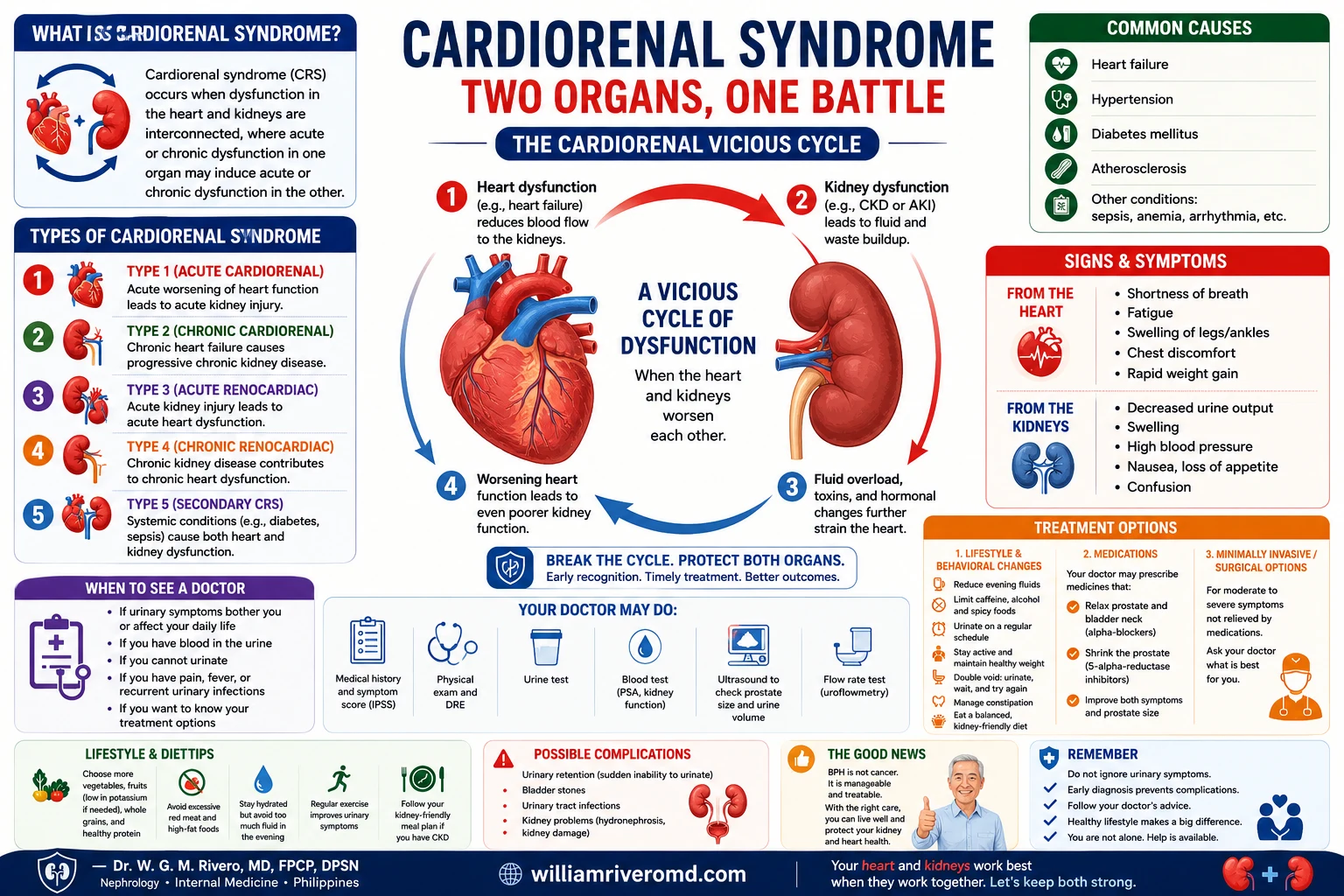
Cardiorenal Syndrome — Two Organs, One Battle: definition of CRS, the cardiorenal vicious cycle in 4 steps, the five types of cardiorenal syndrome (acute cardiorenal, chronic cardiorenal, acute renocardiac, chronic renocardiac, secondary CRS), common causes, signs and symptoms from the heart and kidneys, treatment options, lifestyle and diet tips, possible complications, and key reassurances

An overview of cardiorenal syndrome, the condition where heart and kidney trouble feed into each other, showing the vicious cycle, its five types, common causes, warning signs, and treatment and lifestyle steps.

The cardiorenal syndrome means that heart failure worsens kidney disease and kidney disease worsens heart failure — a reinforcing cycle. SGLT2 inhibitors are the first drug class proven to interrupt both sides simultaneously, with RAAS blockade as the established backbone.Ang cardiorenal syndrome ay nangangahulugang ang heart failure ay nagpapalala ng sakit sa bato at ang sakit sa bato ay nagpapalala ng heart failure — isang nagpapatibay na siklo. Ang mga SGLT2 inhibitor ay ang unang klase ng gamot na napatunayang nakakaputol sa magkabilang panig nang sabay-sabay, na ang RAAS blockade ang naitatag na pundasyon.Ang cardiorenal syndrome nagpasabot nga ang heart failure nagpagrabe sa sakit sa bato ug ang sakit sa bato nagpagrabe sa heart failure — usa ka nagpalig-on nga siklo. Ang mga SGLT2 inhibitor mao ang unang klase sa medisina nga napatunayang makaputol sa duha ka bahin sa dungan, nga ang RAAS blockade ang naitatag nga pundasyon. Ing cardiorenal syndrome ya nangangahulugang ing heart failure ya nagpapalala ning sakit king batu at ing sakit king batu ya nagpapalala ning heart failure — metung a nagpapatibay a siklo. Ing deng SGLT2 inhibitor ya ing unang klase ning gamut a napatunayang nakakaputol king magkabilang panig nang sabay-sabay, a ing RAAS blockade ing naitatag a pundasyon.

Your heart and kidneys are physiologically inseparable. The heart pumps blood to the kidneys; the kidneys regulate blood volume, pressure, and electrolytes that determine how hard the heart must work. When one organ fails, it actively accelerates the failure of the other — creating a vicious cycle that must be interrupted simultaneously from both ends.Ang inyong puso at bato ay physiologically hindi mapaghihiwalay. Ang puso ay nagbobomba ng dugo sa mga bato; ang mga bato ay nag-aayos ng dami ng dugo, presyon, at mga electrolyte na nagtatakda kung gaano kahirap ang trabaho ng puso. Kapag nabigo ang isang organo, ito ay aktibong nagpapabilis ng pagkabigo ng isa pa — na lumilikha ng masamang siklo na dapat na maputol nang sabay-sabay mula sa magkabilang dulo.Ang inyong kasingkasing ug mga bato physiologically dili mabubulag. Ang kasingkasing nagabomba sa dugo ngadto sa mga bato; ang mga bato nagakontrola sa dami sa dugo, presyon, ug mga electrolyte nga nagtino kon unsa kakusog ang trabaho sa kasingkasing. Kon mobigo ang usa ka organo, kini aktibo nga nagpaabtik sa pagpalya sa usa pa — nagmugna og usa ka makasamok nga siklo nga kinahanglan mapugngan sa dungan gikan sa duha ka tumoy. Ing inyu pusu at batu ya physiologically ali mapaghihiwalay. Ing pusu ya nagbobomba ning daya king deng batu; ing deng batu ya nag-aayos ning dami ning daya, presyon, at deng electrolyte a nagtatakda nung gaano kahirap ing obran ning pusu. Nung nabigo ing metung a organo, ini ya aktibong nagpapabilis ning pagkabigo ning metung pa — a lumilikha ning masamang siklo a dapat a maputol nang sabay-sabay mula king magkabilang dulo.

Cardiorenal syndrome (CRS) is the formal term for this bidirectional dysfunction. It is not simply "having both heart disease and kidney disease" — it is the recognition that each condition is mechanistically driving the other, and that treating them in isolation is inadequate.Ang cardiorenal syndrome (CRS) ang pormal na termino para sa bidirectional dysfunction na ito. Hindi lamang ito "pagkakaroon ng parehong sakit sa puso at sakit sa bato" — ito ay pagkilala na ang bawat kondisyon ay mekanistikong nagpapatakbo ng isa pa, at ang paggamot sa kanila nang hiwa-hiwalay ay hindi sapat.Ang cardiorenal syndrome (CRS) mao ang pormal nga termino alang niining bidirectional dysfunction. Dili lamang kini "pagkaadunay pareho nga sakit sa kasingkasing ug sakit sa bato" — kini ang pagkilala nga ang matag kondisyon mekanistikong nagmamaneho sa usa pa, ug ang pagtambal kanila nga bulag-bulag dili igo. Ing cardiorenal syndrome (CRS) ing pormal a termino para king bidirectional dysfunction a ini. Ali lamang ini "pagkakaroon ning parehong sakit king pusu at sakit king batu" — ini ya pagkilala a ing bawat kondisyon ya mekanistikong nagpapatakbo ning metung pa, at ing paggamut king kanila nang hiwa-hialay ya ali sapat.

The statistics are soberingAng mga estadistika ay nagpapanatag ng isipAng mga estadistika nagpahinumdom Ing deng estadistika ya nagpapanatag ning isip

Cardiovascular disease is the leading cause of death in CKD patients — accounting for over 50% of all-cause mortality in dialysis patients. A 25-to-35-year-old on dialysis has a cardiovascular mortality risk equivalent to a 75-to-80-year-old in the general population.Ang cardiovascular disease ang nangungunang sanhi ng kamatayan sa mga pasyenteng may CKD — sumasaklaw ng higit sa 50% ng lahat ng pagkamatay sa mga pasyenteng nasa dialysis. Ang isang 25-hanggang-35-taong-gulang na nasa dialysis ay may cardiovascular mortality risk na katumbas ng isang 75-hanggang-80-taong-gulang sa pangkalahatang populasyon.Ang cardiovascular disease mao ang nanguna nga hinungdan sa kamatayon sa mga pasyente nga adunay CKD — nagkuwenta og labaw sa 50% sa tanan nga pagkamatay sa mga pasyente nga nag-dialysis. Ang usa ka 25-hangtud-35-ka-tuig ang edad nga nag-dialysis adunay cardiovascular mortality risk nga katumbas sa usa ka 75-hangtud-80-ka-tuig ang edad sa kinatibuk-ang populasyon. Ing cardiovascular disease ing nangungunang sanhi ning kamatayan king deng pasyenteng atin CKD — sumasaklaw ning higit king 50% ning amin ning pagkamatay king deng pasyenteng nasa dialysis. Ing metung a 25-anggang-35-taong-gulang a nasa dialysis ya atin cardiovascular mortality risk a katumbas ning metung a 75-anggang-80-taong-gulang king pangkalahatang populasyon.

The flip sideAng kabilang panigAng pikas bahin Ing kabilang panig

Effective treatment of heart failure causes reduced kidney perfusion, worsening kidney function. Effective treatment of fluid overload can drop blood pressure too low, causing AKI. Managing both simultaneously requires expertise and constant balancing — which is why nephrologist-cardiologist collaboration is so important.Ang epektibong paggamot ng heart failure ay nagdudulot ng nabawasang perfusion ng bato, na nagpapalala ng tungkulin ng bato. Ang epektibong paggamot ng labis na likido ay maaaring magpababa ng presyon ng dugo nang masyadong mababa, na nagdudulot ng AKI. Ang pamamahala ng pareho nang sabay-sabay ay nangangailangan ng kadalubhasaan at patuloy na pagbabalanse — kaya naman napakahalaga ng pakikipagtulungan ng nephrologist at cardiologist.Ang epektibong pagtambal sa heart failure nagdala sa pagkunhod sa perfusion sa bato, nga nagpagrabe sa tungkulin sa bato. Ang epektibong pagtambal sa sobra nga likido mahimong mopababa sa presyon sa dugo nga labaw nga ubos, nga nagdala sa AKI. Ang pagdumala sa duha sa dungan nanginahanglan og kahanas ug kanunay nga pagbalansi — mao kini ngano nga ang pakigtambayayong sa nephrologist ug cardiologist kamahinungdanon. Ing epektibong paggamut ning heart failure ya nagdudulot ning nabawasang perfusion ning batu, a nagpapalala ning tungkulin ning batu. Ing epektibong paggamut ning labis a likido ya maaaring magpababa ning presyon ning daya nang masyadong mababa, a nagdudulot ning AKI. Ing pamamahala ning pareho nang sabay-sabay ya nangangailangan ning kadalubhasaan at patuloy a pagbabalanse — kaya naman napakahalaga ning pakikipagtulungan ning nephrologist at cardiologist.

The Cardiorenal Vicious CycleAng Masamang Siklo ng CardiorenalAng Makasamok nga Siklo sa Cardiorenal Ing Masamang Siklo ning Cardiorenal

Step 1Hakbang 1Lakang 1 Hakbang 1

CKD causes fluid retention and sodium overload → raises blood pressureAng CKD ay nagdudulot ng pagtatago ng likido at labis na sodium → nagpapataas ng presyon ng dugoAng CKD nagdala sa pagpugong sa likido ug sobra nga sodium → nagpataas sa presyon sa dugo Ing CKD ya nagdudulot ning pagtatago ning likido at labis a sodium → nagpapataas ning presyon ning daya

Step 2Hakbang 2Lakang 2 Hakbang 2

Hypertension forces the heart to pump harder → left ventricular hypertrophyAng hypertension ay pinipilit ang puso na mag-bomba nang mas malakas → left ventricular hypertrophyAng hypertension nagpugos sa kasingkasing nga mobomba nga mas kusog → left ventricular hypertrophy Ing hypertension ya pinipilit ing pusu a mag-bomba nang mas malakas → left ventricular hypertrophy

Step 3Hakbang 3Lakang 3 Hakbang 3

Stiffened, enlarged heart pumps less efficiently → reduced cardiac outputAng natigás at lumaki na puso ay mas hindi mahusay na nagbo-bomba → nabawasang cardiac outputAng nagtig-a ug nagpadako nga kasingkasing nagbomba nga dili kaayo episyente → pagkunhod sa cardiac output Ing natigás at lumaki a pusu ya mas ali mahusay a nagbo-bomba → nabawasang cardiac output

Step 4Hakbang 4Lakang 4 Hakbang 4

Reduced cardiac output lowers kidney perfusion → further kidney injuryAng nabawasang cardiac output ay nagpapababa ng perfusion ng bato → karagdagang pinsala sa batoAng pagkunhod sa cardiac output nagpababa sa perfusion sa bato → dugang nga kadaot sa bato Ing nabawasang cardiac output ya nagpapababa ning perfusion ning batu → karagdagang pinsala king batu

Step 5Hakbang 5Lakang 5 Hakbang 5

Worsening kidney function raises BP, anemia, and uremic toxins → returns to Step 1Ang lumalalang tungkulin ng bato ay nagpapataas ng BP, anemia, at mga uremic toxin → bumabalik sa Hakbang 1Ang nagpagrabe nga tungkulin sa bato nagpataas sa BP, anemia, ug mga uremic toxin → mobalik sa Lakang 1 Ing lumalalang tungkulin ning batu ya nagpapataas ning BP, anemia, at deng uremic toxin → bumabalik king Hakbang 1

How CKD Damages the HeartPaano Nasisira ng CKD ang PusoUnsaon sa CKD Pagdaot sa Kasingkasing Paano Nasisira ning CKD ing Pusu
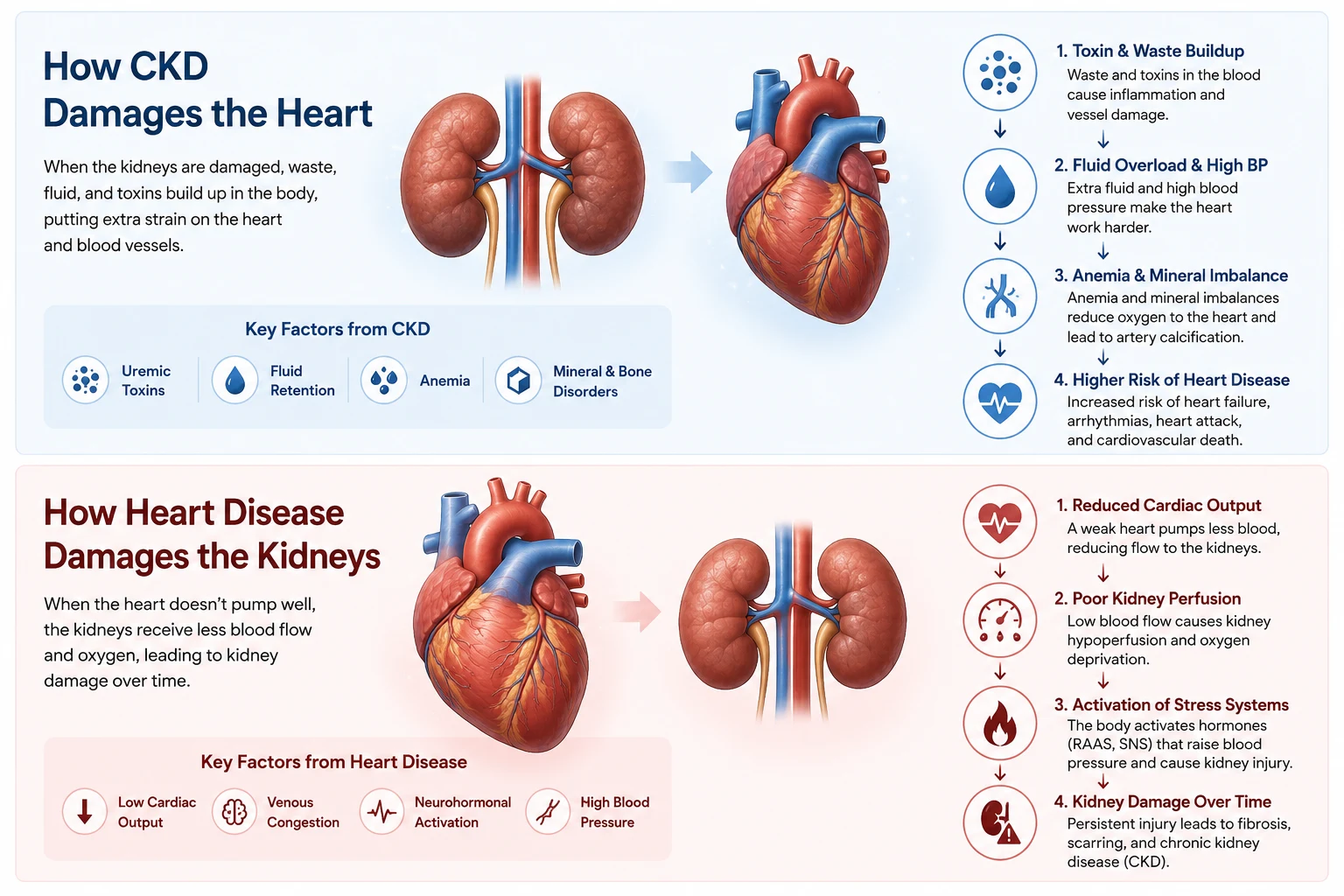
How CKD Damages the Heart and How Heart Disease Damages the Kidneys: bidirectional pathophysiology — kidney-to-heart pathway via uremic toxins, fluid retention, anemia, and mineral and bone disorders leading to higher risk of heart disease; and heart-to-kidney pathway via reduced cardiac output, poor kidney perfusion, neurohormonal activation (RAAS, SNS), and chronic kidney damage

A two-way diagram showing how kidney disease can harm the heart through toxins, fluid buildup, anemia, and mineral imbalances, and how heart disease can harm the kidneys by reducing blood flow to them.

CKD does not simply "raise blood pressure" and leave the rest to chance. It actively damages the cardiovascular system through multiple simultaneous pathways — many of which operate silently for years.Ang CKD ay hindi lamang "nagpapataas ng presyon ng dugo" at iniiwan ang natitirang bahagi sa pagkakataon. Aktibo nitong nasisira ang cardiovascular system sa pamamagitan ng maraming sabay-sabay na landas — marami sa mga ito ay tahimik na gumagana sa loob ng maraming taon.Ang CKD dili lamang "nagpataas sa presyon sa dugo" ug gibilin ang uban nga bahin sa kahigayonan. Aktibo niini nga ginadaot ang cardiovascular system pinaagi sa daghang sabay-sabay nga mga dalan — daghan niini hilom nga nagtrabaho sulod sa daghang tuig. Ing CKD ya ali lamang "nagpapataas ning presyon ning daya" at iniiwan ing natitirang bahagi king pagkakabanua. Aktibo nitong nasisira ing cardiovascular system king pamamagitan ning dacal a sabay-sabay a landas — dacal king deng ini ya tahimik a gumagana king loob ning dacal a banua.
Failing kidneys retain sodium and water, expanding blood volume. This raises blood pressure and forces the heart to work against higher resistance with every beat. Over time, the left ventricle hypertrophies (thickens) and eventually stiffens — a condition called left ventricular hypertrophy (LVH), present in over 75% of dialysis patients.Ang nabigong mga bato ay nagtatago ng sodium at tubig, na nagpapalawak ng dami ng dugo. Pinapataas nito ang presyon ng dugo at pinipilit ang puso na magtrabaho laban sa mas mataas na resistensya sa bawat tibok. Sa paglipas ng panahon, ang kaliwang ventricle ay hypertrophies (lumaki at lumapot) at sa huli ay nagiging matigas — isang kondisyong tinatawag na left ventricular hypertrophy (LVH), na nasa higit sa 75% ng mga pasyenteng nasa dialysis.Ang mga nabigong bato nagpugong sa sodium ug tubig, nagpapadako sa dami sa dugo. Kini nagpataas sa presyon sa dugo ug nagpugos sa kasingkasing nga magtrabaho batok sa mas taas nga resistensya sa matag bukto. Sa paglabay sa panahon, ang wala nga ventricle hypertrophies (nagpadako ug nagpalapot) ug sa katapusan nagtig-a — usa ka kondisyon nga gitawag nga left ventricular hypertrophy (LVH), anaa sa labaw sa 75% sa mga pasyente nga nag-dialysis. Ing nabigong deng batu ya nagtatago ning sodium at danum, a nagpapalawak ning dami ning daya. Pinapataas nini ing presyon ning daya at pinipilit ing pusu a magtrabaho laban king mas matas a resistensya king bawat tibok. King paglipas ning panahon, ing kaliwang ventricle ya hypertrophies (lumaki at lumapot) at king huli ya nagiging matigas — metung a kondisyong tinatawag a left ventricular hypertrophy (LVH), a nasa higit king 75% ning deng pasyenteng nasa dialysis.

CKD reduces erythropoietin production, causing anemia. The heart compensates for reduced oxygen delivery by increasing cardiac output — beating faster and harder. Chronic anemia causes the heart to enlarge (dilated cardiomyopathy) and is an independent risk factor for heart failure and cardiovascular death in CKD patients.Ang CKD ay nagpapababa ng produksyon ng erythropoietin, na nagdudulot ng anemia. Ang puso ay nagkokompensasyon para sa nabawasang paghahatid ng oxygen sa pamamagitan ng pagpapataas ng cardiac output — titibok nang mas mabilis at mas malakas. Ang matagal na anemia ay nagdudulot ng pagpalaki ng puso (dilated cardiomyopathy) at isang independiyenteng risk factor para sa heart failure at cardiovascular death sa mga pasyenteng may CKD.Ang CKD nagpababa sa produksyon sa erythropoietin, nagdala sa anemia. Ang kasingkasing nagkompensasyon para sa pagkunhod sa paghatod sa oxygen pinaagi sa pagdugang sa cardiac output — nagbukto nga mas paspas ug mas kusog. Ang kronikong anemia nagpadako sa kasingkasing (dilated cardiomyopathy) ug usa ka independyenteng risk factor alang sa heart failure ug cardiovascular death sa mga pasyente nga adunay CKD. Ing CKD ya nagpapababa ning produksyon ning erythropoietin, a nagdudulot ning anemia. Ing pusu ya nagkokompensasyon para king nabawasang paghahatid ning oxygen king pamamagitan ning pagpapataas ning cardiac output — titibok nang mas mabilis at mas malakas. Ing matagal a anemia ya nagdudulot ning pagpalaki ning pusu (dilated cardiomyopathy) at metung a independiyenteng risk factor para king heart failure at cardiovascular death king deng pasyenteng atin CKD.

Elevated phosphorus, secondary hyperparathyroidism, and altered vitamin D metabolism promote calcium-phosphate deposition in arterial walls. This calcification causes arteries to stiffen (arteriosclerosis) — raising pulse pressure and accelerating atherosclerosis. Calcified coronary arteries are present in the majority of dialysis patients.Ang mataas na phosphorus, secondary hyperparathyroidism, at nagbagong metabolismo ng vitamin D ay nagtataguyod ng deposisyon ng calcium-phosphate sa mga dingding ng ugat. Ang calcification na ito ay nagdudulot ng pagiging matigas ng mga ugat (arteriosclerosis) — nagpapataas ng pulse pressure at nagpapabilis ng atherosclerosis. Ang mga calcified na coronary artery ay nasa karamihan ng mga pasyenteng nasa dialysis.Ang taas nga phosphorus, secondary hyperparathyroidism, ug gibag-o nga metabolismo sa vitamin D nagpasibu sa deposisyon sa calcium-phosphate sa mga bungbong sa ugat. Kining calcification nagpahimo sa mga ugat nga magtig-a (arteriosclerosis) — nagpataas sa pulse pressure ug nagpaabtik sa atherosclerosis. Ang mga calcified nga coronary artery anaa sa kadaghanan sa mga pasyente nga nag-dialysis. Ing matas a phosphorus, secondary hyperparathyroidism, at nagbagong metabolismo ning vitamin D ya nagtataguyod ning deposisyon ning calcium-phosphate king deng dingding ning ugat. Ing calcification a ini ya nagdudulot ning pagiging matigas ning deng ugat (arteriosclerosis) — nagpapataas ning pulse pressure at nagpapabilis ning atherosclerosis. Ing deng calcified a coronary artery ya nasa kadaklan ning deng pasyenteng nasa dialysis.

Uremic toxins — particularly indoxyl sulfate and p-cresol sulfate — are directly cardiotoxic. They damage endothelial cells, promote oxidative stress, accelerate atherosclerosis, and impair cardiac muscle function. These protein-bound toxins are poorly cleared by standard hemodialysis, which is why gut-kidney axis interventions (probiotics, fiber) are increasingly recognized as cardiorenal protective tools.Ang mga uremic toxin — partikular na ang indoxyl sulfate at p-cresol sulfate — ay direktang nakakalason sa puso. Nasisira nila ang mga endothelial cell, nagtataguyod ng oxidative stress, nagpapabilis ng atherosclerosis, at nagpapahina ng tungkulin ng kalamnan ng puso. Ang mga toxin na nakatali sa protein na ito ay hindi mahusay na nililinis ng standard hemodialysis, kaya naman ang mga interbensyon sa gut-kidney axis (probiotics, fiber) ay lalong kinikilala bilang mga cardiorenal protective na kagamitan.Ang mga uremic toxin — labi na ang indoxyl sulfate ug p-cresol sulfate — direkta nga cardiotoxic. Ginadaot nila ang mga endothelial cell, nagpasibu sa oxidative stress, nagpaabtik sa atherosclerosis, ug nagpahuyang sa tungkulin sa kalamnan sa kasingkasing. Kining mga toxin nga nakatali sa protein dili maayo nga nalimpyuhan sa standard hemodialysis, mao kini ngano nga ang mga interbensyon sa gut-kidney axis (probiotics, fiber) lalong gikilala ingon mga cardiorenal protective nga himan. Ing deng uremic toxin — partikular a ing indoxyl sulfate at p-cresol sulfate — ya direktang nakakalason king pusu. Nasisira nila ing deng endothelial cell, nagtataguyod ning oxidative stress, nagpapabilis ning atherosclerosis, at nagpapahina ning tungkulin ning kalamnan ning pusu. Ing deng toxin a nakatali king protein a ini ya ali mahusay a nililinis ning standard hemodialysis, kaya naman ing deng interbensyon king gut-kidney axis (probiotics, fiber) ya lalong kinikilala bilang deng cardiorenal protective a kagamitan.

Hyperkalemia (high potassium) from CKD directly alters the cardiac electrical conduction system — causing dangerous arrhythmias including ventricular fibrillation and sudden cardiac death. This is why potassium control is treated with extreme seriousness in CKD and dialysis patients. Metabolic acidosis compounds this by shifting potassium out of cells into the bloodstream.Ang hyperkalemia (mataas na potassium) mula sa CKD ay direktang nagbabago ng cardiac electrical conduction system — nagdudulot ng mapanganib na mga arrhythmia kabilang ang ventricular fibrillation at biglaang pagkamatay ng puso. Kaya naman ang kontrol ng potassium ay tinatrato nang may matinding pagiging seryoso sa mga pasyenteng may CKD at dialysis. Ang metabolic acidosis ay nagpapalala nito sa pamamagitan ng paglilipat ng potassium mula sa mga cell papunta sa daluyan ng dugo.Ang hyperkalemia (taas nga potassium) gikan sa CKD direkta nga nagbag-o sa cardiac electrical conduction system — nagdala sa mga delikadong arrhythmia lakip ang ventricular fibrillation ug kalit nga pagkamatay sa kasingkasing. Mao kini ngano nga ang kontrol sa potassium gitambal nga adunay hilabihang kaseriosohan sa mga pasyente nga adunay CKD ug dialysis. Ang metabolic acidosis nagpagrabe niini pinaagi sa paglipat sa potassium gikan sa mga cell ngadto sa daluyan sa dugo. Ing hyperkalemia (matas a potassium) mula king CKD ya direktang nagbabago ning cardiac electrical conduction system — nagdudulot ning mapanganib a deng arrhythmia kabilang ing ventricular fibrillation at biglaang pagkamatay ning pusu. Kaya naman ing kontrol ning potassium ya tinatrato nang atin matinding pagiging seryoso king deng pasyenteng atin CKD at dialysis. Ing metabolic acidosis ya nagpapalala nini king pamamagitan ning paglilipat ning potassium mula king deng cell papunta king daluyan ning daya.

How Heart Disease Damages the KidneysPaano Nasisira ng Sakit sa Puso ang mga BatoUnsaon sa Sakit sa Kasingkasing Pagdaot sa mga Bato Paano Nasisira ning Sakit king Pusu ing deng Batu

How heart disease damages the kidneys: reduced cardiac output, venous congestion, neurohormonal activation, and contrast nephropathy mechanisms
Biomedical mechanism schematic of cardiorenal syndrome: low cardiac output and venous congestion reduce kidney perfusion and activate RAAS and the sympathetic system, causing sodium and water retention and tubular injury in a bidirectional spiral, broken by decongestion, RAAS blockade and SGLT2 inhibitors
The cardiorenal spiral: low cardiac output and venous congestion reduce kidney perfusion and switch on RAAS and the sympathetic system, causing salt and water retention that worsens congestion — a bidirectional loop. Decongestion, RAAS blockade, and SGLT2 inhibitors break the cycle.Ang cardiorenal spiral: ang mababang cardiac output at venous congestion ay nagbabawas ng perfusion ng bato at nag-a-activate ng RAAS at sympathetic system, na nagdudulot ng pagtatago ng asin at tubig na lumalala ang congestion — isang bidirectional loop. Ang decongestion, RAAS blockade, at SGLT2 inhibitors ang pumuputol sa siklo.Ang cardiorenal spiral: ang ubos nga cardiac output ug venous congestion nagpakunhod sa perfusion sa bato ug nag-on sa RAAS ug sympathetic system, hinungdan sa pagpugong sa asin ug tubig nga nagpagrabe sa congestion — usa ka bidirectional loop. Ang decongestion, RAAS blockade, ug SGLT2 inhibitors maoy nagputol sa siklo.Ing cardiorenal spiral: ing mababang cardiac output at venous congestion ya magbawas king perfusion ning batu at mag-activate king RAAS at sympathetic system, a magdulot ning pamagtago ning asin at danum a magpalala king congestion — metung a bidirectional loop. Ing decongestion, RAAS blockade, at SGLT2 inhibitors ing mamutul king siklo.

Reduced kidney perfusionNabawasang perfusion ng batoPagkunhod sa perfusion sa bato Nabawasang perfusion ning batu

In heart failure, the weakened heart pumps less blood forward. Kidney blood flow falls — triggering RAAS activation, sodium retention, and progressively worsening kidney function. This is "forward failure" causing cardiorenal syndrome Type 1 and 2.Sa heart failure, ang pinahinang puso ay nagbo-bomba ng mas kaunting dugo pasulong. Ang daloy ng dugo sa bato ay bumababa — nagtatrigger ng RAAS activation, pagtatago ng sodium, at progresibong pagpalala ng tungkulin ng bato. Ito ang "forward failure" na nagdudulot ng cardiorenal syndrome Type 1 at 2.Sa heart failure, ang nagpahuyang kasingkasing nagbomba og diyutay nga dugo padulong. Ang daloy sa dugo sa bato moubos — nagtrigger sa RAAS activation, pagpugong sa sodium, ug progresibong pagpagrabe sa tungkulin sa bato. Kini ang "forward failure" nga nagdala sa cardiorenal syndrome Type 1 ug 2. King heart failure, ing pinahinang pusu ya nagbo-bomba ning mas kaunting daya pasulong. Ing daloy ning daya king batu ya bumababa — nagtatrigger ning RAAS activation, pagtatago ning sodium, at progresibong pagpalala ning tungkulin ning batu. Ini ing "forward failure" a nagdudulot ning cardiorenal syndrome Type 1 at 2.

Venous congestionVenous congestionVenous congestion Venous congestion

Fluid backs up from a failing right ventricle into the venous circulation, raising renal venous pressure. This directly impairs glomerular filtration — the kidney cannot filter against a "back pressure." Decongestion (diuretics, ultrafiltration) is as important as improving cardiac output.Ang likido ay bumabalik mula sa nabigong kanang ventricle patungo sa venous circulation, na nagpapataas ng renal venous pressure. Direkta nitong napipigilan ang glomerular filtration — ang bato ay hindi makakapagsala laban sa "back pressure." Ang decongestion (diuretics, ultrafiltration) ay kasinghalaga ng pagpapabuti ng cardiac output.Ang likido mobalik gikan sa nabigong tuo nga ventricle ngadto sa venous circulation, nagpataas sa renal venous pressure. Direkta niining gipahuyang ang glomerular filtration — ang bato dili makasala batok sa "back pressure." Ang decongestion (diuretics, ultrafiltration) kasingkahalagang ang pagpaayo sa cardiac output. Ing likido ya bumabalik mula king nabigong kanang ventricle patungo king venous circulation, a nagpapataas ning renal venous pressure. Direkta nitong napipigilan ing glomerular filtration — ing batu ya ali makakapagsala laban king "back pressure." Ing decongestion (diuretics, ultrafiltration) ya kasinghalaga ning pagpapabuti ning cardiac output.

Neurohormonal activationNeurohormonal activationNeurohormonal activation Neurohormonal activation

Heart failure activates the sympathetic nervous system and RAAS — causing renal vasoconstriction, sodium and water retention, and progressive kidney scarring. This neurohormonal storm is the primary target of ACE inhibitors, ARBs, and beta-blockers in heart failure with CKD.Ang heart failure ay nag-a-activate ng sympathetic nervous system at RAAS — nagdudulot ng renal vasoconstriction, pagtatago ng sodium at tubig, at progresibong pagkapeklat ng bato. Ang neurohormonal storm na ito ang pangunahing target ng mga ACE inhibitor, ARB, at beta-blocker sa heart failure na may CKD.Ang heart failure nag-activate sa sympathetic nervous system ug RAAS — nagdala sa renal vasoconstriction, pagpugong sa sodium ug tubig, ug progresibong pagpeklat sa bato. Kining neurohormonal storm mao ang pangunahing target sa mga ACE inhibitor, ARB, ug beta-blocker sa heart failure nga adunay CKD. Ing heart failure ya nag-a-activate ning sympathetic nervous system at RAAS — nagdudulot ning renal vasoconstriction, pagtatago ning sodium at danum, at progresibong pagkapeklat ning batu. Ing neurohormonal storm a ini ing pangunahing target ning deng ACE inhibitor, ARB, at beta-blocker king heart failure a atin CKD.

Atrial fibrillationAtrial fibrillationAtrial fibrillation Atrial fibrillation

AFib reduces cardiac output by 20–30% (loss of atrial kick). This impairs renal perfusion and is independently associated with CKD progression. Anticoagulation in AFib+CKD requires careful balancing — bleeding risk is higher as eGFR declines.Ang AFib ay nagpapababa ng cardiac output ng 20–30% (pagkawala ng atrial kick). Nagpapahina nito ang renal perfusion at independiyenteng nauugnay sa pag-unlad ng CKD. Ang anticoagulation sa AFib+CKD ay nangangailangan ng maingat na pagbabalanse — mas mataas ang panganib ng pagdurugo habang bumababa ang eGFR.Ang AFib nagpababa sa cardiac output og 20–30% (pagkawala sa atrial kick). Kini nagpahuyang sa renal perfusion ug independyenteng nalangkit sa pag-uswag sa CKD. Ang anticoagulation sa AFib+CKD nanginahanglan og maampingong pagbalansi — mas taas ang risgo sa pagdugo samtang mopaubos ang eGFR. Ing AFib ya nagpapababa ning cardiac output ning 20–30% (pagkaala ning atrial kick). Nagpapahina nini ing renal perfusion at independiyenteng nauugnay king pag-unlad ning CKD. Ing anticoagulation king AFib+CKD ya nangangailangan ning maingat a pagbabalanse — mas matas ing panganib ning pagdurugo habang bumababa ing eGFR.

Contrast nephropathyContrast nephropathyContrast nephropathy Contrast nephropathy

Cardiac procedures (angiography, CT with contrast) use iodinated contrast that can cause acute kidney injury — especially in pre-existing CKD. Always inform every cardiologist and interventionist of your kidney status before any procedure.Ang mga cardiac procedure (angiography, CT na may contrast) ay gumagamit ng iodinated contrast na maaaring magdulot ng acute kidney injury — lalo na sa pre-existing CKD. Palaging ipaalam sa bawat cardiologist at interventionist ang katayuan ng inyong bato bago ang anumang procedure.Ang mga cardiac procedure (angiography, CT nga adunay contrast) naggamit sa iodinated contrast nga mahimong magdala sa acute kidney injury — labi na sa pre-existing CKD. Kanunay ipahibalo sa matag cardiologist ug interventionist ang kahimtang sa inyong bato sa wala pa ang bisan unsang procedure. Ing deng cardiac procedure (angiography, CT a atin contrast) ya gumagamit ning iodinated contrast a maaaring magdulot ning acute kidney injury — lalo a king pre-existing CKD. Papirming ipaalam king bawat cardiologist at interventionist ing katayuan ning inyu batu bago ing anumang procedure.

Shared Risk Factors — Treat the Root, Protect Both OrgansMga Ibinahaging Risk Factor — Gamutin ang Ugat, Protektahan ang Parehong OrganoMga Giambit nga Risk Factor — Tambalon ang Ugat, Panalipdan ang Duha ka Organo Deng Ibinahaging Risk Factor — Gamutin ing Ugat, Protektahan ing Parehong Organo
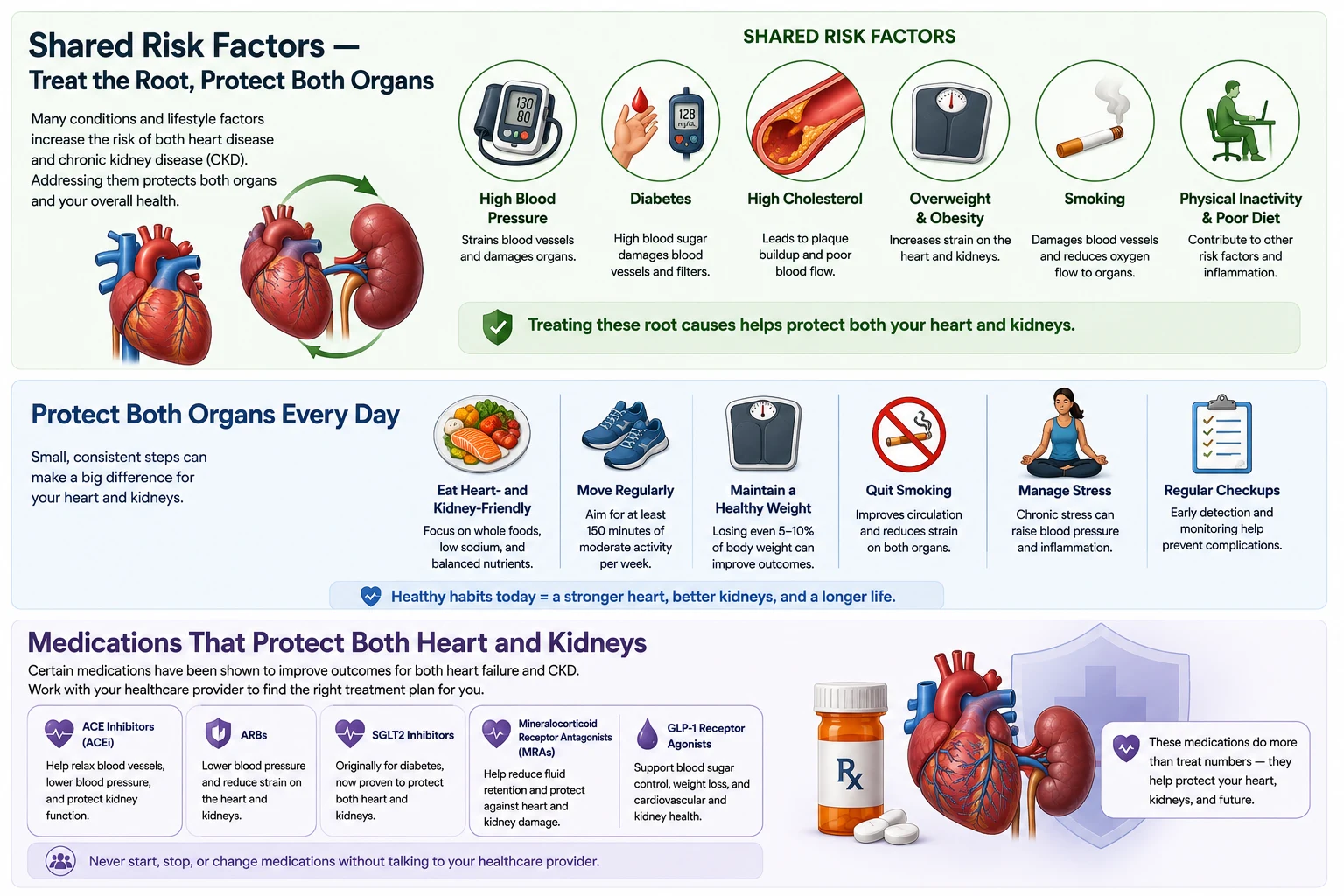
Shared Risk Factors and Daily Protection for Heart and Kidneys: six shared risk factors (hypertension, diabetes, high cholesterol, overweight, smoking, physical inactivity), six daily protective habits (heart-and-kidney-friendly eating, regular movement, healthy weight, smoking cessation, stress management, regular checkups), and five medication classes that protect both organs (ACE inhibitors, ARBs, SGLT2 inhibitors, mineralocorticoid receptor antagonists, GLP-1 receptor agonists)

A summary of the risk factors the heart and kidneys share, the daily habits that protect both organs, and the classes of medicine that guard them at the same time.

Heart disease and kidney disease are driven by the same upstream risk factors. Addressing these simultaneously is the most powerful intervention available.Ang sakit sa puso at sakit sa bato ay pinapatakbo ng parehong mga risk factor sa itaas. Ang pagtugon sa mga ito nang sabay-sabay ang pinakamakapangyarihang interbensyon na available.Ang sakit sa kasingkasing ug sakit sa bato ginamaneho sa pareho nga mga risk factor sa itaas. Ang pagtubag niini sa dungan mao ang labing gamhanang interbensyon nga magamit. Ing sakit king pusu at sakit king batu ya pinapatakbo ning parehong deng risk factor king itaas. Ing pagtugon king deng ini nang sabay-sabay ing pinakamakapangyarihang interbensyon a available.

Risk FactorRisk FactorRisk Factor Risk FactorKidney damage mechanismMekanismo ng pinsala sa batoMekanismo sa kadaot sa bato Mekanismo ning pinsala king batuCardiac damage mechanismMekanismo ng pinsala sa pusoMekanismo sa kadaot sa kasingkasing Mekanismo ning pinsala king pusuPrimary interventionPangunahing interbensyonPanguna nga interbensyon Pangunahing interbensyon
HypertensionHypertensionHypertension Hypertension Glomerular hypertension → nephrosclerosis → CKDGlomerular hypertension → nephrosclerosis → CKDGlomerular hypertension → nephrosclerosis → CKD Glomerular hypertension → nephrosclerosis → CKD LV hypertrophy → heart failure; accelerated atherosclerosisLV hypertrophy → heart failure; pinabilis na atherosclerosisLV hypertrophy → heart failure; gipadali nga atherosclerosis LV hypertrophy → heart failure; pinabilis a atherosclerosis ACE inhibitor / ARB + lifestyle. Target <140/90 (<130/80 with CKD/DM)ACE inhibitor / ARB + pamumuhay. Target <140/90 (<130/80 na may CKD/DM)ACE inhibitor / ARB + pamumuhay. Target <140/90 (<130/80 nga adunay CKD/DM) ACE inhibitor / ARB + pamumuhay. Target <140/90 (<130/80 a atin CKD/DM)
Diabetes MellitusDiabetes MellitusDiabetes Mellitus Diabetes Mellitus Diabetic nephropathy → proteinuria → ESKDDiabetic nephropathy → proteinuria → ESKDDiabetic nephropathy → proteinuria → ESKD Diabetic nephropathy → proteinuria → ESKD Endothelial dysfunction → coronary artery disease; cardiomyopathyEndothelial dysfunction → coronary artery disease; cardiomyopathyEndothelial dysfunction → coronary artery disease; cardiomyopathy Endothelial dysfunction → coronary artery disease; cardiomyopathy SGLT2 inhibitor (protects both) + HbA1c 7–8% + statinSGLT2 inhibitor (nagpoprotekta sa dalawa) + HbA1c 7–8% + statinSGLT2 inhibitor (nagpanalipod sa duha) + HbA1c 7–8% + statin SGLT2 inhibitor (nagpoprotekta king dalawa) + HbA1c 7–8% + statin
DyslipidemiaDyslipidemiaDyslipidemia Dyslipidemia Lipid deposition in glomeruli (glomerulopathy); accelerates CKD progressionDeposisyon ng lipid sa glomeruli (glomerulopathy); nagpapabilis ng pag-unlad ng CKDDeposisyon sa lipid sa glomeruli (glomerulopathy); nagpaabtik sa pag-uswag sa CKD Deposisyon ning lipid king glomeruli (glomerulopathy); nagpapabilis ning pag-unlad ning CKD Atherosclerotic plaque → MI, stroke, sudden deathAtherosclerotic plaque → MI, stroke, biglaang kamatayanAtherosclerotic plaque → MI, stroke, kalit nga kamatayon Atherosclerotic plaque → MI, stroke, biglaang kamatayan High-intensity statin; target LDL <55 mg/dL in CKD (very high risk)High-intensity statin; target LDL <55 mg/dL sa CKD (napakataas na panganib)High-intensity statin; target LDL <55 mg/dL sa CKD (hilabihang taas nga risgo) High-intensity statin; target LDL <55 mg/dL king CKD (napakataas a panganib)
ObesityObesityObesity Obesity Glomerular hyperfiltration → protein leak → CKDGlomerular hyperfiltration → pagtulo ng protein → CKDGlomerular hyperfiltration → pagtulo sa protein → CKD Glomerular hyperfiltration → pagtulo ning protein → CKD Metabolic syndrome → insulin resistance → CADMetabolic syndrome → insulin resistance → CADMetabolic syndrome → insulin resistance → CAD Metabolic syndrome → insulin resistance → CAD GLP-1 receptor agonists (semaglutide) + lifestyle; SGLT2iGLP-1 receptor agonists (semaglutide) + pamumuhay; SGLT2iGLP-1 receptor agonists (semaglutide) + pamumuhay; SGLT2i GLP-1 receptor agonists (semaglutide) + pamumuhay; SGLT2i
SmokingPaninigarilyoPagpanigarilyo Paninigarilyo Renal vasoconstriction → ischemic nephropathyRenal vasoconstriction → ischemic nephropathyRenal vasoconstriction → ischemic nephropathy Renal vasoconstriction → ischemic nephropathy Endothelial damage → accelerated atherosclerosisPinsala sa endothelial → pinabilis na atherosclerosisKadaot sa endothelial → gipadali nga atherosclerosis Pinsala king endothelial → pinabilis a atherosclerosis Complete cessation — the single highest-impact modifiable risk factorKumpletong pagtigil — ang natatanging modifiable risk factor na may pinakamataas na epektoKompleto nga paghunong — ang nag-iisang modifiable risk factor nga adunay labing taas nga epekto Kumpletong pagtigil — ing natatanging modifiable risk factor a atin pinakamatas a epekto
AnemiaAnemiaAnemia Anemia Reduced renal oxygenation → tubular injuryNabawasang oxygenation ng bato → pinsala sa tubularPagkunhod sa oxygenation sa bato → kadaot sa tubular Nabawasang oxygenation ning batu → pinsala king tubular Compensatory high cardiac output → cardiac remodelingCompensatory na mataas na cardiac output → cardiac remodelingCompensatory nga taas nga cardiac output → cardiac remodeling Compensatory a matas a cardiac output → cardiac remodeling ESA + IV iron to maintain Hgb 100–115 g/LESA + IV iron para mapanatili ang Hgb 100–115 g/LESA + IV iron aron mapadayon ang Hgb 100–115 g/L ESA + IV iron para mapanatili ing Hgb 100–115 g/L

Medications That Protect Both Heart and KidneysMga Gamot na Nagpoprotekta sa Parehong Puso at BatoMga Medisina nga Nagpanalipod sa Kasingkasing ug mga Bato Deng Gamut a Nagpoprotekta king Parehong Pusu at Batu

Medications protecting both heart and kidneys: ACE inhibitors/ARBs, SGLT2 inhibitors, finerenone, GLP-1 agonists, statins

The most exciting advance in cardiorenal medicine over the past decade is the recognition that several drug classes provide simultaneous, independent protection to both organs. These are not just blood pressure or sugar pills — they are organ-protective agents.Ang pinaka-kapana-panabik na pag-unlad sa cardiorenal medicine sa nakalipas na dekada ay ang pagkilala na ilang mga klase ng gamot ang nagbibigay ng sabay-sabay, independiyenteng proteksyon sa parehong mga organo. Hindi lamang ito mga tableta para sa presyon ng dugo o asukal — sila ay mga organ-protective na ahente.Ang labing kapana-panabik nga pag-uswag sa cardiorenal medicine sa nakalabay nga dekada mao ang pagkilala nga pipila ka mga klase sa medisina naghatag sa dungan, independyenteng proteksyon sa duha ka organo. Kini dili lamang mga tableta para sa presyon sa dugo o asukar — kini mga organ-protective nga ahente. Ing pinaka-kapana-panabik a pag-unlad king cardiorenal medicine king nakalipas a dekada ya ing pagkilala a ilang deng klase ning gamut ing nagbibigay ning sabay-sabay, independiyenteng proteksyon king parehong deng organo. Ali lamang ini deng tableta para king presyon ning daya o asukal — sila ya deng organ-protective a ahente.

ACE Inhibitors / ARBs
Ramipril, Irbesartan, Losartan
Block the RAAS — reduce intraglomerular pressure (kidney), prevent cardiac remodeling (heart), lower blood pressure, and reduce proteinuria. First-line in all CKD+hypertension and heart failure with reduced ejection fraction.Hinahadlangan ang RAAS — binabawasan ang intraglomerular pressure (bato), pinipigilan ang cardiac remodeling (puso), nagpapababa ng presyon ng dugo, at nagpapababa ng proteinuria. First-line sa lahat ng CKD+hypertension at heart failure na may nabawasang ejection fraction.Gibalda ang RAAS — gipababa ang intraglomerular pressure (bato), gipugngan ang cardiac remodeling (kasingkasing), nagpababa sa presyon sa dugo, ug nagpababa sa proteinuria. First-line sa tanan nga CKD+hypertension ug heart failure nga adunay pagkunhod sa ejection fraction. Hinahadlangan ing RAAS — binabawasan ing intraglomerular pressure (batu), pinipigilan ing cardiac remodeling (pusu), nagpapababa ning presyon ning daya, at nagpapababa ning proteinuria. First-line king amin ning CKD+hypertension at heart failure a atin nabawasang ejection fraction.
SGLT2 Inhibitors
Dapagliflozin (Catania / Rhea)
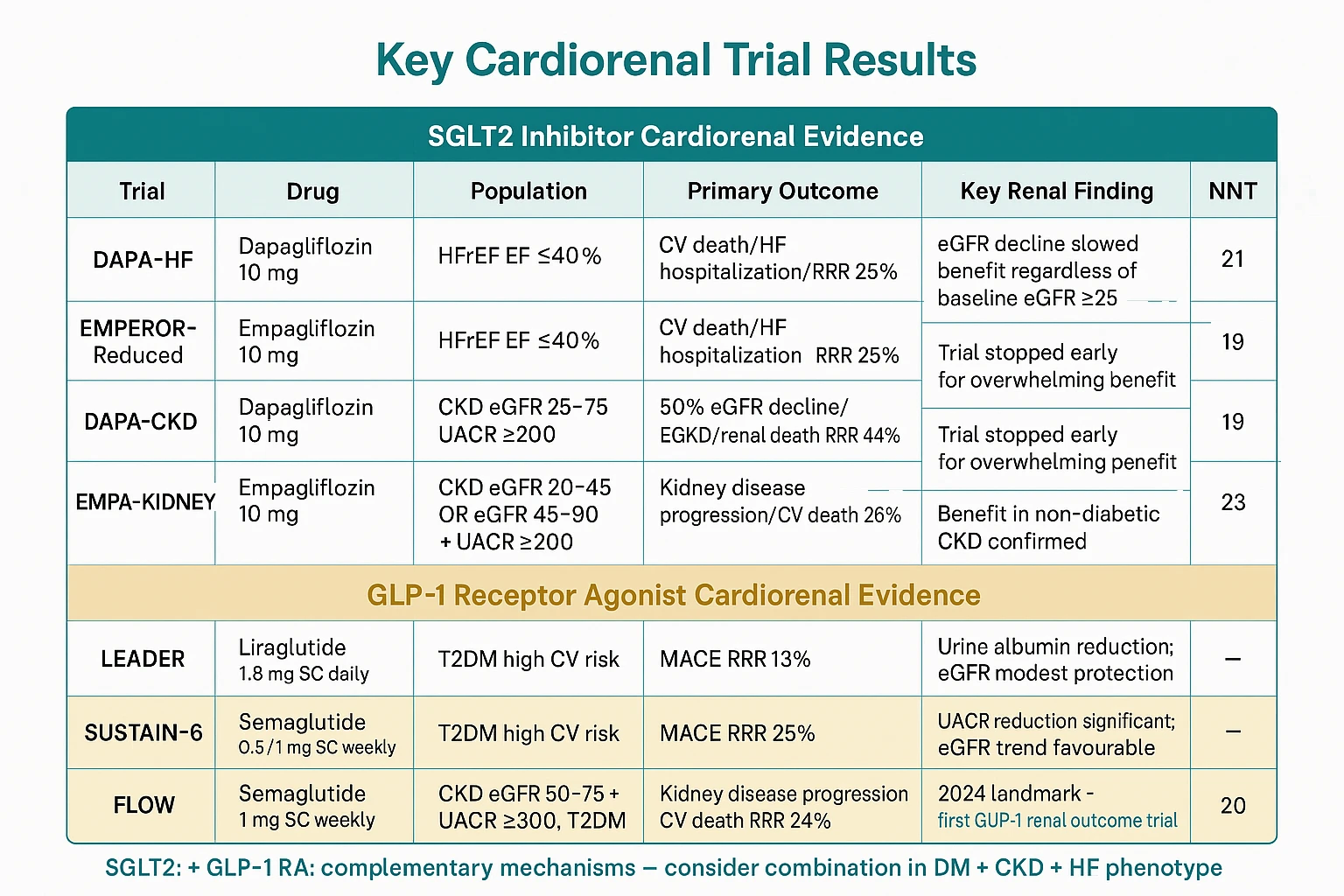
Landmark trials show 30–40% reduction in both heart failure hospitalization AND kidney failure independently of diabetes status. Reduces intraglomerular pressure, promotes natriuresis, improves cardiac energetics. Now standard of care in CKD and heart failure with reduced or preserved ejection fraction.Nagpapakita ang mga landmark trial ng 30–40% na pagbaba sa parehong hospitalization dahil sa heart failure AT pagkabigo ng bato nang independiyente sa katayuan ng diabetes. Nagpapababa ng intraglomerular pressure, nagtataguyod ng natriuresis, nagpapabuti ng cardiac energetics. Ngayon ay standard of care na sa CKD at heart failure na may nabawasang o napanatiling ejection fraction.Ang mga landmark trial nagpakita og 30–40% nga pagkunhod sa parehong hospitalization tungod sa heart failure UG pagpalya sa bato nga independyente sa kahimtang sa diabetes. Nagpababa sa intraglomerular pressure, nagpasibu sa natriuresis, nagpaayo sa cardiac energetics. Karon standard of care na sa CKD ug heart failure nga adunay pagkunhod o napreserba nga ejection fraction. Nagpapakita ing deng landmark trial ning 30–40% a pagbaba king parehong hospitalization dahil king heart failure AT pagkabigo ning batu nang independiyente king katayuan ning diabetes. Nagpapababa ning intraglomerular pressure, nagtataguyod ning natriuresis, nagpapabuti ning cardiac energetics. Ngayon ya standard of care a king CKD at heart failure a atin nabawasang o napanatiling ejection fraction.
GLP-1 Receptor Agonists
Semaglutide (Ozempic) / Dulaglutide
Reduce cardiovascular events (LEADER, SUSTAIN-6) and kidney failure (FLOW trial). Promote weight loss, reduce inflammation and proteinuria. Powerful when combined with SGLT2i for cardiorenal protection in Type 2 DM.Nagpapababa ng mga cardiovascular event (LEADER, SUSTAIN-6) at pagkabigo ng bato (FLOW trial). Nagtataguyod ng pagbaba ng timbang, nagpapababa ng pamamaga at proteinuria. Makapangyarihan kapag pinagsama sa SGLT2i para sa cardiorenal protection sa Type 2 DM.Nagpababa sa mga cardiovascular event (LEADER, SUSTAIN-6) ug pagpalya sa bato (FLOW trial). Nagpasibu sa pagkawala sa timbang, nagpababa sa pamamaga ug proteinuria. Gamhanan kon gitipon sa SGLT2i alang sa cardiorenal protection sa Type 2 DM. Nagpapababa ning deng cardiovascular event (LEADER, SUSTAIN-6) at pagkabigo ning batu (FLOW trial). Nagtataguyod ning pagbaba ning timbang, nagpapababa ning pamamaga at proteinuria. Makapangyarihan nung pinagsama king SGLT2i para king cardiorenal protection king Type 2 DM.
Finerenone
Non-steroidal MRANon-steroidal MRANon-steroidal MRA Non-steroidal MRA
FIDELIO-DKD and FIGARO-DKD trials: reduces both CKD progression and cardiovascular events in diabetic kidney disease. Targets aldosterone-driven fibrosis in both the kidney and the heart. Lower hyperkalemia risk than spironolactone.Mga trial na FIDELIO-DKD at FIGARO-DKD: nagpapababa ng parehong pag-unlad ng CKD at mga cardiovascular event sa diabetic kidney disease. Tinatarget ang aldosterone-driven fibrosis sa parehong bato at puso. Mas mababang panganib ng hyperkalemia kaysa sa spironolactone.Mga trial nga FIDELIO-DKD ug FIGARO-DKD: nagpababa sa parehong pag-uswag sa CKD ug mga cardiovascular event sa diabetic kidney disease. Gipunting ang aldosterone-driven fibrosis sa pareho nga bato ug kasingkasing. Mas ubos nga risgo sa hyperkalemia kaysa sa spironolactone. Deng trial a FIDELIO-DKD at FIGARO-DKD: nagpapababa ning parehong pag-unlad ning CKD at deng cardiovascular event king diabetic kidney disease. Tinatarget ing aldosterone-driven fibrosis king parehong batu at pusu. Mas mababang panganib ning hyperkalemia kaysa king spironolactone.
High-Intensity StatinsHigh-Intensity StatinsHigh-Intensity Statins High-Intensity Statins
Rosuvastatin ± Ezetimibe (Rozuor)
CKD = very high ASCVD risk by 2026 ACC/AHA classification. LDL target <55 mg/dL. Statins reduce cardiovascular events in CKD Stages 1–4. Benefit less clear in dialysis patients — start before dialysis initiation.Ang CKD = napakataas na ASCVD risk ayon sa 2026 ACC/AHA classification. Target na LDL <55 mg/dL. Ang mga statin ay nagpapababa ng mga cardiovascular event sa CKD Stages 1–4. Ang benepisyo ay hindi gaanong malinaw sa mga pasyenteng nasa dialysis — simulan bago ang pagsisimula ng dialysis.Ang CKD = hilabihang taas nga ASCVD risk sumala sa 2026 ACC/AHA classification. Target nga LDL <55 mg/dL. Ang mga statin nagpababa sa mga cardiovascular event sa CKD Stages 1–4. Ang benepisyo dili kaayo klaro sa mga pasyente nga nag-dialysis — sugdan sa wala pa magsugod ang dialysis. Ing CKD = napakataas a ASCVD risk ayon king 2026 ACC/AHA classification. Target a LDL <55 mg/dL. Ing deng statin ya nagpapababa ning deng cardiovascular event king CKD Stages 1–4. Ing benepisyo ya ali gaanong malinaw king deng pasyenteng nasa dialysis — simulan bago ing pagsisimula ning dialysis.
Erythropoiesis-Stimulating Agents + IV IronErythropoiesis-Stimulating Agents + IV IronErythropoiesis-Stimulating Agents + IV Iron Erythropoiesis-Stimulating Agents + IV Iron
epoetin alfa (Eposino) + iron sucrose (Ferrofer)
Treating anemia of CKD reduces cardiac workload and prevents the compensatory cardiac remodeling that leads to dilated cardiomyopathy. Target Hgb 100–115 g/L. IV iron first — ESA only when iron replete.Ang paggamot sa anemia ng CKD ay nagpapababa ng cardiac workload at pinipigilan ang compensatory cardiac remodeling na humahantong sa dilated cardiomyopathy. Target na Hgb 100–115 g/L. IV iron muna — ESA lamang kapag puno na ang iron.Ang pagtambal sa anemia sa CKD nagpababa sa cardiac workload ug gipugngan ang compensatory cardiac remodeling nga nagdala sa dilated cardiomyopathy. Target nga Hgb 100–115 g/L. IV iron una — ESA lamang kon puno na ang iron. Ing paggamut king anemia ning CKD ya nagpapababa ning cardiac workload at pinipigilan ing compensatory cardiac remodeling a humahantong king dilated cardiomyopathy. Target a Hgb 100–115 g/L. IV iron muna — ESA lamang nung puno a ing iron.

The creatinine bump with ACE inhibitors — do not panicAng pagtaas ng creatinine sa ACE inhibitors — huwag mag-panicAng pagtaas sa creatinine sa ACE inhibitors — ayaw magkalisang Ing pagtaas ning creatinine king ACE inhibitors — eka mag-panic

Starting an ACE inhibitor or ARB often causes a modest rise in creatinine (up to 30% from baseline) in the first 2 weeks. This reflects reduced intraglomerular pressure — a beneficial, intended effect. Do not stop the medication for this reason alone. A rise greater than 30%, or a potassium above 5.5 mEq/L, warrants prompt medical review.Ang pagsisimula ng ACE inhibitor o ARB ay kadalasang nagdudulot ng katamtamang pagtaas ng creatinine (hanggang 30% mula sa baseline) sa unang 2 linggo. Ito ay sumasalamin sa nabawasang intraglomerular pressure — isang kapaki-pakinabang at nilalayong epekto. Huwag ihinto ang gamot sa kadahilanang ito lamang. Ang pagtaas na higit sa 30%, o potassium na higit sa 5.5 mEq/L, ay nangangailangan ng mabilis na medikal na pagsusuri.Ang pagsugod sa ACE inhibitor o ARB kasagaran nagdala sa katamtamang pagtaas sa creatinine (hangtud sa 30% gikan sa baseline) sa unang 2 ka semana. Kini nagpakita sa pagkunhod sa intraglomerular pressure — usa ka mapuslanon, gituyo nga epekto. Ayaw ihunong ang medisina tungod niining rason lamang. Ang pagtaas nga labaw sa 30%, o potassium nga labaw sa 5.5 mEq/L, nanginahanglan og dali nga medikal nga pagsusi. Ing pagsisimula ning ACE inhibitor o ARB ya kadalasang nagdudulot ning katamtamang pagtaas ning creatinine (anggang 30% mula king baseline) king unang 2 lutu. Ini ya sumasalamin king nabawasang intraglomerular pressure — metung a kapaki-pakinabang at nilalayong epekto. Eka ihinto ing gamut king kadahilanang ini lamang. Ing pagtaas a higit king 30%, o potassium a higit king 5.5 mEq/L, ya nangangailangan ning mabilis a medikal a pagsusuri.

Key Goals for Heart and Kidney ProtectionMga Pangunahing Layunin para sa Proteksyon ng Puso at BatoMga Yawe nga Tumong alang sa Proteksyon sa Kasingkasing ug Bato Deng Pangunahing Layunin para king Proteksyon ning Pusu at Batu
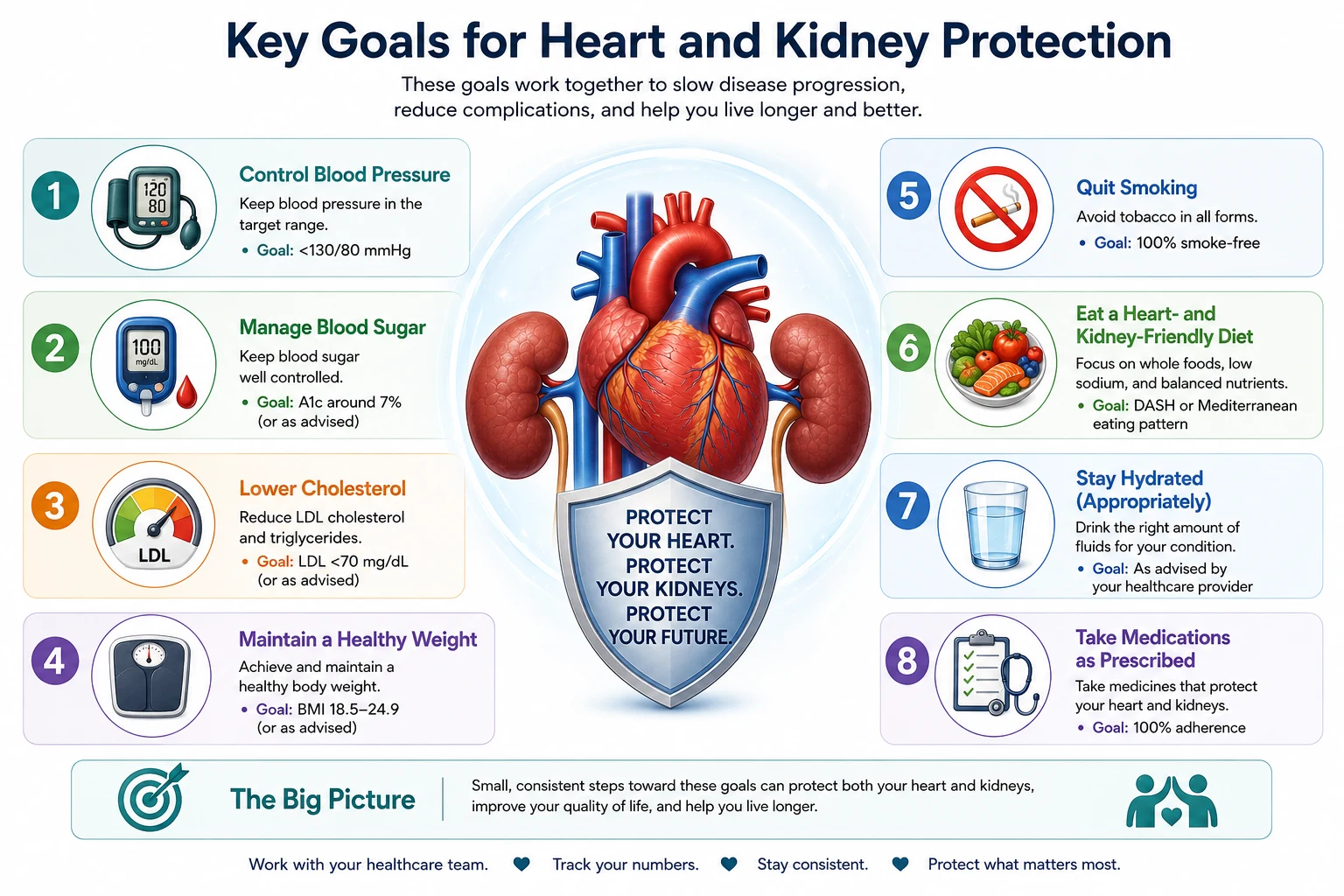
Key Goals for Heart and Kidney Protection: 8 actionable targets — control blood pressure (<130/80 mmHg), manage blood sugar (A1c around 7%), lower cholesterol (LDL <70 mg/dL), maintain healthy weight (BMI 18.5–24.9), quit smoking (100% smoke-free), eat a heart- and kidney-friendly diet (DASH or Mediterranean), stay appropriately hydrated, and take medications as prescribed (100% adherence)

A set of eight clear targets for protecting the heart and kidneys, covering blood pressure, blood sugar, cholesterol, healthy weight, quitting smoking, diet, hydration, and taking medicines as prescribed.

ParameterParameterParameter ParameterTargetTargetTarget TargetWhy it protects both organsBakit nagpoprotekta sa parehong organoNgano nga nagpanalipod sa duha ka organo Bakit nagpoprotekta king parehong organo
Blood pressurePresyon ng dugoPresyon sa dugo Presyon ning daya<140/90 (<130/80 with CKD/DM)Reduces glomerular pressure AND cardiac afterload simultaneouslyNagpapababa ng glomerular pressure AT cardiac afterload nang sabay-sabayNagpababa sa glomerular pressure UG cardiac afterload sa dungan Nagpapababa ning glomerular pressure AT cardiac afterload nang sabay-sabay
LDL cholesterolLDL cholesterolLDL cholesterol LDL cholesterol<55 mg/dL (very high-risk CKD)Slows atherosclerosis in both coronary and renal arteriesNagpapabagal ng atherosclerosis sa parehong coronary at renal arteryNagpahinay sa atherosclerosis sa pareho nga coronary ug renal artery Nagpapabagal ning atherosclerosis king parehong coronary at renal artery
HbA1c (if diabetic)HbA1c (kung may diabetes)HbA1c (kon adunay diabetes) HbA1c (nung atin diabetes)7–8% in CKDReduces endothelial damage, diabetic nephropathy, and cardiomyopathyNagpapababa ng pinsala sa endothelial, diabetic nephropathy, at cardiomyopathyNagpababa sa kadaot sa endothelial, diabetic nephropathy, ug cardiomyopathy Nagpapababa ning pinsala king endothelial, diabetic nephropathy, at cardiomyopathy
HemoglobinHemoglobinHemoglobin Hemoglobin100–115 g/LReduces cardiac workload and prevents LV remodelingNagpapababa ng cardiac workload at pinipigilan ang LV remodelingNagpababa sa cardiac workload ug gipugngan ang LV remodeling Nagpapababa ning cardiac workload at pinipigilan ing LV remodeling
Potassium (pre-HD)Potassium (bago ang HD)Potassium (sa wala pa ang HD) Potassium (bago ing HD)3.5–5.5 mEq/LPrevents life-threatening ventricular arrhythmiasPinipigilan ang mapanganib sa buhay na ventricular arrhythmiaGipugngan ang delikadong ventricular arrhythmia Pinipigilan ing mapanganib king biye a ventricular arrhythmia
Calcium-Phosphorus productCalcium-Phosphorus productCalcium-Phosphorus product Calcium-Phosphorus product<55 mg²/dL²Prevents vascular calcification in both coronary and renal arteriesPinipigilan ang vascular calcification sa parehong coronary at renal arteryGipugngan ang vascular calcification sa pareho nga coronary ug renal artery Pinipigilan ing vascular calcification king parehong coronary at renal artery
Body weightTimbang ng katawanTimbang sa lawas Timbang ning bangkîBMI 18.5–25 kg/m²Each kg lost reduces intraglomerular pressure AND cardiac preloadAng bawat kg na nawala ay nagpapababa ng intraglomerular pressure AT cardiac preloadAng matag kg nga nawala nagpababa sa intraglomerular pressure UG cardiac preload Ing bawat kg a nawala ya nagpapababa ning intraglomerular pressure AT cardiac preload
ProteinuriaProteinuriaProteinuria ProteinuriaUACR <30, or reduce by ≥30%Proteinuria is an independent cardiac risk marker — reducing it protects bothAng proteinuria ay isang independiyenteng cardiac risk marker — ang pagbabawas nito ay nagpoprotekta sa dalawaAng proteinuria usa ka independyenteng cardiac risk marker — ang pagkunhod niini nagpanalipod sa duha Ing proteinuria ya metung a independiyenteng cardiac risk marker — ing pagbabawas nini ya nagpoprotekta king dalawa

When to Seek Immediate CareKailan Humingi ng Agarang Pag-aalagaKanus-a Mangita og Dayon nga Pag-atiman Kailan Humingi ning Agarang Pag-aalaga

Cardiorenal emergency warning signs: cardiac and kidney red flags requiring immediate ER care

Go to the ER or call your doctor immediately for any of these:Pumunta sa ER o tumawag agad sa inyong doktor para sa alinman sa mga ito:Adto sa ER o tawagan dayon ang inyong doktor alang sa bisan hisang niini: Pumunta king ER o tumawag agad king inyu doktor para king alinman king deng ini:

Chest pain, pressure, or tightness lasting more than 5 minutesSakit sa dibdib, presyon, o katigasan na tumatagal ng higit sa 5 minutoSakit sa dughan, presyon, o katig-ason nga molungtad og labaw sa 5 minuto Sakit king dibdib, presyon, o katigasan a tumatagal ning higit king 5 minuto
Sudden shortness of breath at rest or when lying flatBiglang hihirap huminga habang nagpapahinga o nakahiga nang patagKalit nga kakulang sa gininhawa samtang nagpahulay o naghigda nga patag Biglang hihirap huminga habang nagpapahinga o nakahiga nang patag
Rapid, irregular heartbeat (palpitations) with dizzinessMabilis, hindi regular na tibok ng puso (palpitations) na may pagkahiloPaspas, dili regular nga tibok sa kasingkasing (palpitations) nga adunay pagkaluya Mabilis, ali regular a tibok ning pusu (palpitations) a atin pagkahilo
Sudden worsening of leg or face swellingBiglang pagpalala ng pamamaga ng binti o mukhaKalit nga pagpagrabe sa pamaga sa tiil o nawong Biglang pagpalala ning pamamaga ning binti o mukha
Sudden drop in urine outputBiglang pagbaba ng dami ng ihiKalit nga pagkunhod sa gidaghanon sa ihi Biglang pagbaba ning dami ning ihi
Blood pressure above 180/110 mmHgPresyon ng dugo na higit sa 180/110 mmHgPresyon sa dugo nga labaw sa 180/110 mmHg Presyon ning daya a higit king 180/110 mmHg
Muscle weakness or paralysis (possible hyperkalemia)Kahinaan ng kalamnan o paralysis (posibleng hyperkalemia)Kahuyangan sa kalamnan o paralysis (posibleng hyperkalemia) Kahinaan ning kalamnan o paralysis (posibleng hyperkalemia)
Confusion, severe fatigue, inability to stand upKalituhan, matinding pagod, hindi makatayoKalibog, grabe nga kakapoy, dili makatindog Kalituhan, matinding pagod, ali makatayo
Fainting or near-fainting with exertionPagkahimatay o halos pagkahimatay habang nag-eehersisyoPagkahimatay o hapit mahimatay samtang naghago Pagkahimatay o halos pagkahimatay habang nag-eehersisyo
Sudden cold, blue, or painful extremityBiglang malamig, asul, o masakit na paa o kamayKalit nga bugnaw, asul, o masakit nga tiil o kamot Biglang malamig, asul, o masakit a paa o kamay

Cardiorenal Risk Calculator — CRS Classifier & Volume Overload AssessmentCardiorenal Risk Calculator — CRS Classifier at Pagtatasa ng Labis na Dami ng LikidoCardiorenal Risk Calculator — CRS Classifier ug Pagtasa sa Sobra nga Dami sa Likido Cardiorenal Risk Calculator — CRS Classifier at Pagtatasa ning Labis a Dami ning Likido

Classify the type of cardiorenal syndrome affecting your patient, estimate the degree of fluid overload, and determine the monitoring intensity and treatment urgency based on combined cardiac and renal function.I-classify ang uri ng cardiorenal syndrome na nakakaapekto sa inyong pasyente, tantyahin ang antas ng labis na likido, at tukuyin ang intensity ng pagsubaybay at urgency ng paggamot batay sa pinagsama na cardiac at renal function.I-classify ang klase sa cardiorenal syndrome nga nakaapekto sa inyong pasyente, taksay-i ang grado sa sobra nga likido, ug tukuya ang intensity sa pagbantay ug urgency sa pagtambal base sa pinagsama nga cardiac ug renal function. I-classify ing uri ning cardiorenal syndrome a nakakaapekto king inyu pasyente, tantyahin ing antas ning labis a likido, at tukuyin ing intensity ning pagsubaybay at urgency ning paggamut batay king pinagsama a cardiac at renal function.

Cardiac biomarker reflecting ventricular wall stress / volume overload
Compare to your usual dry weight or post-dialysis weight
CRS Type
Fluid Status
Urgency

⚕ Cardiorenal syndrome (CRS) classification per Ronco et al. (JACC 2008), endorsed by KDIGO. BNP thresholds adjusted for CKD — BNP and NT-proBNP are chronically elevated in CKD independent of fluid status, so higher thresholds apply. This tool provides clinical framework support — cardiorenal management requires combined nephrology and cardiology assessment.

Frequently Asked QuestionsMga Madalas na ItanongMga Kanunay nga Gipangutana Deng Madalas a Itanong

?

I have both heart failure and CKD — how can diuretics help one without hurting the other?Mayroon akong parehong heart failure at CKD — paano matutulungan ng mga diuretic ang isa nang hindi nasasaktang ang isa pa?Adunay akoy pareho nga heart failure ug CKD — unsaon sa mga diuretic pagtabang sa usa nga dili makadaot sa usa pa? Mayroon akong parehong heart failure at CKD — paano matutulungan ning deng diuretic ing metung nang ali nasasaktang ing metung pa?

This is one of the most challenging clinical balancing acts in medicine. Diuretics relieve fluid congestion (protecting the heart) but can reduce kidney perfusion if overused (worsening CKD). The key is decongestion to dry weight without volume depletion — guided by daily weights, urine output, and serial creatinine. SGLT2 inhibitors now provide gentle, safe natriuresis that works in this setting without the creatinine risk of aggressive loop diuretics.Ito ay isa sa pinaka-mapaghamong klinikal na pagbabalanse sa medisina. Ang mga diuretic ay nagpapagaan ng congestion ng likido (nagpoprotekta sa puso) ngunit maaaring magpababa ng kidney perfusion kung sobra ang gamit (nagpapalala ng CKD). Ang susi ay decongestion hanggang sa dry weight nang walang volume depletion — ginagabayan ng pang-araw-araw na timbang, dami ng ihi, at serial creatinine. Ang mga SGLT2 inhibitor ay nagbibigay ngayon ng maamo, ligtas na natriuresis na gumagana sa ganitong sitwasyon nang walang panganib ng creatinine ng aggressive na loop diuretics.Kini usa sa labing mapaghamong klinikal nga pagbalansi sa medisina. Ang mga diuretic nagpainum sa congestion sa likido (nagpanalipod sa kasingkasing) apan mahimong magpababa sa kidney perfusion kon sobra ang paggamit (nagpagrabe sa CKD). Ang yawe mao ang decongestion hangtud sa dry weight nga walay volume depletion — gipiyalan sa inadlaw nga timbang, gidaghanon sa ihi, ug serial creatinine. Ang mga SGLT2 inhibitor karon naghatag ug humok, luwas nga natriuresis nga nagtrabaho niining kahimtanga nga walay risgo sa creatinine sa aggressive nga loop diuretics. Ini ya metung king pinaka-mapaghamong klinikal a pagbabalanse king medisina. Ing deng diuretic ya nagpapagaan ning congestion ning likido (nagpoprotekta king pusu) ngarud maaaring magpababa ning kidney perfusion nung sobra ing gamit (nagpapalala ning CKD). Ing susi ya decongestion anggang king dry weight nang alang volume depletion — ginagabayan ning aldo-aldong a timbang, dami ning ihi, at serial creatinine. Ing deng SGLT2 inhibitor ya nagbibigay ngayon ning maamo, ligtas a natriuresis a gumagana king ganitong sitwasyon nang alang panganib ning creatinine ning aggressive a loop diuretics.

?

My cardiologist and nephrologist give different advice — who should I follow?Ang aking cardiologist at nephrologist ay nagbibigay ng magkaibang payo — sino ang dapat kong sundin?Ang akong cardiologist ug nephrologist naghatag og lain-laing tambag — kinsa ang akong sundon? Ing aking cardiologist at nephrologist ya nagbibigay ning magkaibang payo — sino ing dapat kong sundin?

This tension is real and common. The best solution is a unified care conference where both specialists communicate directly. Your nephrologist manages fluid balance, potassium, and medications affecting kidney function; your cardiologist manages rhythm, cardiac function, and coronary risk. Both perspectives are essential — advocate for coordinated care, and bring your complete medication list to every appointment.Ang tensyon na ito ay tunay at karaniwan. Ang pinakamahusay na solusyon ay isang pinagsamang care conference kung saan ang parehong espesyalista ay direktang nakikipag-usap. Ang inyong nephrologist ay namamahala ng balanse ng likido, potassium, at mga gamot na nakakaapekto sa tungkulin ng bato; ang inyong cardiologist ay namamahala ng ritmo, cardiac function, at coronary risk. Ang parehong pananaw ay mahalaga — itaguyod ang coordinated care, at dalhin ang kumpletong listahan ng inyong mga gamot sa bawat appointment.Kining tensyon tinuod ug komon. Ang labing maayong solusyon usa ka nagkahiusa nga care conference diin ang duha ka espesyalista direkta nga nakig-komunikasyon. Ang inyong nephrologist nagdumala sa balanse sa likido, potassium, ug mga medisina nga nakaapekto sa tungkulin sa bato; ang inyong cardiologist nagdumala sa ritmo, cardiac function, ug coronary risk. Ang duha ka panan-aw hinungdanon — ipasiugda ang coordinated care, ug dad-a ang kompleto nga listahan sa inyong mga medisina sa matag appointment. Ing tensyon a ini ya tunay at karaniwan. Ing pinakamahusay a solusyon ya metung a pinagsamang care conference nung saan ing parehong espesyalista ya direktang nakikipag-usap. Ing inyu nephrologist ya namamahala ning balanse ning likido, potassium, at deng gamut a nakakaapekto king tungkulin ning batu; ing inyu cardiologist ya namamahala ning ritmo, cardiac function, at coronary risk. Ing parehong pananaw ya importante — itaguyod ing coordinated care, at dalhin ing kumpletong listahan ning inyu deng gamut king bawat appointment.

?

Can I exercise safely with both heart and kidney disease?Maaari ba akong mag-ehersisyo nang ligtas na may parehong sakit sa puso at bato?Mahimo ba akong mag-ehersisyo nga luwas nga adunay pareho nga sakit sa kasingkasing ug bato? Maaari ba akong mag-ehersisyo nang ligtas a atin parehong sakit king pusu at batu?

Yes — in fact, exercise is one of the most powerful interventions for cardiorenal patients. Supervised moderate exercise (walking, cycling, water aerobics) at 50–70% of maximum heart rate reduces blood pressure, improves cardiac output, lowers inflammatory markers, and improves dialysis adequacy. Start slow and check with your doctor about your specific safe exercise range, particularly if you have recent cardiac events or severe fluid overload.Oo — sa katunayan, ang ehersisyo ay isa sa pinaka-makapangyarihang interbensyon para sa mga cardiorenal na pasyente. Ang supervised na katamtamang ehersisyo (paglalakad, pagbibisikleta, water aerobics) sa 50–70% ng maximum heart rate ay nagpapababa ng presyon ng dugo, nagpapabuti ng cardiac output, nagpapababa ng mga inflammatory marker, at nagpapabuti ng adequacy ng dialysis. Magsimulang dahan-dahan at kumonsulta sa inyong doktor tungkol sa inyong tiyak na ligtas na hanay ng ehersisyo, lalo na kung mayroon kayong kamakailang cardiac event o malubhang labis na likido.Oo — sa tinuod, ang ehersisyo usa sa labing gamhanang interbensyon alang sa mga cardiorenal nga pasyente. Ang supervised nga katamtamang ehersisyo (paglakaw, pagsakay sa bisikleta, water aerobics) sa 50–70% sa maximum heart rate nagpababa sa presyon sa dugo, nagpaayo sa cardiac output, nagpababa sa mga inflammatory marker, ug nagpaayo sa adequacy sa dialysis. Sugdi nga hinay-hinay ug konsultahon ang inyong doktor bahin sa inyong tiyak nga luwas nga saklaw sa ehersisyo, labi na kon adunay kamayoridad nga cardiac event o grabe nga sobra nga likido. Oo — king katunayan, ing ehersisyo ya metung king pinaka-makapangyarihang interbensyon para king deng cardiorenal a pasyente. Ing supervised a katamtamang ehersisyo (paglalakad, pagbibisikleta, water aerobics) king 50–70% ning maximum heart rate ya nagpapababa ning presyon ning daya, nagpapabuti ning cardiac output, nagpapababa ning deng inflammatory marker, at nagpapabuti ning adequacy ning dialysis. Magsimulang dahan-dahan at kumonsulta king inyu doktor tungkol king inyu tiyak a ligtas a hanay ning ehersisyo, lalo a nung mayroon kayung kamakailang cardiac event o malubhang labis a likido.

?

Does a kidney transplant fix the heart problems caused by CKD?Naaayos ba ng kidney transplant ang mga problema sa puso na dulot ng CKD?Naayo ba sa kidney transplant ang mga problema sa kasingkasing nga dulot sa CKD? Naaayos ba ning kidney transplant ing deng problema king pusu a dulot ning CKD?

A successful kidney transplant significantly reduces cardiovascular risk compared to remaining on dialysis — blood pressure normalizes, anemia improves, uremic toxins are cleared more completely, and vascular calcification may partially stabilize. However, existing cardiac damage (LV hypertrophy, coronary artery disease) does not fully reverse. Cardiovascular risk remains higher than the general population post-transplant, and cardiac screening is part of every transplant evaluation.Ang matagumpay na kidney transplant ay makabuluhang nagpapababa ng cardiovascular risk kumpara sa pagpanatili sa dialysis — ang presyon ng dugo ay nagiging normal, ang anemia ay bumubuti, ang mga uremic toxin ay mas kumpletong nililinis, at ang vascular calcification ay maaaring bahagyang maging matatag. Gayunpaman, ang kasalukuyang pinsala sa puso (LV hypertrophy, coronary artery disease) ay hindi ganap na bumabalik. Ang cardiovascular risk ay nananatiling mas mataas kaysa sa pangkalahatang populasyon pagkatapos ng transplant, at ang cardiac screening ay bahagi ng bawat pagsusuri sa transplant.Ang maayo nga kidney transplant makadako ug pagkunhod sa cardiovascular risk kon itandi sa pagpabilin sa dialysis — ang presyon sa dugo mobalhin sa normal, ang anemia mopaayo, ang mga uremic toxin malimpyuhan nga mas kompleto, ug ang vascular calcification mahimong bahin nga mag-estabilidad. Apan, ang naanaa na nga kadaot sa kasingkasing (LV hypertrophy, coronary artery disease) dili hingpit nga mobalik. Ang cardiovascular risk nagpabilin nga mas taas kaysa sa kinatibuk-ang populasyon human sa transplant, ug ang cardiac screening bahin sa matag pagsusi sa transplant. Ing matagumpay a kidney transplant ya makabuluhang nagpapababa ning cardiovascular risk kumpara king pagpanatili king dialysis — ing presyon ning daya ya nagiging normal, ing anemia ya bumubuti, ing deng uremic toxin ya mas kumpletong nililinis, at ing vascular calcification ya maaaring bahagyang maging matatag. Gayunpaman, ing kasalukuyang pinsala king pusu (LV hypertrophy, coronary artery disease) ya ali ganap a bumabalik. Ing cardiovascular risk ya nananatiling mas matas kaysa king pangkalahatang populasyon kapabanuan ning transplant, at ing cardiac screening ya bahagi ning bawat pagsusuri king transplant.
ImportantMahalagang PaalalaImportante nga Pahibalo Mahalagang Paalala: This guide is for educational purposes only. The management of combined heart and kidney disease is complex and highly individualized. Always follow the joint recommendations of your nephrology and cardiology care team.Ang gabay na ito ay para lamang sa layuning pang-edukasyon. Ang pamamahala ng pinagsama na sakit sa puso at bato ay kumplikado at lubos na indibidwalisado. Laging sundin ang magkasamang rekomendasyon ng inyong nephrology at cardiology care team.Kining giya alang lamang sa mga katuyoan sa edukasyon. Ang pagdumala sa pinagsama nga sakit sa kasingkasing ug bato komplikado ug hilabihang indibidwalisado. Kanunay sunda ang magkahiusa nga rekomendasyon sa inyong nephrology ug cardiology care team. Ing gabay a ini ya para lamang king layuning pang-edukasyon. Ing pamamahala ning pinagsama a sakit king pusu at batu ya kumplikado at lubos a indibidwalisado. Pirming sundin ing magkasamang rekomendasyon ning inyu nephrology at cardiology care team.

Burden of Cardiorenal Syndrome

CRS is not a rare complication — it is the expected intersection of the two leading causes of global mortality. In the Philippines, diabetes and hypertension together drive the dominant cardiorenal phenotype; undiagnosed CKD at first HF presentation is common, and limited echocardiographic access outside tertiary centers compounds underrecognition.

StatisticDataSource
CKD prevalence in HF patients~50% of hospitalised HF patients have CKD (eGFR <60); ~25% have Stage 3b or worseADHERE, OPTIMIZE-HF registries
Worsening renal function in ADHFOccurs in 25–40% of acute decompensated HF admissions; associated with 2–3× higher in-hospital mortalityForman et al. JACC 2004
CV mortality in CKDLeading cause of death across all CKD stages; Stage 4–5 patients have 10–30× higher CV mortality than the general populationCKD Prognosis Consortium; USRDS
ESKD cardiovascular burdenCV disease causes >50% of all-cause mortality in dialysis patients; cardiac risk approximates that of an 80-year-old in the general populationUSRDS 2023
Philippine / Asian contextDM + HTN drive Type 2 and 4 CRS dominance; CKD frequently unrecognized until HF admission; high rates of uncontrolled BP and suboptimal GDMT uptakePSN registry; DOPPS Asia
Hospitalisation impactCRS patients have 2–4× longer hospital stays and higher 30/90-day readmission rates; CKD + HF co-diagnosis is among the highest-cost diagnostic pairsNIS database analyses

Normal Cardiorenal Physiology — The Shared Substrate

Every therapeutic lever in CRS — diuretics, RAASi, SGLT2i, MRA — modulates the same shared cardiorenal axis. Understanding the normal state clarifies why each intervention works and what its limits are.

Physiologic elementNormal functionRelevance in CRS
Renal autoregulationMaintains GFR across MAP 60–160 mmHg via afferent/efferent arteriolar toneFails at extremes — cardiogenic shock (↓ MAP) and elevated CVP both collapse the renal filtration gradient independently
RAAS axisAngiotensin II maintains efferent tone to preserve GFR during low-flow states; aldosterone reclaims Na⁺Chronic RAAS activation in HF → glomerulosclerosis and fibrosis; functional eGFR dip on RAASi initiation is expected and prognostically neutral
Sympathetic nervous systemRenal SNS ↑ renin release, tubular Na⁺ reabsorption, and afferent vasoconstrictionSustained activation in HF drives progressive volume retention and renal fibrosis; beta-blockade partially offsets this pathway
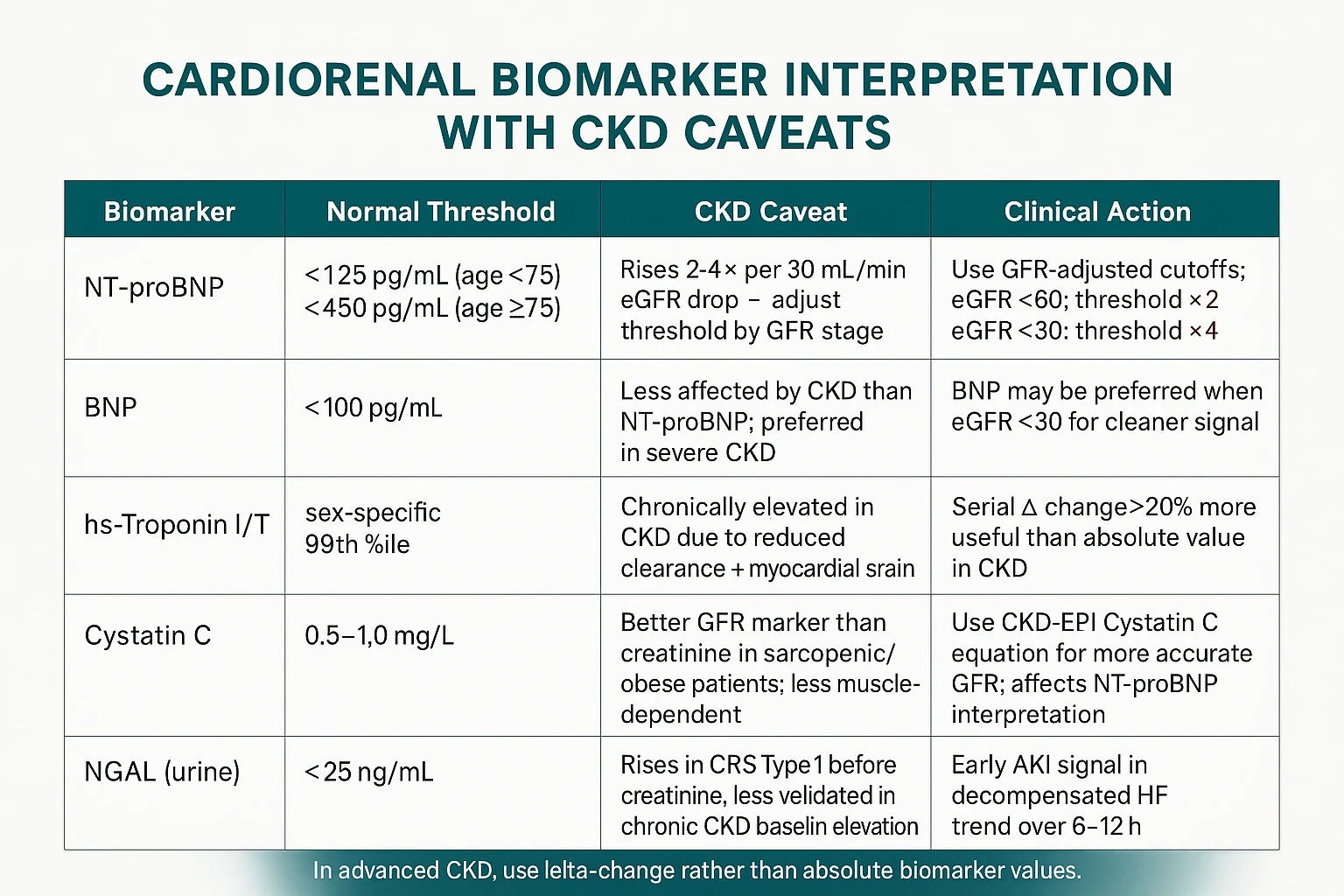
ANP / BNPReleased by stretched atria/ventricles → natriuresis, vasodilation, RAAS inhibitionARNI (sacubitril/valsartan) amplifies natriuretic peptide signalling; CKD impairs clearance → inflated measured BNP/NT-proBNP levels
Tubuloglomerular feedback (TGF)↑ Distal Na⁺/Cl⁻ delivery → adenosine-mediated afferent constriction → ↓ GFRIn diabetic CKD, proximal SGLT2-mediated reabsorption blunts distal delivery, overriding TGF → glomerular hypertension; SGLT2i restores physiologic TGF
Renal venous pressureNormally 5–8 mmHg — negligible contribution to filtration gradientIn ADHF, CVP rises to 15–25 mmHg → renal venous hypertension → reverses filtration gradient → AKI despite preserved MAP

Cardiorenal Syndrome — Classification, Pathophysiology & Evidence-Based Management

Cardiorenal syndrome (CRS) is a bidirectional disorder in which dysfunction of the heart and kidneys propagates injury in the other organ. Effective management requires identifying the dominant hemodynamic driver, distinguishing pseudo-worsening renal function from true tubular injury, and deploying the disease-modifying therapies that are now proven to act on both organs simultaneously.

📌

Framing principle

CRS is not the mere coexistence of heart and kidney disease. It is the recognition that each organ is mechanistically driving deterioration of the other, and that decongestion, neurohormonal blockade, and SGLT2 inhibition must be titrated against both end-organs rather than optimized for one at the expense of the other.

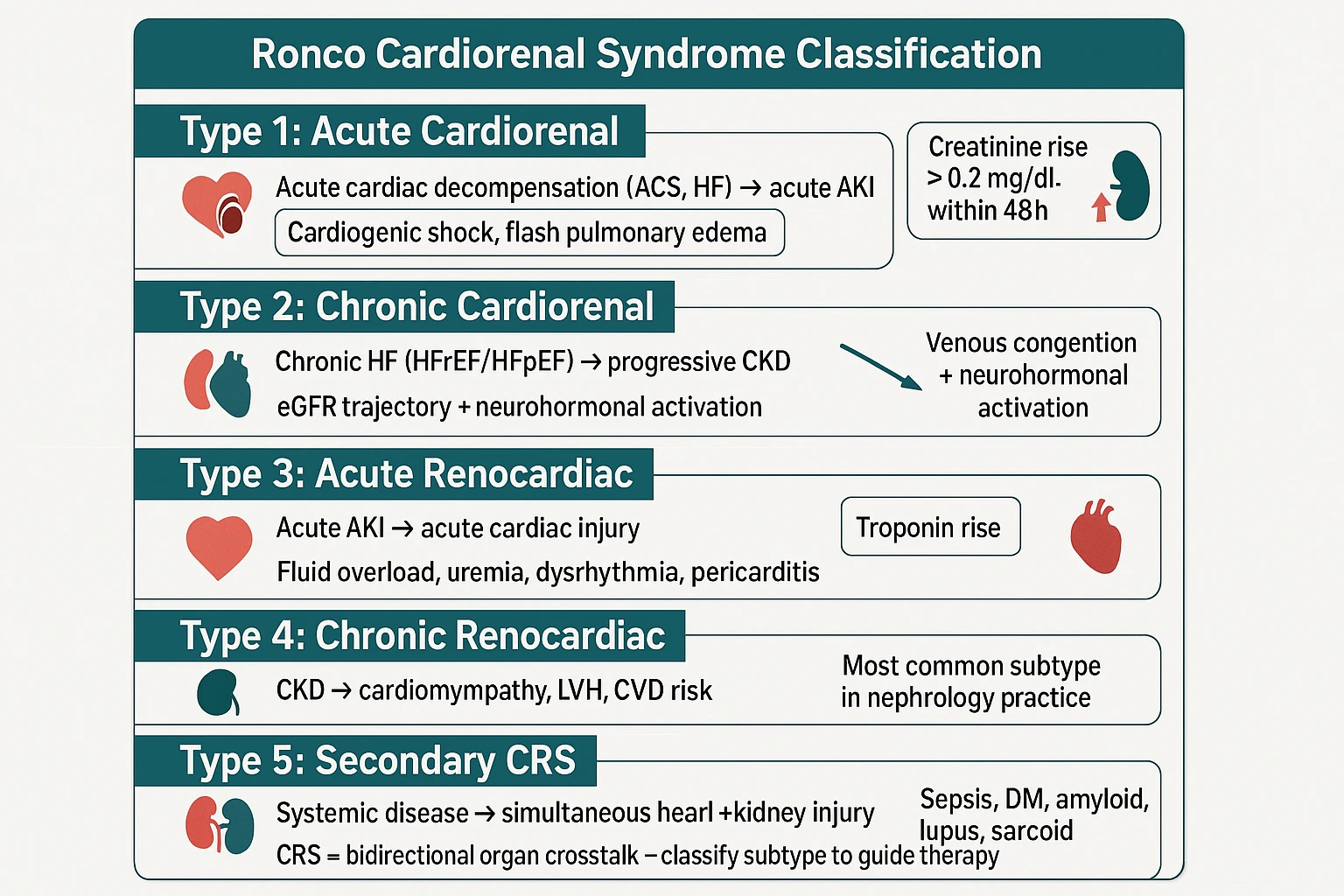
Ronco Classification — The Five Subtypes

TypePrimary insult → consequenceTypical clinical settingDominant mechanism
Type 1 Acute cardiorenalAcute cardiac dysfunction → AKIAcute decompensated HF, cardiogenic shock, post-MIVenous congestion > low output; neurohormonal surge
Type 2 Chronic cardiorenalChronic HF → progressive CKDChronic HFrEF/HFpEF with declining eGFRSustained low perfusion, venous congestion, RAAS/SNS activation
Type 3 Acute renocardiacAKI → acute cardiac dysfunctionAKI-induced volume/electrolyte shifts, uremic effectsFluid overload, hyperkalaemia, acidaemia, arrhythmia
Type 4 Chronic renocardiacCKD → cardiovascular diseaseCKD/ESKD with LVH, accelerated atherosclerosis, SCDPressure/volume load, uremic cardiomyopathy, calcification
Type 5 SecondarySystemic process → simultaneous heart + kidney injurySepsis, amyloidosis, cirrhosis, SLE, diabetesSystemic inflammation, infiltration, hemodynamic stress

The subtype is a clinical framework, not a rigid diagnosis — patients frequently transition between types (e.g. Type 1 → Type 2) and the therapeutic priorities differ accordingly.

Ronco Cardiorenal Syndrome Classification: five stacked panels for CRS Types 1–5, each with teal header, mechanism arrow, biomarker callout, and clinical action — from acute cardiorenal (Type 1) through secondary systemic CRS (Type 5)

Acute Cardiac Dysfunction → AKI

The most common inpatient cardiorenal scenario. Acute hemodynamic deterioration — ADHF, cardiogenic shock, post-MI — precipitates AKI within 24–72 hours. The dominant mechanism is renal venous congestion (elevated CVP collapsing the renal filtration gradient) rather than low cardiac output alone; both can coexist.

DomainKey points
TriggersAcute decompensated HF · cardiogenic shock · acute MI · acute valvular emergency · post-cardiac surgery
Mechanism↑ CVP → ↑ renal venous / interstitial pressure → ↓ net filtration gradient; neurohormonal surge (RAAS, SNS, AVP) → Na⁺/water retention
Diagnostic clueAKI coinciding with clinical signs of congestion (elevated JVP, B-lines on lung US, acute weight gain) — not hypovolaemia
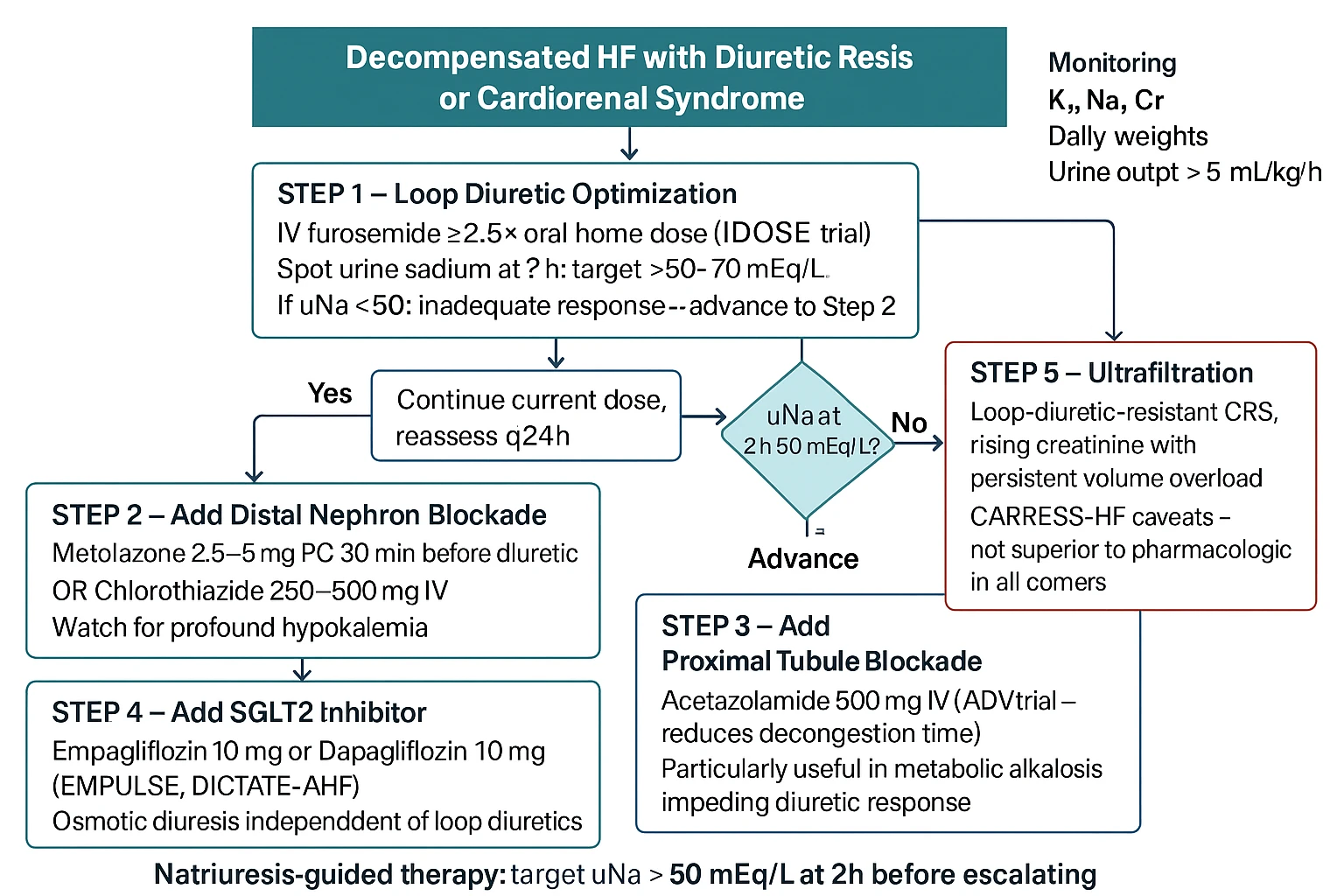
Management priorityDecongestion first: IV loop ± sequential blockade; monitor spot uNa⁺ at 2 h; avoid reflexive diuretic withholding for rising creatinine if patient remains fluid-overloaded
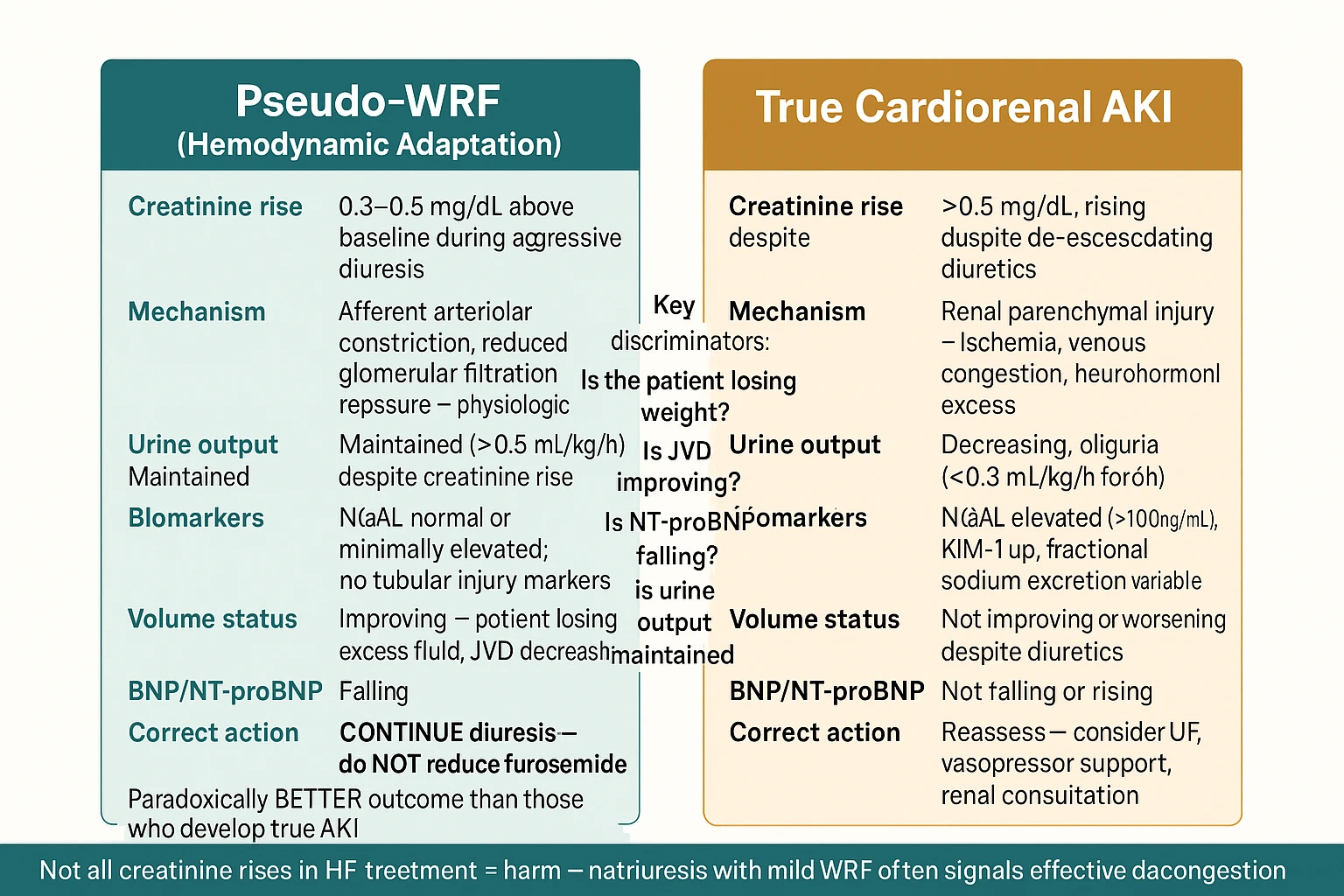
Creatinine riseFunctional rise during effective diuresis is expected and acceptable (pseudo-WRF); true tubular injury (oliguria, hemoconcentration absent) requires reassessment of perfusion
EscalationPersistent AKI + refractory congestion → inotropic support, consider ultrafiltration; RRT if K⁺ >6.5, severe acidosis, or anuria

Chronic HF → Progressive CKD

Sustained neurohormonal activation, chronically elevated venous pressure, and reduced renal perfusion in chronic heart failure drive progressive CKD over months to years. eGFR decline is often slow and underappreciated until advanced stages. The target is simultaneous optimisation of both organs — diuretic overuse and under-dosing of GDMT are the two most common errors.

DomainKey points
TriggersChronic HFrEF or HFpEF with persistent congestion · repeated decompensations · suboptimal GDMT
MechanismSustained ↑ CVP + ↓ effective renal perfusion + RAAS/SNS activation → glomerulosclerosis, tubular atrophy, interstitial fibrosis
Diagnostic clueGradual eGFR decline (>3–5 mL/min/year) in established HF without another renal diagnosis; UACR often elevated
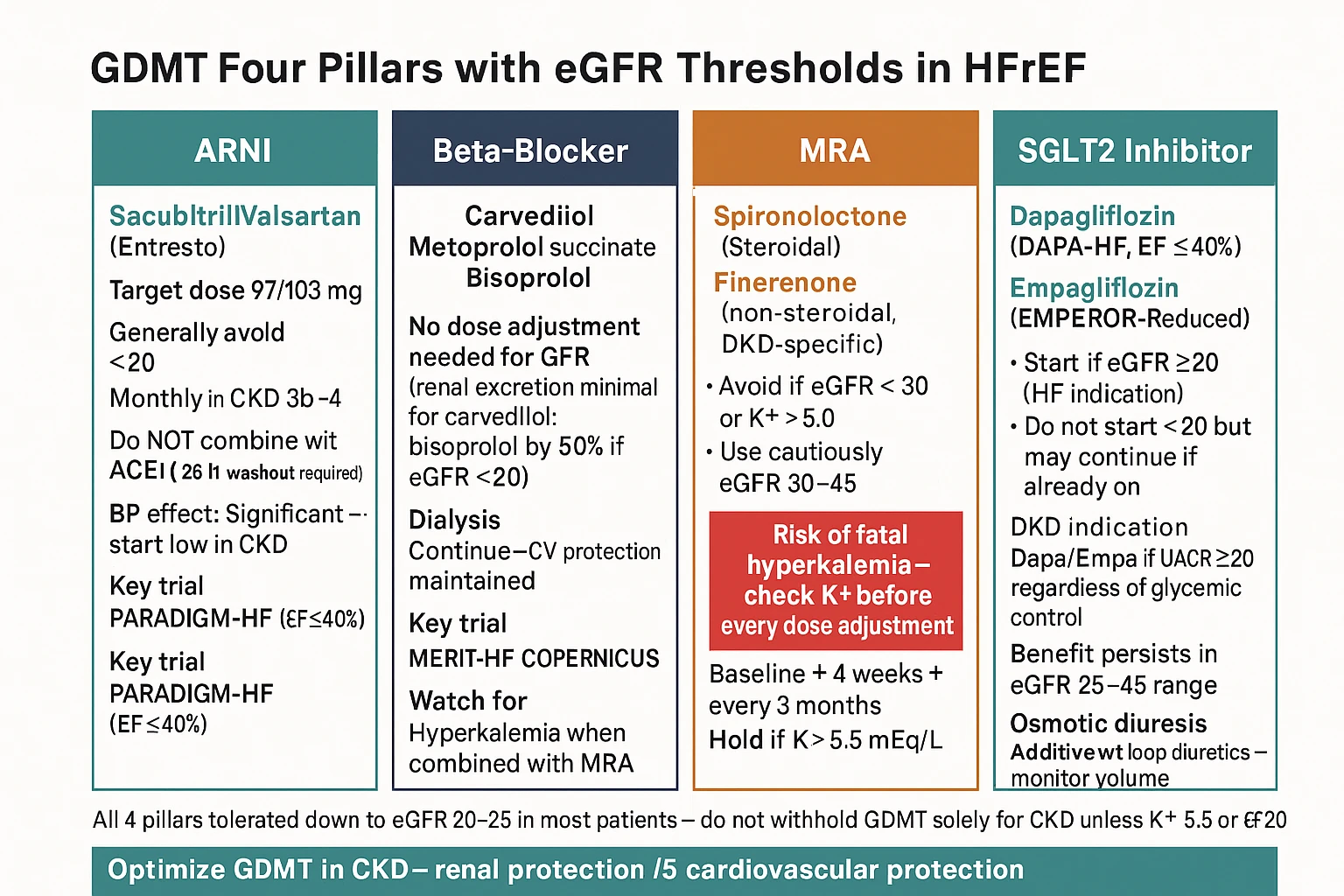
Management priorityMaximise GDMT (SGLT2i, RAASi/ARNI, MRA, BB); optimize volume — avoid chronic over-diuresis; nephrology co-management when eGFR <30 or declining rapidly
MonitoringeGFR + UACR + electrolytes every 3–6 months; reassess after every GDMT change; annual echo for LV function
Key pitfallAttributing eGFR decline solely to "CKD" without recognising inadequately treated chronic congestion as the driver

AKI → Acute Cardiac Injury

AKI of any cause drives acute cardiac dysfunction through volume overload, electrolyte chaos, uremic myocardial depression, and pericarditis. This type is the least recognized — the kidney is the aggressor and the heart is the victim. Management targets the underlying AKI cause; cardiac protection is secondary but urgent.

DomainKey points
TriggersSepsis-AKI · contrast nephropathy · obstruction · rhabdomyolysis · drug-induced AKI with rapid decompensation
MechanismsFluid overload → pulmonary edema · hyperkalaemia → arrhythmia (peaked T waves, wide QRS, VF) · metabolic acidosis → myocardial depression · uremic pericarditis / myocarditis
Diagnostic clueNew arrhythmia, pulmonary edema, or troponin rise in the context of AKI — not primary cardiac pathology
Cardiac monitoringSerial ECG for hyperkalaemia changes; troponin trend; echocardiogram if pericardial effusion suspected; telemetry during severe electrolyte shifts
Management priorityTreat the AKI cause; urgent K⁺ management (calcium gluconate, insulin/dextrose, Kayexalate/Kalimate); loop diuretics for volume if urine output preserved; RRT early if: K⁺ >6.5 refractory, severe acidosis (pH <7.1), anuria with fluid overload
Key pitfallInitiating cardiac catheterisation for "new MI" without recognising uremic troponin elevation — always check serial delta and clinical context

ECG in AKI — a cardiac emergency

Hyperkalaemia in AKI can cause peaked T waves → prolonged PR → wide QRS → sine wave → VF in sequence. Any ECG change in a patient with AKI and K⁺ >5.5 mmol/L warrants immediate management — do not wait for K⁺ >6.5.

Systemic Disease Injuring Both Organs Simultaneously

A systemic process damages both the heart and kidney simultaneously, with no clear temporal or causal precedence between the organs. The key diagnostic insight is that treating the systemic driver is the primary intervention — organ-directed therapy follows but cannot succeed if the underlying cause is unaddressed.

Systemic causeCardiac manifestationRenal manifestationTherapeutic focus
SepsisSeptic cardiomyopathy, arrhythmia, distributive shockSepsis-AKI (tubular injury, microvascular)Source control · MAP ≥65 with noradrenaline · avoid nephrotoxins · conservative fluid strategy post-resuscitation
Diabetes mellitusDiabetic cardiomyopathy, accelerated coronary disease, HFpEFDiabetic nephropathy, glomerulosclerosisSGLT2i + GLP-1 RA + finerenone; HbA1c individualized; BP <130/80
AmyloidosisRestrictive cardiomyopathy (esp. TTR), arrhythmia, low-flow low-gradient ASNephrotic syndrome, rapidly progressive renal failureAL: daratumumab-based chemotherapy; TTR: tafamidis (cardiac); renal support as needed
SLE / vasculitisPericarditis, Libman-Sacks endocarditis, myocarditisLupus nephritis, ANCA GNImmunosuppression per disease activity; hydroxychloroquine (renal/CV protection); monitor eGFR closely on cyclophosphamide
Cirrhosis / HepatorenalCirrhotic cardiomyopathy (latent systolic/diastolic dysfunction), QTc prolongationHepatorenal syndrome Types 1 and 2Terlipressin + albumin for HRS-AKI; avoid diuretic overuse; liver transplant resolves both
COVID-19 (severe)Myocarditis, pericarditis, Takotsubo, microvascular thrombosisCOVID-AKI (tubular injury, microthrombi)Supportive; steroids (dexamethasone) reduce organ injury; anticoagulation per thrombosis risk

Beyond Low Output — Venous Congestion, Neurohormonal & Inflammatory Drivers

The historical "forward-failure" model — reduced cardiac output causing renal hypoperfusion — is incomplete. In acute decompensated heart failure, elevated central venous pressure and renal venous congestion are stronger determinants of worsening renal function than cardiac index (Mullens et al., JACC 2009; Damman et al.). Renal perfusion is governed by the arterio-venous pressure gradient across the kidney; a congested renal vein and elevated intra-abdominal pressure raise interstitial and tubular pressure, collapsing that gradient even when output is preserved.

PathwayMechanismTherapeutic lever
Renal venous congestion↑ Renal interstitial & tubular pressure → ↓ net glomerular filtration gradient; ↑ intra-abdominal pressure compoundsDecongestion (loop ± sequential blockade); paracentesis if tense ascites
Neurohormonal activationRAAS and sympathetic outflow → vasoconstriction, Na⁺/water retention, fibrosis, remodelingRAASi/ARNI, beta-blockade, MRA, finerenone
Reduced effective outputLow cardiac index in advanced disease → afferent hypoperfusionInotropes/MCS (selected), afterload reduction
Inflammation & oxidative stressCytokine activation, endothelial dysfunction, ↑ permeabilitySGLT2i (pleiotropic), treat underlying drivers
Tubuloglomerular feedback / adenosine↑ Distal Na⁺ delivery → afferent vasoconstriction (relevant during aggressive diuresis)Rate-controlled diuresis; SGLT2i restores TGF
🔬

Clinical implication

A "congested" kidney often improves with rather than despite decongestion. Withholding diuresis purely because creatinine is rising — when the patient remains volume-overloaded — frequently worsens both organs.

FGF-23, Phosphate & Uremic Cardiomyopathy

Fibroblast growth factor-23 (FGF-23), secreted by osteocytes in response to phosphate loading, rises from CKD Stage 3 — often years before phosphate itself becomes elevated. Beyond mineral metabolism, FGF-23 has direct cardiotoxic effects independent of PTH and phosphate (Faul et al., JCI 2011).

PathwayMechanismClinical consequence
FGF-23 → LVHFGF-23 activates FGFR4 on cardiomyocytes → PLCγ/calcineurin/NFAT hypertrophic signalling → concentric LVH independent of BP or anemiaFGF-23 elevation precedes echocardiographic LVH by years; higher FGF-23 = greater LVH severity and SCD risk; directly correlates with HF hospitalisation
Phosphate → vascular calcificationHyperphosphataemia promotes vascular smooth muscle → osteoblastic transdifferentiation; elevated Ca×P product accelerates medial calcificationArterial stiffness → ↑ pulse pressure → LV pressure overload → concentric LVH; aortic valve calcification → functional AS in ESKD
Klotho deficiencyCKD reduces soluble klotho (FGF-23 co-receptor); klotho loss itself promotes vascular calcification and endothelial dysfunctionKlotho is a cardioprotective hormone — its depletion amplifies cardiorenal risk beyond phosphate alone
Secondary hyperparathyroidismPTH receptors on cardiomyocytes → direct myocardial fibrosis and calcification independent of mineral levelsPTH control (cinacalcet, paricalcitol, parathyroidectomy) partially attenuates cardiac remodeling in ESKD
📌

Clinical implication

Phosphate control is cardiac prevention, not just bone management. Target serum phosphate within normal range in CKD 3b–5D per KDIGO 2017 CKD-MBD guidelines. Use non-calcium phosphate binders where possible to minimize calcium loading that accelerates vascular calcification.

Anemia in CKD — Cardiac Consequences & Evidence-Based Correction

Anemia of CKD begins from Stage 3 and worsens with declining eGFR. Beyond fatigue, anemia drives a compensatory increase in cardiac output that progressively remodels the ventricle. The landmark trials demonstrate that the target hemoglobin matters as much as treatment itself.

AspectDetail
Cardiac remodeling pathwayAnemia → tissue hypoxia → compensatory ↑ HR + stroke volume → chronic volume overload → eccentric LVH → diastolic dysfunction → HF. FGF-23 and PTH compound LVH via pressure overload simultaneously.
TREAT (2009)Darbepoetin to Hb 13 g/dL vs. rescue (<9 g/dL) in T2D + CKD: no mortality benefit; significant ↑ stroke risk (HR 1.92) in the higher-Hb group. Lesson: normalizing Hb with ESA is harmful.
CHOIR (2006)Epoetin to Hb 13.5 vs. 11.3 g/dL in CKD: higher-Hb arm had ↑ death/MI/hospitalisation (HR 1.34). TREAT + CHOIR together drove current conservative Hb targets.
AFFIRM-AHF (2020)IV ferric carboxymaltose in HFrEF/HFmrEF + iron deficiency (TSAT <20% or ferritin <100–299 ng/mL): ↓ HF hospitalisations (RR 0.74); no mortality signal. Treat iron deficiency before initiating ESA.
HIF-PHI agentsRoxadustat, daprodustat — oral HIF-prolyl hydroxylase inhibitors stimulating endogenous EPO production. Non-inferior to ESA in dialysis; roxadustat ASCEND trials: cautionary MACE signal in non-dialysis CKD. Limited PH availability.
Current targetsHb 10–11.5 g/dL with ESA (do not target >11.5 g/dL); treat iron deficiency first (TSAT <20%, ferritin <100 ng/mL); IV iron preferred in HF + iron deficiency regardless of baseline Hb level (KDIGO 2024; ESC HF 2024).

Biomarkers & Volume Status in the Cardiorenal Patient

Marker / toolCaveat in CKD/CRSPractical use
NT-proBNPRenally cleared — rises as eGFR falls; absolute values overestimate cardiac stress at low eGFRUse higher decision thresholds; trend within-patient rather than single cut-off
BNPLess renal dependence than NT-proBNP but still confounded; degraded by neprilysin (uninterpretable on sacubitril)Prefer NT-proBNP if patient is on ARNI
High-sensitivity troponinChronically elevated in CKD without acute ischaemiaInterpret serial deltas, not isolated values
Cystatin C eGFRLess affected by muscle mass/diet than creatinineConfirm GFR in cachectic/sarcopenic HF patients before dosing decisions
Tubular markers NGAL, KIM-1, TIMP-2·IGFBP7Distinguish tubular injury from hemodynamic (functional) creatinine riseAdjunct when differentiating pseudo-WRF from true AKI
Volume assessmentJVP, weight, and exam are insensitive for residual congestionLung ultrasound (B-lines), IVC, bioimpedance, and hemoconcentration trend
Cardiorenal Biomarker Interpretation reference table: NT-proBNP, BNP, hs-Troponin, Cystatin C, and NGAL — each with normal threshold, CKD caveat, and clinical action. GFR-adjusted thresholds and delta-change guidance highlighted.

Echocardiography, Lung Ultrasound & Volume Assessment in CRS

Biomarkers quantify; imaging contextualises. Point-of-care and formal echocardiography provide the hemodynamic story that guides direction and intensity of therapy — particularly in distinguishing wet from dry, and high-output from low-output states.

ToolKey parametersCardiorenal interpretation
2D echo — LV functionEF (Simpson biplane), LV volumes, wall thickness, RWMAEF <40% (HFrEF) vs. ≥50% (HFpEF) determines GDMT backbone; concentric LVH in CKD Stage 4–5 even with preserved EF — do not be reassured by EF alone
Diastolic function (ASE 2016)E/A ratio, E/e′ (septal + lateral average), LA volume index, TR Vmax for estimated RVSPE/e′ >14 suggests elevated LV filling pressure; LA volume index >34 mL/m² = chronic pressure overload; Grade III diastolic dysfunction carries poor prognosis in CRS
Right heart assessmentTAPSE, RV FAC, IVS flattening (D-sign), estimated RVSPRV dysfunction (TAPSE <17 mm) predicts poor decongestion response; pulmonary hypertension in CKD/ESKD is multifactorial — volume, anemia, high-flow AV fistula all contribute
Pericardial effusionSize, circumferential vs. localised, respiratory variation in inflowUremic pericarditis in CKD Stage 5/dialysis — even moderate effusions may require urgent dialysis intensification; tamponade physiology mandates drainage regardless of absolute size
Lung ultrasound (POCUS)B-line count per zone (8-zone protocol); ≥3 B-lines in a zone = interstitial edema; >15 total B-lines = clinically significant congestionLEVELS study: >15 B-lines at discharge predicts 90-day HF readmission better than clinical assessment; use serially to titrate diuresis and confirm decongestion before discharge
IVC assessmentIVC diameter + collapsibility index (CI >50% on sniff = likely RA pressure <5 mmHg)Useful adjunct for volume estimation; reliability reduced by mechanical ventilation, elevated intra-abdominal pressure, severe TR — integrate with full clinical picture

Interpreting the Creatinine Rise During Decongestion

A modest creatinine increase during effective decongestion is common and, when accompanied by clinical improvement and hemoconcentration, is not associated with worse outcomes (post-hoc analyses of DOSE; Testani et al.). This functional, reversible rise — "pseudo-WRF" — must be separated from true tubular injury.

FeaturePseudo-WRF (functional)True AKI (tubular injury)
Volume statusImproving congestion, net negative balanceOften euvolaemic/hypovolaemic or persistently congested
Urine outputPreserved / brisk diuresisOliguria
TrajectoryPlateaus, reverses after euvolaemiaContinued rise after decongestion achieved
HemoconcentrationPresent (rising Hb/albumin/protein)Absent
ActionContinue decongestion; do not reflexively stop GDMTReassess perfusion, hold nephrotoxins, consider injury work-up

Permissible creatinine rise

An eGFR decline up to ~30% (or creatinine rise up to ~30%) that stabilizes is generally acceptable when initiating/uptitrating RAASi or ARNI, provided potassium is controlled and the patient is not volume-depleted. Recheck renal panel and K⁺ within 1–2 weeks.

Two-panel clinical comparison: Pseudo-WRF (left, teal background) vs True Cardiorenal AKI (right, amber background) — differentiating creatinine rise during HF decongestion by urine output, NGAL, volume trajectory, NT-proBNP trend, and correct clinical action

Loop Diuretic Resistance & Sequential Nephron Blockade

StepInterventionEvidence / note
1. Optimise loopIV loop at ≥2.5× home oral dose; bolus or continuous infusionDOSE (NEJM 2011): higher-dose strategy improved decongestion; bolus vs infusion equivalent
2. Confirm responseSpot urine Na⁺ at 2 h (<50–70 mmol/L = inadequate natriuresis) and/or 6 h urine outputEarly natriuretic response predicts diuretic adequacy — escalate promptly if poor
3. Add acetazolamideIV acetazolamide with loop on admissionADVOR (NEJM 2022): improved successful decongestion
4. Sequential nephron blockadeAdd thiazide-type (metolazone, HCTZ, chlorthalidone)CLOROTIC: HCTZ add-on improved weight loss; monitor K⁺/Na⁺/renal panel closely
5. SGLT2 inhibitorContinue/initiate during admission once stableAdds osmotic/natriuretic effect; EMPULSE supports in-hospital initiation
6. RefractoryHypertonic saline + high-dose loop; ultrafiltrationCARRESS-HF: UF not superior to stepped pharmacologic therapy and more adverse renal events — reserve UF for true diuretic failure
📌

Tolvaptan / hyponatraemia

Vasopressin antagonism (tolvaptan) aids aquaresis in hypervolaemic hyponatraemia and can support decongestion without worsening renal function, though EVEREST showed no mortality benefit. Use selectively for symptomatic hyponatraemia or diuretic-resistant congestion.

Sequential nephron blockade flowchart for cardiorenal decongestion: Steps 1–6 from IV loop diuretic optimization with urine sodium check at 2h, through acetazolamide, metolazone, SGLT2 inhibitor, to ultrafiltration — with DOSE, ADVOR, CLOROTIC, and EMPULSE trial evidence

When Congestion Is Not the Only Problem — Low-Output CRS

Most acute CRS is congestion-driven and responds to decongestion. A subset have concomitant or primary low-cardiac-output states where diuresis alone is insufficient or may worsen renal perfusion. Identifying the hemodynamic phenotype — cold-wet vs. warm-wet — determines the correct escalation path.

InterventionIndicationRenal consideration
DobutamineCardiogenic shock or severe low-output (cold-wet phenotype); reduced CI on hemodynamics↑ Renal blood flow at low–moderate doses; tachycardia and proarrhythmia limit duration; no mortality benefit — use as bridge to recovery or decision
MilrinonePDE-3 inhibitor; preferred in BB-dependent or RV-dominant failure; post-cardiac surgery low output~80% renally cleared — reduce dose in CKD; longer half-life means effects outlast infusion; more hypotension than dobutamine; caution if eGFR <30
LevosimendanCalcium sensitiser; LIDO, REVIVE data in ADHF with low EF; less proarrhythmic than catecholaminesMaintains or improves renal blood flow; sustained effect (active metabolite half-life ~80 h); limited PH availability — consider in diuretic-resistant ADHF with low output
NoradrenalineCardiogenic shock with refractory hypotension (MAP <65 mmHg)SOAP-II: noradrenaline superior to dopamine in cardiogenic shock (↓ arrhythmia); "renal-dose" dopamine is disproven and should not be used for renal protection
IABPCardiogenic shock bridging; post-MI mechanical complicationsIABP-SHOCK II: no mortality benefit in STEMI-CS; hemodynamically neutral on kidneys; still used as a bridge while awaiting escalation or recovery decision
RRT escalationRefractory fluid overload + AKI despite maximal pharmacologic therapyIndications: K⁺ >6.5 refractory to measures, pH <7.1, anuria with fluid overload, symptomatic uremia. CARRESS-HF: ultrafiltration not superior to stepped pharmacologic therapy and caused more renal adverse events — exhaust all drug options first

The Four Pillars Across the eGFR Spectrum

PillareGFR considerationsCardiorenal note
ARNI / ACEi / ARBARNI studied to eGFR 30 (PARADIGM-HF); use with monitoring below 30. Expect a functional creatinine rise on initiationSTOP-ACEi (NEJM 2022): discontinuing RAASi in advanced CKD did not preserve eGFR or improve outcomes — favor continuation
Beta-blockerNo renal dose limitation; evidence-based agents (carvedilol, bisoprolol, metoprolol succinate)Carvedilol shown beneficial in dialysis-dependent HFrEF
MRA (steroidal)Caution < eGFR 30; avoid if K⁺ > 5.0; monitor K⁺ at 1 & 4 weeksMortality benefit in HFrEF (RALES, EMPHASIS-HF); hyperkalaemia is the rate-limiter
SGLT2 inhibitorInitiate down to eGFR ~20; continue until dialysis/transplantBenefit independent of diabetes and largely independent of baseline eGFR — see next section
Finerenone (non-steroidal MRA)T2D + CKD; eGFR ≥ 25; lower hyperkalaemia risk than steroidal MRAFIDELIO-DKD / FIGARO-DKD / FIDELITY: reduced CKD progression and CV events
🔬

Sequencing

Rapid, simultaneous low-dose initiation of all pillars (then uptitrate) is now favored over slow sequential single-agent titration (STRONG-HF). SGLT2i and beta-blockers are generally the best tolerated to start; RAASi/ARNI and MRA require K⁺ and renal monitoring.

GDMT Four Pillars with eGFR Thresholds in HFrEF: four vertical columns for ARNI, Beta-Blocker, MRA (spironolactone and finerenone), and SGLT2 inhibitor — each with target dose, eGFR start/stop thresholds, K+ monitoring schedule, and key trial references

Trial Evidence by Indication & eGFR Stratum

TrialPopulationeGFR entryKey result
DAPA-HFHFrEF ± diabetes≥ 30↓ CV death/HF worsening; renal benefit consistent
EMPEROR-ReducedHFrEF≥ 20↓ CV death/HF hospitalisation; slower eGFR decline
EMPEROR-Preserved / DELIVERHFpEF / HFmrEF≥ 20 / ≥ 25↓ HF hospitalisation across LVEF spectrum
CREDENCET2D + albuminuric CKD30–90↓ ESKD, doubling of creatinine, renal/CV death
DAPA-CKDCKD ± diabetes≥ 25↓ CKD progression and CV death across causes
EMPA-KIDNEYBroad CKD20–45, or 45–90 with ACR ≥ 200↓ Kidney disease progression / CV death across wide eGFR range

The initial eGFR dip

An acute hemodynamic eGFR decline (~3–5 mL/min/1.73 m²) on initiation is expected, reflects restoration of tubuloglomerular feedback, is reversible, and is not a reason to discontinue. Do not stop for the dip; continue therapy until chronic dialysis or transplantation.

GLP-1 RA — Emerging Cardiorenal Evidence

GLP-1 receptor agonists have evolved from glucose-lowering agents into agents with demonstrated cardiorenal protection. KDIGO 2024 now recommends GLP-1 RA alongside SGLT2i in T2D + CKD — making them part of the standard cardiorenal toolkit where available.

TrialAgentPopulationKey cardiorenal result
LEADER (2016)LiraglutideT2D + high CV risk↓ MACE 13%; ↓ CV death; secondary endpoint: ↓ new/worsening nephropathy; slower eGFR decline
SUSTAIN-6 (2016)Semaglutide SCT2D + high CV risk↓ MACE 26%; ↓ new/worsening nephropathy; ↓ UACR
FLOW (2024)Semaglutide SC 1 mgT2D + CKD (eGFR 25–75 + UACR ≥300 mg/g)First GLP-1 trial with CKD progression as primary endpoint: ↓ kidney failure / ≥50% eGFR decline / renal or CV death by 24% (HR 0.76); stopped early for efficacy (NEJM 2024)
SELECT (2023)Semaglutide SC 2.4 mgOverweight/obese + established CVD, no diabetes required↓ MACE 20% — extends CV benefit beyond diabetes; renal subgroup analyses pending
STEP-HFpEF (2023)Semaglutide SC 2.4 mgHFpEF + obesity (BMI ≥30), no T2D↓ HF symptoms; improved 6MWT; ↓ NT-proBNP; ↓ body weight — relevant to HFpEF-CRS management
🔬

KDIGO 2024 position & practical notes

GLP-1 RA recommended for T2D + CKD (Grade 1B) — use alongside SGLT2i, not as a substitute. No eGFR-based dose adjustment required. Nausea-induced volume depletion can precipitate AKI, especially at eGFR <20 — counsel on hydration. PH availability: semaglutide (Ozempic) available but costly; liraglutide available; dulaglutide available. Tirzepatide (GIP/GLP-1 dual agonist) — limited PH availability; CV outcome trial data expected 2025.

Key cardiorenal trial evidence table: SGLT2 inhibitors (DAPA-HF, EMPEROR-Reduced, DAPA-CKD, EMPA-KIDNEY) and GLP-1 receptor agonists (LEADER, SUSTAIN-6, FLOW 2024) — population, primary outcome, key renal finding, and NNT for each trial

Enabling RAASi / MRA Continuation

Hyperkalaemia is the principal reason RAASi and MRA are sub-optimally dosed or discontinued in CRS — yet discontinuation forfeits prognostic benefit. Modern potassium binders enable continuation of guideline-directed neurohormonal blockade.

AgentEvidencePractical note
Calcium polystyrene sulfonate (Kalimate / CPS)Long-established cation-exchange resin; enables continued RAASi dosing in hyperkalaemiaOnset hours–days; give with sorbitol or adequate fluids; monitor Ca²⁺; available in PH
Sodium polystyrene sulfonate (Kayexalate / Resonium A)Widely used in PH for K⁺ 5.0–6.0 on RAASi/MRAAvoid in post-operative ileus or bowel obstruction; sodium load relevant in HF — prefer Kalimate where possible
Dietary + loop/SGLT2iSGLT2i modestly lowers K⁺; loop diuretics kaliureticLeverage as adjuncts before reducing prognostic therapy
Finerenone vs steroidal MRALower incidence of hyperkalaemia-related discontinuationConsider in T2D + CKD where steroidal MRA is K⁺-limited
📌

Decision rule

For K⁺ 5.0–5.5 mmol/L on RAASi/MRA: optimize diet, stop other potassium-raising drugs, and add a binder rather than reflexively down-titrating prognostic therapy. Reserve dose reduction/withdrawal for refractory or severe (> 5.5–6.0) hyperkalaemia.

AF Management Across the eGFR Spectrum

AF and CKD are bidirectionally linked: AF promotes renal embolism and hemodynamic impairment; CKD promotes atrial remodeling via uremic toxins, inflammation, and volume overload. AF prevalence reaches 30–40% in CKD Stage 5/dialysis. CKD simultaneously raises both stroke risk and bleeding risk — requiring individualized anticoagulation decisions.

DomaineGFR ≥30eGFR 15–30eGFR <15 / Dialysis
Rate controlBeta-blockers preferred; rate-limiting CCB (diltiazem/verapamil); digoxin — use cautiously (narrow TI, renally cleared)Bisoprolol preferred (hepatic clearance); avoid digoxin or use 0.0625 mg with level monitoringSame — digoxin accumulates; avoid if possible; bisoprolol or carvedilol
Rhythm controlEAST-AFNET 4: early rhythm control ↓ CV outcomes; cardioversion + antiarrhythmics or ablationAmiodarone preferred antiarrhythmic (hepatic metabolism); adjust sotalol/flecainide dose or avoidAmiodarone if needed; catheter ablation increasingly performed at specialist centers despite higher procedural risk
ApixabanFull dose 5 mg BD or reduced 2.5 mg BD (if ≥2: age ≥80, weight ≤60 kg, Cr ≥133 μmol/L)No eGFR-based dose adjustment; apply clinical dose-reduction criteria aboveNo formal RCT approval; observational data favor apixaban over warfarin in dialysis (↓ bleeding, possible ↓ stroke); preferred DOAC if anticoagulation chosen
Rivaroxaban20 mg OD with evening meal15 mg OD; caution below eGFR 30Avoid — 33% renal clearance, accumulation risk
Dabigatran150 mg BD (or 110 mg BD if high bleed risk)110 mg BD; avoid if eGFR <30Contraindicated — 80% renal clearance, toxic accumulation
Warfarin in ESKDConsider transition off as approaching dialysisNo proven mortality benefit; associated with accelerated vascular calcification (depletes vitamin K-dependent calcification inhibitors); KDIGO 2024: no routine recommendation for anticoagulation in ESKD + AF — individualize

Blood Pressure Targets & Agent Selection Across HF + CKD

BP targets in CRS must reconcile three frameworks: CKD guidelines (lower is generally better for renal protection), HF guidelines (avoid excessively low BP in HFrEF), and trial evidence that defined "optimal" BP in specific populations.

ContextTargetEvidenceFirst-line agent(s)
CKD + albuminuria (>30 mg/g), no HFSBP <120 mmHg (KDIGO 2024, standardised office measurement)SPRINT-CKD: SBP <120 ↓ CV events 25% in CKD; ↑ functional AKI — reversible and acceptableACEi/ARB first; add amlodipine; chlorthalidone in CKD 4 (CLICK trial)
HFrEF (EF <40%)Individualise; avoid SBP <90–95 mmHgGDMT achieves BP reduction as a secondary effect; additional antihypertensives can reduce CO in low-EF states — titrate by symptomsARNI/ACEi + BB + MRA; avoid alpha-blockers and non-DHP CCB
HFpEF (EF ≥50%)SBP <130 mmHgBP control reduces diastolic dysfunction progression; SPRINT HFpEF subgroup supports intensive controlSGLT2i, ARB, CCB, thiazide-like diuretic
CKD + HF combinedSBP 120–130 mmHg where toleratedPragmatic target balancing renal protection and cardiac output; accept functional eGFR dip on RAASi; STOP-ACEi confirms continuation is preferable to withdrawalContinue GDMT; reassess if orthostatic symptoms or eGFR decline >30%
Nocturnal / non-dippingNormalise dipping pattern if possibleNon-dipping is highly prevalent in CKD (nocturnal fluid redistribution, baroreceptor dysfunction); independently associated with ↑ LVH and CV eventsEvening dosing of one antihypertensive (MAPEC, TIME trials); ABPM preferred over office BP in CKD

Lipid Management — Evidence, Targets & the Dialysis Paradox

Statins reduce events in non-dialysis CKD but not in dialysis — not because they stop working, but because the CV phenotype in advanced CKD and dialysis is largely uremic and arrhythmic rather than atherosclerotic. SHARP is the pivotal trial shaping current KDIGO recommendations.

TrialPopulationInterventionResult & implication
SHARP (2011)Non-dialysis CKD + dialysis (n=9,270)Simvastatin 20 mg + ezetimibe 10 mg vs. placebo↓ Major atherosclerotic events 17% (RRR); dialysis subgroup non-significant but directionally positive; supports statin/ezetimibe in CKD overall
4D (2005)T2D on haemodialysisAtorvastatin 20 mg vs. placeboNeutral on primary composite; ↑ fatal stroke signal. Confirms dialysis CV phenotype is not statin-responsive for primary prevention
AURORA (2009)Haemodialysis (broad population)Rosuvastatin 10 mg vs. placeboNeutral on CV death/MI/stroke. Consistent with 4D — do not initiate statin de novo in dialysis
FOURIER CKD subgroupEstablished ASCVD + CKD (eGFR <60)Evolocumab (PCSK9i) + statin↓ MACE consistent with overall trial (~15% RRR); no safety signal in CKD; limited PH availability and cost
📌

KDIGO 2024 lipid recommendations

Non-dialysis CKD: statin ± ezetimibe regardless of baseline LDL. LDL target <70 mg/dL (high risk: CKD 3b+ with DM or CVD); <55 mg/dL (very high risk). Dialysis: do not initiate de novo — continue if already on a statin. Post-transplant: fluvastatin or pravastatin preferred (minimal CYP3A4 interaction with calcineurin inhibitors).

Uremic Cardiomyopathy, LVH & Sudden Cardiac Death in CKD/ESKD

Cardiovascular disease is the leading cause of death in CKD and accounts for >50% of mortality in dialysis patients; cardiovascular risk for a young dialysis patient approximates that of an octogenarian in the general population. The phenotype differs from atherosclerotic disease in the general population.

ProcessMechanism in CKDManagement consideration
LVH / uremic cardiomyopathyPressure + volume load, anemia, FGF-23, fibrosis (>70% of dialysis patients have LVH)BP and volume control; avoid excessive ultrafiltration; treat anemia to individualized target
Sudden cardiac deathLeading mode of cardiac death in ESKD; electrolyte shifts, autonomic dysfunction, arrhythmic substrateAvoid low-K⁺/low-Ca²⁺ dialysate swings; assess peridialytic timing of events
Vascular / valvular calcificationMineral-bone disorder, hyperphosphataemia, elevated Ca×PPhosphate control, judicious Ca-based binder use, manage CKD-MBD
Accelerated atherosclerosisInflammation, oxidative stress, endothelial dysfunctionStatins: SHARP supports statin/ezetimibe in non-dialysis CKD; do not initiate statin solely for primary prevention in dialysis (4D, AURORA neutral) — continue if already established

ICD, CRT & Remote Monitoring — Evidence in Renal Disease

CKD patients are systematically under-represented in device therapy trials yet bear the highest absolute risk of SCD. Benefit from ICD and CRT is attenuated — not abolished — in advanced CKD, and decisions must weigh infection risk (elevated in uremia), lead complications, and competing mortality against arrhythmic risk reduction.

DeviceEvidence in CKDPractical considerations
ICD (primary prevention)SCD-HeFT, MADIT-II: CKD subgroups show attenuated but present benefit at eGFR 30–60; eGFR <30 / dialysis — benefit less clear; PREDICTS trial (ICD in dialysis + HFrEF) ongoingHigher lead infection and pocket complication rates in uremia; discuss absolute SCD risk vs. competing non-sudden death risks (infection, malignancy) in ESKD; wearable defibrillator (LifeVest) as bridge — no renal dose limitation
CRT-P / CRT-DCARE-HF, COMPANION: benefit maintained in CKD Stage 3–4 (EF <35%, LBBB, QRS >150 ms); limited data in Stage 5/dialysisAvoid in severe RV dysfunction (predicts poor CRT response); if AV fistula on ipsilateral arm, use contralateral subclavian access; consider subcutaneous ICD or leadless alternatives in recurrent line infection
CardioMEMS (remote PA pressure monitoring)CHAMPION trial: implantable PA sensor-guided management → 37% ↓ HF hospitalisation; benefit seen across CKD subgroupsNot yet available in PH; requires dedicated monitoring team; transmits daily PA pressure readings enabling proactive diuretic adjustment before clinical decompensation — particularly relevant in CRS where volume is the primary driver
Wearable cardioverter-defibrillatorVEST: wearable ICD in post-MI EF <35% — neutral on arrhythmic mortality but reduced all-cause mortality; no renal dose limitationBridge post-MI or post-device explant pending re-implantation in CKD; compliance critical (>22 h/day wear required)

Dialysis Modality, LVAD & Transplant Considerations

When CRS progresses to concomitant advanced HF and ESKD, therapeutic decisions compound in complexity. Dialysis modality affects hemodynamic stability; LVAD can reverse renal injury but may also require renal support; simultaneous organ transplantation offers definitive therapy in selected patients.

ScenarioKey considerationsEvidence / guidance
Peritoneal dialysis in HF-dominant ESKDContinuous slow UF avoids intradialytic hemodynamic swings; no extracorporeal circuit; BP-friendly; preserves residual renal function longer than HDFAVORED (observational): PD associated with better survival in ESKD + HF vs. HD in some analyses; consider PD-first strategy when HF is the dominant clinical problem and no contraindications exist (peritoneal adhesions, obesity extremes)
Haemodialysis in HFIntradialytic hypotension (IDH) in ~30% of sessions → myocardial stunning → progressive LV dysfunction; high-flux, longer or more frequent HD reduces CV eventsFHN trial: 6×/week HD vs. 3×/week → ↓ LV mass, improved BP; individualize dialysate temperature (cooler ↓ IDH), avoid low-K dialysate in arrhythmia risk, Na⁺ profiling to reduce symptoms
LVAD and the kidneyPre-LVAD eGFR <40 predicts lower probability of renal recovery; post-LVAD eGFR often improves as CO normalizes; hemolysis from pump thrombosis → hemoglobin cast nephropathy → AKIINTERMACS registry: pre-implant renal function is a key predictor of outcomes; renal improvement post-LVAD seen in ~50% of CKD patients; continuous-flow LVADs (HeartMate 3) have lower thrombosis/hemolysis risk
Simultaneous heart-kidney transplant (SHKT)Indicated when significant CKD (eGFR <30, often on dialysis) coexists with end-stage HF requiring heart transplant listing; kidney graft protects the cardiac allograft from CNI-nephrotoxicity post-transplantSHKT volumes ↑ 3-fold over the past decade (UNOS data); outcomes comparable to heart-alone transplant in carefully selected patients; listing requires multidisciplinary hemodynamic and renal candidacy assessment

Monitoring Cadence & Nephrology–Cardiology Referral Triggers

ScenarioAction
RAASi/ARNI/MRA initiation or uptitrationRenal panel + K⁺ at 1–2 weeks; again after each dose change
SGLT2i initiationCounsel on sick-day rules and volume; expect/accept the initial eGFR dip; no need for routine early labs solely for the dip
Creatinine rise > 30% or hyperkalaemia > 5.5 refractory to measuresReassess volume/perfusion, nephrotoxins, renovascular disease; nephrology input
Diuretic resistance / repeated congestion admissionsCombined cardiorenal review; consider sequential blockade, device/advanced HF assessment
eGFR < 30 and progressive, or HF on dialysisCo-management with nephrology; individualize GDMT and volume targets
Suspected Type 5 (sepsis, amyloid, cirrhosis)Treat systemic driver; organ-support decisions multidisciplinary

Pitfalls & Red Flags

💡
  • Venous congestion, not low output, drives most cardiorenal AKI in acute decompensated HF — decongest the congested kidney.
  • A stabilizing creatinine rise during effective diuresis with hemoconcentration is reassuring, not a mandate to stop GDMT.
  • The SGLT2i initiation eGFR dip is expected and reversible — do not discontinue for it.
  • STOP-ACEi: withdrawing RAASi in advanced CKD does not protect the kidney — continuation is generally preferred.
  • Use a potassium binder to keep patients on prognostic RAASi/MRA before down-titrating.
  • NT-proBNP and hs-troponin are chronically elevated in CKD — trend them, do not anchor on single thresholds.
  • Do not initiate a statin solely for primary prevention in a dialysis patient; do continue an established statin.
  • Spot urine sodium at 2 hours objectively flags inadequate natriuresis — escalate diuretics early rather than waiting a day.

KDIGO 2024 CKD ↔ ACC/AHA/HFSA Heart Failure — Reconciled Recommendations

DomainKDIGO 2024 (CKD)AHA/ACC/HFSA HF (2022 + 2023 updates)ESC HF 2024
SGLT2 inhibitorRecommended in CKD (with/without DM) within eligible eGFR range; continue to dialysis/transplantClass 1 across the LVEF spectrum; foundational HFrEF therapyClass IA across all LVEF categories; HFpEF evidence confirmed (DELIVER, EMPEROR-Preserved)
RAAS blockadeACEi/ARB to maximum tolerated in albuminuric CKD; continue rather than withdraw in advanced CKD (STOP-ACEi)ARNI preferred over ACEi/ARB in HFrEF (Class 1); no new upper eGFR limit for initiationARNI Class IA in HFrEF; may be initiated de novo (not just as switch from ACEi/ARB)
MRAFinerenone for T2D + albuminuric CKD; steroidal MRA per cardiac indication with K⁺ monitoringSteroidal MRA Class 1 in HFrEF; finerenone aligns with DKD indicationSteroidal MRA Class IA in HFrEF; finerenone noted for CKD-T2D overlap
GLP-1 receptor agonistRecommended for T2D + CKD (Grade 1B) alongside SGLT2i (FLOW 2024); consider in non-DM CKD + obesity + CVD (SELECT data)Not in core HF GDMT but noted for weight reduction in HFpEF (STEP-HFpEF)ESC 2024: GLP-1 RA in T2D + HF for CV risk reduction; semaglutide reduces HF hospitalisations in HFpEF + obesity
Blood pressureSBP <120 mmHg (standardised office); UACR as co-primary treatment target alongside eGFRGDMT achieves BP control; individualize in HFrEF; SBP <130 in HFpEFConcordant — GDMT-driven control; SBP <130/80 in CKD; avoid aggressive lowering in HFrEF
StatinStatin ± ezetimibe in non-dialysis CKD regardless of LDL; do not initiate de novo in dialysisPer ASCVD risk calculation; continue if establishedConcordant with KDIGO; PCSK9i if statin-intolerant or LDL target not met
VericiguatNot addressed in CKD guidelinesClass 2b in selected HFrEF despite GDMT (VICTORIA trial); limited data in CKDESC 2024: Class IIb in HFrEF; note renal clearance — caution <eGFR 15
Potassium managementBinders (Kalimate, Kayexalate) to enable RAASi/MRA continuationConcordant — preserve prognostic neurohormonal therapy at all costsConcordant; potassium optimisation integral to GDMT uptitration strategy
Iron deficiencyIV iron in CKD + HF + iron deficiency regardless of Hb (AFFIRM-AHF, HEART-FID)IV iron (ferric carboxymaltose or ferric derisomaltose) Class 2a in HFrEF + iron deficiencyIV iron Class IA in HFrEF + iron deficiency — ↓ HF hospitalisation; screen all HF patients for iron deficiency

This crosswalk is a practical synthesis for point-of-care use and does not replace the full guideline texts. Sources: KDIGO 2024 CKD Guidelines; AHA/ACC/HFSA 2022 HF Guidelines + 2023 Focused Update; ESC 2024 Heart Failure Guidelines. Verify thresholds against current published recommendations and local formulary.

ReferencesMga SanggunianMga TinubdanReng Reperensya 5 sources
  1. Levin, A., Ahmed, S. B., Carrero, J. J., Foster, B., Francis, A., Hall, R. K., Herrington, W. G., Hill, G., Inker, L. A., Kazancıoğlu, R., Lamb, E., Lin, P., Madero, M., McIntyre, N., Morrow, K., Roberts, G., Sabanayagam, D., Schaeffner, E., & Shlipak, M. ... Stevens, P. E. (2024). Executive summary of the KDIGO 2024 Clinical Practice Guideline for the Evaluation and Management of Chronic Kidney Disease: Known knowns and known unknowns. Kidney International, 105(4), 684–701. https://doi.org/10.1016/j.kint.2023.10.016
  2. Grundy, S. M., Stone, N. J., Bailey, A. L., Beam, C., Birtcher, K. K., Blumenthal, R. S., Braun, L. T., de Ferranti, S., Faiella-Tommasino, J., Forman, D. E., Goldberg, R., Heidenreich, P. A., Hlatky, M. A., Jones, D. W., Lloyd-Jones, D., Lopez-Pajares, N., Ndumele, C. E., Orringer, C. E., & Peralta, C. A. ... Yeboah, J. (2018). 2018 AHA/ACC/AACVPR/AAPA/ABC/ACPM/ADA/AGS/APhA/ASPC/NLA/PCNA guideline on the management of blood cholesterol: A report of the American College of Cardiology/American Heart Association Task Force on Clinical Practice Guidelines. Circulation, 139(25), e1082–e1143. https://doi.org/10.1161/CIR.0000000000000625
  3. Heerspink, H. J. L., Stefánsson, B. V., Correa-Rotter, R., Chertow, G. M., Greene, T., Hou, F. F., Mann, J. F. E., McMurray, J. J. V., Lindberg, M., Rossing, P., Sjöström, C. D., Toto, R. D., Langkilde, A. M., & Wheeler, D. C. (2020). Dapagliflozin in patients with chronic kidney disease. The New England Journal of Medicine, 383(15), 1436–1446. https://doi.org/10.1056/NEJMoa2024816
  4. Bakris, G. L., Agarwal, R., Anker, S. D., Pitt, B., Ruilope, L. M., Rossing, P., Kolkhof, P., Nowack, C., Schloemer, P., Joseph, A., & Filippatos, G. (2020). Effect of finerenone on chronic kidney disease outcomes in type 2 diabetes. The New England Journal of Medicine, 383(23), 2219–2229. https://doi.org/10.1056/NEJMoa2025845
  5. Perkovic, V., Tuttle, K. R., Rossing, P., Mahaffey, K. W., Mann, J. F. E., Bakris, G., Baeres, F. M. M., Idorn, T., Bosch-Traberg, H., Lausvig, N. L., & Pratley, R. (2024). Effects of semaglutide on chronic kidney disease in patients with type 2 diabetes. The New England Journal of Medicine, 391(2), 109–121. https://doi.org/10.1056/NEJMoa2403347
Dr. W Rivero, MD

W Rivero, MD, FPCP, DPSN

Specialist in Internal Medicine, Nephrology, and Clinical Nutrition. Practicing integrative and evidence-based nephrology across Quezon City, Pampanga, and Bulacan.Espesyalista sa Panloob na Medisina, Nefrolohiya, at Klinikal na Nutrisyon. Nagpapraktis ng integratibo at ebidensya-batay na nefrolohiya sa Quezon City, Pampanga, at Bulacan.Espesyalista sa Internal nga Medisina, Nefrolohiya, ug Klinikal nga Nutrisyon. Nagpraktis og integratibo ug ebidensya-base nga nefrolohiya sa Quezon City, Pampanga, ug Bulacan.Espesyalista king Panloob na Medisina, Nefrolohiya, at Klinikal na Nutrisyon. Nagpapraktis ning integratibo at ebidensya-base na nefrolohiya sa Quezon City, Pampanga, at Bulacan.

· Book an Appointment →

QR code — scan to save Dr. Rivero's contact info

Scan and saveI-scan at i-saveI-scan ug i-saveI-scan at i-save