What this tool is — and is not
This tool estimates severity among a patient already being clinically evaluated for leptospirosis. It does not diagnose leptospirosis, and it does not decide who needs post-exposure prophylaxis. Regardless of the score: anuria or markedly reduced urine output, shock, respiratory distress or hemoptysis, altered mental status, or major bleeding requires urgent referral and escalation — do not wait for the calculator to confirm a HIGH band before acting on these findings. See Flood Exposure — What To Do Right Now for the patient-facing action pathway.
- Use in a patient with suspected or confirmed leptospirosis and a compatible exposure (flood/typhoon, wading in contaminated water, agricultural or sewage contact).
- Tick every severity predictor that is present. You can enter the serum creatinine and potassium directly; the tool flags AKI and hyperkalemia automatically, or tick the boxes if you only have a qualitative result.
- The points are summed live and mapped to a LOW / MODERATE / HIGH risk band for severe disease, dialysis-requiring AKI, and death.
- Auto-HIGH override: if pulmonary hemorrhage / massive hemoptysis OR oligoanuria is present, the band is forced to HIGH regardless of the total — these are the dominant drivers of mortality and dialysis need.
- Read the verdict, the dialysis-consideration flag, and the recommended actions. This supports — it does not replace — clinical judgment or local DOH protocols.
This is an educational synthesis of published predictors, not a single prospectively validated score. All computation runs in your browser; no values are stored or transmitted.
When to Use
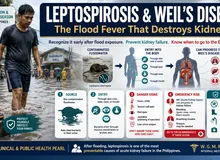
Leptospirosis is endemic in the Philippines and surges after floods and typhoons. While most infections are mild and self-limiting, a subset progress to severe disease (Weil's syndrome) with acute kidney injury, jaundice, pulmonary hemorrhage, and shock — and oliguric AKI from severe leptospirosis frequently requires dialysis. Use this tool at the bedside or in the emergency department to triage a patient with suspected or confirmed leptospirosis: which patients need ICU-level care, early nephrology referral, and prompt dialysis planning.
Appropriate population
Patients with suspected or laboratory-confirmed leptospirosis (compatible illness plus a flood/water/animal/sewage exposure) being assessed for severity and the likelihood of needing renal-replacement therapy or intensive care. Especially useful during the rainy season and post-typhoon surges in Filipino patients.
When NOT to rely on it
This is an educational risk estimate that synthesizes published severity predictors — it is not a single prospectively validated score and does not diagnose leptospirosis. It does not replace MAT / PCR / serologic confirmation, and crucially it must never delay empiric antibiotics or supportive care. A low score does not exclude rapid deterioration: leptospirosis can decompensate quickly, so re-assess serially. Always follow local DOH leptospirosis protocols.
Pearls & Pitfalls
The classic AKI is non-oliguric and HYPOkalemic — early
Leptospiral AKI is distinctive: early on it is typically non-oliguric and hypokalemic, reflecting proximal tubular dysfunction and renal potassium wasting. As disease becomes severe, it converts to oliguric and hyperkalemic — that conversion is the danger signal that predicts dialysis need. Normal or low potassium early does not reassure; track the trajectory.
Pulmonary hemorrhage and oligoanuria dominate outcome
Severe pulmonary involvement (dyspnea, hemoptysis, alveolar hemorrhage) is a leading cause of death, and oligoanuric AKI drives the need for dialysis. This tool forces a HIGH band whenever either is present, regardless of the point total — these findings demand ICU care and immediate escalation on their own.
Pitfalls
(1) Do not wait for serologic confirmation before treating — start empiric antibiotics on clinical suspicion. (2) A low score is not a discharge license; re-assess serially, as leptospirosis can deteriorate within hours. (3) The cutoffs are an educational synthesis, not a validated threshold — weight them with the whole clinical picture. (4) Maintain high suspicion in any febrile patient with flood/water exposure even before classic Weil's features appear.
Why Use It
In a post-typhoon surge, the hard question is not "is this leptospirosis?" but "which leptospirosis patient is about to crash?" Early recognition of the patients who will need dialysis, ICU care, and aggressive supportive management measurably improves survival — early initiation of dialysis for oliguric AKI in severe leptospirosis is associated with better outcomes, and pulmonary hemorrhage demands intensive care before it becomes catastrophic. This tool pulls the published severity predictors into one transparent points view so the high-risk patient is flagged early, antibiotics and supportive care are escalated promptly, and nephrology is involved before oliguria and hyperkalemia become refractory.
Leptospirosis Severity & AKI Risk Calculator
Tick every severity predictor present, or enter the labs directly. The points sum live and map to a LOW / MODERATE / HIGH risk band for severe disease, dialysis-requiring AKI, and death. Pulmonary hemorrhage or oligoanuria forces a HIGH band on its own.
Severity predictors — tick all that are present
Each item carries the weight shown. Oliguria and pulmonary hemorrhage are auto-HIGH overrides.
⚕ Educational points model (synthesis, not a single validated score): Oliguria +3, AKI +2, Hyperkalemia +2, Shock +2, Pulmonary involvement +3, Jaundice +1, Thrombocytopenia +1, Altered sensorium +2, Age > 40 +1, Delayed antibiotics +1. Bands: 0–2 LOW · 3–5 MODERATE · ≥6 HIGH. Pulmonary hemorrhage OR oligoanuria forces HIGH. SI: SCr mg/dL = µmol/L ÷ 88.4. Synthesizes severity predictors from Daher EF et al. and Spichler AS et al. (Am J Trop Med Hyg), WHO leptospirosis guidance, and the Philippine DOH leptospirosis CPG. Does not replace clinical judgment or local protocols.
Next Steps
Treat early — do not wait for confirmation.
- Start empiric antibiotics on clinical suspicion. Severe/hospitalized disease: IV penicillin G or ceftriaxone. Mild/outpatient disease: oral doxycycline. Do not delay for MAT/PCR/serology.
- Aggressive supportive care: careful fluid resuscitation, correct hyperkalemia and acidosis, and avoid additional nephrotoxins.
- Early nephrology referral and prompt dialysis for oliguric AKI, refractory hyperkalemia, severe metabolic acidosis, or fluid overload — early initiation of dialysis improves survival in severe leptospirosis.
- ICU admission for pulmonary hemorrhage, respiratory failure, or shock.
- Confirm the diagnosis with MAT, PCR, or serology — in parallel with, never instead of, treatment.
- Notify surveillance per Philippine DOH reporting requirements; leptospirosis is a notifiable disease.
Evidence & References
Points model
| Predictor | Points |
|---|---|
| Oliguria / oligoanuria (< 500 mL/day) | +3 — auto-HIGH override |
| Pulmonary involvement (dyspnea, hemoptysis, alveolar hemorrhage) | +3 — auto-HIGH override (hemorrhage) |
| AKI present — creatinine elevated or rising | +2 |
| Hyperkalemia (K > 5.5 mmol/L) | +2 |
| Hypotension / shock / vasopressor need | +2 |
| Altered mental status | +2 |
| Jaundice / hyperbilirubinemia | +1 |
| Thrombocytopenia (platelets < 100,000/µL) | +1 |
| Age > 40 years | +1 |
| Delayed presentation / late antibiotics (> 4–5 days) | +1 |
Risk bands
| Total points | Band — risk of severe disease / dialysis-requiring AKI / death |
|---|---|
| 0–2 | LOW — likely mild/anicteric disease; treat and monitor, re-assess serially |
| 3–5 | MODERATE — admit, watch closely; nephrology input if AKI features evolve |
| ≥ 6 | HIGH — severe disease likely; early nephrology/ICU, prepare for dialysis |
| Override | Pulmonary hemorrhage OR oligoanuria → forced HIGH regardless of total |
These cutoffs are an educational synthesis intended to flag high-risk patients early; they are not a single prospectively validated threshold. SI conversion: SCr (mg/dL) = SCr (µmol/L) ÷ 88.4.
Evidence & References
This model is not a single published score. It synthesizes the severity and mortality predictors repeatedly identified in the leptospirosis literature — oliguria and dialysis-requiring AKI, pulmonary hemorrhage, hypotension/shock, jaundice, thrombocytopenia, altered sensorium, older age, and delayed treatment — into a transparent bedside points tool for triage and dialysis/ICU planning in a Philippine flood/typhoon context.
- Daher EF, Lima RSA, Silva GB Jr, et al. Risk factors for death and changing patterns in leptospirosis acute renal failure. Am J Trop Med Hyg. 1999;61(4):630–634.
- Spichler AS, Vilaça PJ, Athanazio DA, et al. Predictors of lethality in severe leptospirosis in urban Brazil. Am J Trop Med Hyg. 2008;79(6):911–914.
- World Health Organization. Human Leptospirosis: Guidance for Diagnosis, Surveillance and Control. WHO; 2003.
- Department of Health (Philippines). Clinical Practice Guideline / Interim Guidelines on the Diagnosis and Management of Leptospirosis.