- Select the creatinine unit (mg/dL conventional or µmol/L SI). Switching the unit clears the creatinine fields.
- Enter the baseline serum creatinine — the most recent stable pre-admission value (or lowest value in the prior 7 days if no known baseline).
- Enter the current serum creatinine.
- Enter body weight (kg), the urine output volume (mL) collected over a known period, and the hours of that collection.
- If the patient has been started on renal replacement therapy (RRT), check the box — this automatically assigns Stage 3.
- The result shows the KDIGO stage (0–3), the criterion that drove it, and the creatinine and urine output sub-values.
All computation runs in your browser; no values are stored or transmitted.
When to Use
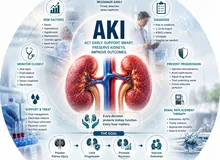
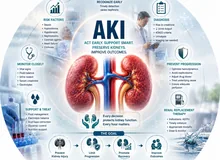
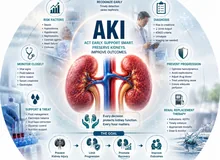
Use this calculator to apply KDIGO 2012 staging criteria whenever AKI is suspected or confirmed — for triage, documentation, risk stratification, and to guide escalation decisions. KDIGO unified the earlier RIFLE (2004) and AKIN (2007) criteria into a single three-stage system that applies to adults and children. Stage drives immediate management: Stage 1 prompts review of nephrotoxins and fluid status; Stage 2 triggers nephrology notification in many institutions; Stage 3 warrants urgent nephrology involvement and consideration of RRT.
Appropriate use
Hospitalized patients with a known or estimated baseline creatinine and a documented urine output period. Urine output staging requires accurate timed collection (e.g., urinary catheter) and a reliable body weight — without these, rely on creatinine criteria alone and document the limitation.
When to interpret with caution
Creatinine lags behind true GFR changes by hours to days — an elevated value may represent stabilizing rather than worsening injury. Creatinine is unreliable at extremes of muscle mass (cachexia, rhabdomyolysis, amputation). Oliguria alone does not equal AKI — volume depletion, obstruction, and physiologic states (post-surgery, SIADH) must be assessed. A missing true baseline creatinine is the single most common source of staging error: without it, estimated baseline from MDRD or the lowest inpatient value in the preceding 7 days may be used, with appropriate caution.
Pearls & Pitfalls
Use the highest stage across both criteria
KDIGO assigns the highest stage met by either the creatinine criterion or the urine output criterion — they are not averaged. A patient with Stage 1 creatinine but Stage 3 urine output (anuria ≥12 h) is classified as Stage 3. Always evaluate both domains and document the driving criterion.
KDIGO unifies RIFLE and AKIN
KDIGO Stage 1 ≈ RIFLE Risk ≈ AKIN Stage 1; Stage 2 ≈ RIFLE Injury ≈ AKIN Stage 2; Stage 3 ≈ RIFLE Failure ≈ AKIN Stage 3. KDIGO additionally captures a 0.3 mg/dL absolute rise within 48 hours (the AKIN criterion) alongside the 1.5× ratio-over-7-days criterion (RIFLE). This calculator applies both and assigns the worse stage.
Critical pitfalls
- Missing true baseline: Using an inpatient creatinine as "baseline" when pre-admission data exists will underestimate the absolute rise and ratio — always seek outpatient values.
- Volume status & obstruction first: KDIGO staging describes severity, not etiology — always exclude pre-renal and post-renal causes in parallel.
- Urine output requires catheter data: Estimated or inaccurate collection volumes make UO staging unreliable. If in doubt, stage on creatinine alone and document.
- Creatinine ≥4.0 mg/dL alone meets Stage 3 only if it also represents an acute rise — a CKD patient with a stable creatinine of 4.5 mg/dL is not in AKI Stage 3.
Why Use It
Rapid, consistent AKI staging at the bedside reduces the time to nephrology involvement, standardizes communication between teams, and aligns institutional protocols with KDIGO guideline thresholds. Studies show that even Stage 1 AKI is associated with increased in-hospital mortality, prolonged ICU stay, and a higher risk of subsequent CKD — making early identification clinically meaningful. The KDIGO system is endorsed by KDIGO (2012), ISN, and reproduced in the 2024 KDIGO AKI update, and it supersedes the older RIFLE and AKIN classifications in most current guidelines.
AKI Staging Calculator — KDIGO 2012
Enter baseline and current creatinine, body weight, urine output, and collection period. Check the RRT box if renal replacement therapy has been initiated. The calculator assigns the highest KDIGO stage met across creatinine and urine output criteria.
⚕ KDIGO 2012 AKI definition: rise in SCr ≥0.3 mg/dL within 48 h, or ≥1.5× baseline within 7 days, or UO <0.5 mL/kg/h for ≥6 h. Staging assigns the highest criterion met across both domains. This tool is for clinical education and decision support — it requires physician interpretation in the context of volume status, obstruction, and the complete clinical picture. Source: KDIGO Clinical Practice Guideline for AKI. Kidney Int Suppl. 2012;2(1):1–138.
Next Steps
Staging is a starting point — management follows clinical assessment, not the stage number alone.
- All stages: Identify and treat the underlying cause (pre-renal, intrinsic renal, post-renal). Remove or dose-adjust nephrotoxins (NSAIDs, aminoglycosides, contrast, ACEi/ARB in hemodynamic instability). Optimize volume status.
- Stage 1: Increase monitoring frequency (creatinine, urine output, fluid balance every 6–12 h). Avoid further insults. Most Stage 1 AKI resolves with early intervention.
- Stage 2: Notify nephrology. Consider early nephrology consultation. Intensify monitoring. Restrict potassium, phosphate, fluid if clinically appropriate.
- Stage 3 / RRT: Urgent nephrology involvement. Discuss RRT indications (refractory hyperkalemia, metabolic acidosis, fluid overload, uremic complications). ICU-level monitoring if not already in place.
- Trend serial creatinine and urine output — a single staging result does not capture trajectory. Document the AKI episode in the medical record per institutional protocol.
Evidence & References
KDIGO 2012 Staging Criteria
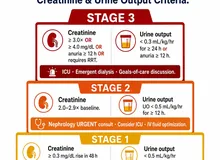
| Stage | Serum Creatinine Criterion | Urine Output Criterion |
|---|---|---|
| 1 | 1.5–1.9× baseline within 7 days, OR absolute rise ≥0.3 mg/dL (≥26.5 µmol/L) within 48 h | <0.5 mL/kg/h for 6–12 h |
| 2 | 2.0–2.9× baseline within 7 days | <0.5 mL/kg/h for ≥12 h |
| 3 | ≥3.0× baseline, OR rise to ≥4.0 mg/dL (≥353.6 µmol/L), OR initiation of RRT | <0.3 mL/kg/h for ≥24 h, OR anuria ≥12 h |
The highest stage met across either criterion is assigned. AKI is defined as any of the Stage 1 criteria being met. Note: the creatinine ≥4.0 mg/dL threshold for Stage 3 applies only when it represents an acute change, not a pre-existing CKD baseline.
Historical Context: RIFLE & AKIN Concordance
| KDIGO Stage | RIFLE Equivalent | AKIN Equivalent |
|---|---|---|
| 1 | Risk | Stage 1 |
| 2 | Injury | Stage 2 |
| 3 | Failure | Stage 3 |
References
- Kidney Disease: Improving Global Outcomes (KDIGO) Acute Kidney Injury Work Group. KDIGO Clinical Practice Guideline for Acute Kidney Injury. Kidney Int Suppl. 2012;2(1):1–138.
- Bellomo R, Ronco C, Kellum JA, Mehta RL, Palevsky P; Acute Dialysis Quality Initiative workgroup. Acute renal failure — definition, outcome measures, animal models, fluid therapy and information technology needs: the Second International Consensus Conference of the Acute Dialysis Quality Initiative (ADQI) Group. Crit Care. 2004;8(4):R204–R212. [RIFLE]
- Mehta RL, Kellum JA, Shah SV, et al. Acute Kidney Injury Network: report of an initiative to improve outcomes in acute kidney injury. Crit Care. 2007;11(2):R31. [AKIN]
- Kellum JA, Romagnani P, Ashuntantang G, et al. Acute kidney injury. Nat Rev Dis Primers. 2021;7(1):52.