- Enter the patient's age, sex, and weight.
- Enter the first creatinine (SCr1) and second creatinine (SCr2) values in mg/dL.
- Enter the time between measurements (ΔT) in hours.
- The kinetic eGFR, static CKD-EPI eGFR, SCr trend, and KDIGO stage update automatically.
All computation runs in your browser; no values are stored or transmitted.
When to Use
Standard CKD-EPI eGFR assumes steady-state creatinine. During AKI (or recovery), creatinine changes faster than GFR can be accurately estimated from a single value. The kinetic eGFR (keGFR) formula by Chen et al. (2013) adjusts for non-steady-state by incorporating the rate of creatinine change.
Appropriate uses
- Rising creatinine in AKI — static CKD-EPI overestimates GFR during rise, underestimates during recovery
- Drug dosing decisions (aminoglycosides, vancomycin, carboplatin) when SCr is changing
- Monitoring AKI recovery trajectory
- Assessing whether creatinine change is consistent with expected GFR
Requires at least two timed creatinine values
keGFR cannot be calculated from a single creatinine. You need SCr1, SCr2, and the time interval between them. Recommended interval: 6–24 hours. Extremely short (<2h) or long (>48h) intervals reduce reliability.
Pearls & Pitfalls
Rising vs. recovering SCr
Rising SCr (keGFR lower than static eGFR): use keGFR for dosing — static eGFR falsely reassures. Falling SCr (keGFR higher than static eGFR): recovery phase — static eGFR underestimates actual GFR. When SCr is stable, keGFR and static eGFR converge.
Formula components
This calculator implements the Chen 2013 kinetic eGFR using the 2021 race-free CKD-EPI equation for the static eGFR component at the average creatinine. Vd = 0.6 × weight (L). The creatinine rate-of-change adjustment is: keGFR = eGFR(SCr_avg) − (ΔSCr/ΔT) × (Vd × 1000 / 60) / SCr_avg.
Pitfalls
- keGFR assumes creatinine balance — urine creatinine excretion changes are not incorporated
- In oliguric AKI the estimate may still underestimate severity
- Extreme intervals (>48h) or rapidly fluctuating creatinine reduce reliability
- Not validated in pediatric populations or patients on dialysis
Why Use It
Standard eGFR is unreliable in dynamic AKI. During the rising phase of AKI, a single serum creatinine lags behind the true fall in GFR — the kidney has already lost function before creatinine reaches its new steady state. This means static CKD-EPI overestimates GFR during AKI onset and underestimates it during recovery. Using a falsely elevated GFR estimate during AKI can lead to under-recognition of severity and dangerous overdosing of renally cleared drugs.
keGFR gives a more actionable real-time GFR estimate by accounting for the rate of creatinine change, making it particularly valuable for critical care nephrology, drug dosing decisions, and trajectory monitoring in hospitalized AKI patients.
Kinetic eGFR Calculator
Enter age, sex, weight, two creatinine values, and the time between them. Results update automatically.
⚕ keGFR is an estimate requiring two timed creatinine values. Assumes creatinine is the sole source of kidney function assessment; ignores urine creatinine excretion changes. For educational and clinical reference only. Reference: Chen S. JASN 2013.
Next Steps
Use keGFR to guide drug dosing and clinical trajectory assessment in AKI.
- keGFR < 30 with rising SCr: restrict renally cleared drugs, consider nephrology consult, and apply KDIGO AKI staging.
- keGFR 30–60 with stable or falling SCr: adjust renally dosed medications based on keGFR rather than static eGFR; monitor trajectory with serial creatinines.
- keGFR rising over serial measurements: AKI recovery phase — reassess dialysis need if applicable, and plan medication dose re-escalation as GFR recovers.
- keGFR > static eGFR (falling SCr): use keGFR for dosing decisions — static eGFR is underestimating true GFR during recovery.
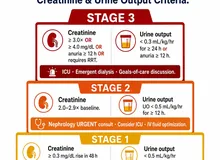
- Use alongside KDIGO staging criteria (creatinine rise and urine output criteria) for full AKI assessment.
Evidence & References
Formula Variables
| Variable | Definition | Notes |
|---|---|---|
| SCr1 | First serum creatinine (mg/dL) | Earlier measurement |
| SCr2 | Second serum creatinine (mg/dL) | Later measurement, ΔT hours after SCr1 |
| SCr_avg | (SCr1 + SCr2) / 2 | Average creatinine for CKD-EPI input |
| ΔSCr | SCr2 − SCr1 | Positive = rising (AKI); negative = recovering |
| ΔT | Time between measurements (hours) | Best accuracy 6–24h; >48h reduces reliability |
| Vd | 0.6 × weight (L) | Creatinine volume of distribution |
CKD-EPI 2021 Race-Free Equation
eGFR = 142 × min(SCr/κ, 1)^α × max(SCr/κ, 1)^−1.200 × 0.9938^Age × [1.012 if female]
where κ = 0.9 (male), 0.7 (female); α = −0.302 (male), −0.241 (female).
keGFR Formula
keGFR = eGFR(SCr_avg) − (ΔSCr / ΔT) × (Vd × 1000 / 60) / SCr_avg
Floor at 1 mL/min/1.73m² to prevent negative values.
References
- Chen S. Retooling the creatinine clearance equation to estimate kinetic GFR when the plasma creatinine is changing acutely. J Am Soc Nephrol. 2013;24(6):877–888. doi:10.1681/ASN.2012070689.
- Bjork J, et al. Validation of a kinetic glomerular filtration rate formula. Nephrol Dial Transplant. 2015;30(5):770–776.
- Inker LA, Eneanya ND, Coresh J, et al. New Creatinine- and Cystatin C–Based Equations to Estimate GFR without Race. N Engl J Med. 2021;385(19):1737–1749.
- Kidney Disease: Improving Global Outcomes (KDIGO) AKI Work Group. KDIGO Clinical Practice Guideline for Acute Kidney Injury. Kidney Int Suppl. 2012;2(1):1–138.