- Select Conventional (Ca in mg/dL, albumin in g/dL) or SI (Ca in mmol/L, albumin in g/L) to match your laboratory report. Switching units clears both fields.
- Enter the total serum calcium value from the lab report.
- Enter the serum albumin value from the same specimen, if available.
- The result shows the corrected calcium and flags it as Low / Normal / High relative to the reference range.
All computation runs in your browser; no values are stored or transmitted.
When to Use
Total serum calcium is bound to albumin (approximately 40%), free (ionized, 50%), and complexed to anions (10%). When serum albumin is low — as it commonly is in CKD, nephrotic syndrome, liver disease, or critical illness — total calcium underestimates the physiologically active ionized fraction, and the uncorrected value will appear falsely low. Albumin correction with the Payne formula adjusts for this binding effect to approximate what the total calcium would be at a normal albumin of 4.0 g/dL (40 g/L).
When correction is useful
Hypoalbuminemia (albumin <3.5 g/dL / <35 g/L): CKD patients on dialysis, nephrotic syndrome, liver cirrhosis, malnutrition, critical illness. The correction is a quick bedside tool when ionized calcium measurement is unavailable, to guide initial assessment of hypo- or hypercalcemia.
When the formula is unreliable
Severe hypoalbuminemia (<2 g/dL / <20 g/L), paraproteinemia (monoclonal proteins bind calcium), and acute acid–base disturbances (pH alters protein binding). In these situations — or when the clinical consequence is high — measure ionized calcium directly. In dialysis patients, ionized calcium is the preferred monitoring target per KDIGO CKD-MBD guidelines.
Pearls & Pitfalls
Pearls
The Payne correction assumes a reference albumin of 4.0 g/dL (40 g/L): add 0.8 mg/dL (0.02 mmol/L) for every 1 g/dL (10 g/L) by which albumin falls below that reference. This is the most widely used formula and is simple enough to perform mentally during a ward round. For monitoring CKD-MBD therapy (cinacalcet, active vitamin D), check both corrected total and ionized calcium.
Ionized calcium is the gold standard
Albumin correction is an approximation. Ionized calcium (reference: 1.15–1.30 mmol/L) is unaffected by albumin concentration or protein binding and directly reflects the biologically active calcium. Order it when the clinical decision is consequential, when the patient has severe hypoalbuminemia, or when the corrected total calcium and the clinical picture are discordant.
Pitfalls
(1) The Payne formula performs poorly in severe hypoalbuminemia — error increases as albumin falls further from 4 g/dL. (2) Paraproteinemia (myeloma, MGUS) — the paraprotein binds calcium; correction overcorrects. (3) Alkalosis raises binding, raising the corrected estimate; acidosis does the opposite — ionized calcium is needed when pH is abnormal. (4) The formula does not account for citrate, phosphate, or bicarbonate complexing.
Why Use It
In CKD and dialysis patients, hypoalbuminemia is almost universal, and managing mineral metabolism requires knowing the true calcium status. Treating based on an uncorrected total calcium can lead to errors: a patient with calcium of 7.8 mg/dL and albumin of 2.0 g/dL has an estimated corrected calcium of 9.4 mg/dL — essentially normal — rather than a calcium that appears to need urgent correction. Conversely, in mild hyperalbuminemia, total calcium may overestimate the ionized fraction. The Payne formula provides a rapid, no-cost approximation that is adequate for most routine clinical decisions when ionized calcium is not immediately available.
Corrected Calcium Calculator — Payne Formula
Enter total serum calcium and serum albumin to calculate the albumin-corrected calcium and see whether it falls below, within, or above the normal range.
⚕ Payne formula — Conventional: Corrected Ca (mg/dL) = measured Ca + 0.8 × (4.0 − albumin g/dL). SI: Corrected Ca (mmol/L) = measured Ca + 0.02 × (40 − albumin g/L). Normal range: 8.5–10.2 mg/dL (2.12–2.55 mmol/L). Formula assumes reference albumin 4.0 g/dL (40 g/L). Unreliable in severe hypoalbuminemia, paraproteinemia, or acid–base disturbance — measure ionized calcium directly when the clinical decision is consequential. Source: Payne RB et al. Br Med J. 1973;4(5893):643–646.
Next Steps
Use the result to support — not replace — clinical judgment.
- If the corrected calcium is abnormal or the clinical picture does not match, order ionized calcium — it is the definitive measurement.
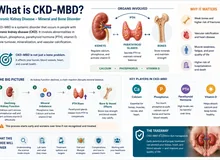
- In CKD-MBD management (KDIGO guidelines), monitor calcium alongside PTH, phosphate, and 25(OH)vitamin D; correct calcium status before interpreting PTH.
- For hypercalcemia: assess for hyperparathyroidism, malignancy (PTHrP, bone metastases), excess vitamin D/calcium supplementation, and medications (thiazides, lithium).
- For hypocalcemia: assess for hypoparathyroidism, vitamin D deficiency, hypomagnesemia (blocks PTH secretion and action), and medications (bisphosphonates, cinacalcet, denosumab).
- Refer to nephrology when calcium disturbances are unexplained, severe, or recurrent — particularly in CKD patients on active vitamin D or calcimimetics.
Evidence & References
Formula
| System | Equation | Reference albumin |
|---|---|---|
| Conventional | Corrected Ca (mg/dL) = measured Ca + 0.8 × (4.0 − albumin g/dL) | 4.0 g/dL |
| SI | Corrected Ca (mmol/L) = measured Ca + 0.02 × (40 − albumin g/L) | 40 g/L |
Normal ranges and clinical thresholds
| Result (corrected Ca) | Conventional | SI | Classification |
|---|---|---|---|
| Hypocalcemia | < 8.5 mg/dL | < 2.12 mmol/L | Below normal; assess cause and severity |
| Normal | 8.5–10.2 mg/dL | 2.12–2.55 mmol/L | Within reference range |
| Hypercalcemia | > 10.2 mg/dL | > 2.55 mmol/L | Above normal; assess cause |
| Severe hypercalcemia | > 14.0 mg/dL | > 3.50 mmol/L | Hypercalcemic crisis — urgent management |
Reference ranges may differ slightly between laboratories. The Payne formula is one of several correction formulas; the Orrell formula uses a coefficient of 0.55 and a reference of 4.0 g/dL. None are as accurate as ionized calcium measurement.
References
- Payne RB, Little AJ, Williams RB, Milner JR. Interpretation of Serum Calcium in Patients with Abnormal Serum Proteins. Br Med J. 1973;4(5893):643–646.
- Kidney Disease: Improving Global Outcomes (KDIGO) CKD-MBD Work Group. KDIGO 2017 Clinical Practice Guideline Update for the Diagnosis, Evaluation, Prevention, and Treatment of Chronic Kidney Disease–Mineral and Bone Disorder (CKD-MBD). Kidney Int Suppl. 2017;7(1):1–59.