- Enter the patient's post-HD dry weight (kg) — the "estimated dry weight" target, not the current pre-HD weight.
- Enter the target session UF (litres) you intend to remove this run, and the planned session duration (minutes).
- If the patient has HFrEF, LV dysfunction, or a history of recurrent intradialytic hypotension, tick the cardiac-fragility flag — the ceiling drops from 13 to 10 mL/kg/hr (Assimon 2016).
- The mean UFR, the applied ceiling, and the minimum session time to stay under the ceiling update live as you type. A green / amber / red badge on mean UFR flags safe / borderline / excess prescribing.
All computation runs in your browser; no values are stored or transmitted.
When to Use
Use this tool whenever you write a hemodialysis prescription — at the initiation of in-centre HD, when adjusting the run after a missed session, when shortening run-time for logistical reasons, and any time a patient has had intradialytic hypotension or interdialytic-weight gains large enough to push the UFR into a dangerous range. The aim is to keep the mean ultrafiltration rate below a weight-indexed safety ceiling — 13 mL/kg/hr for the general HD population, 10 mL/kg/hr for patients with cardiac fragility — both of which are independent predictors of all-cause and cardiovascular mortality in the published literature.
Appropriate population
Adult chronic-HD patients on conventional 3×/week thrice-weekly schedules. The 13 / 10 mL/kg/hr thresholds were derived from chronic-HD cohorts (Flythe 2011, Assimon 2016) and apply to standard post-HD dry-weight targets. The tool is a prescribing aid — not a substitute for live monitoring of intradialytic blood pressure, symptoms, and refill capacity.
When NOT to rely on it
Acute / inpatient continuous renal replacement therapies (CRRT, SLED) use different rate metrics and are out of scope. The thresholds were not derived in paediatric patients, peritoneal dialysis, or home short-daily / nocturnal HD (where lower per-session UFRs are typically easy to achieve). Treat the computed ceiling as a minimum safety check — clinical context (sepsis, recent cardiac event, dry-weight error, antihypertensive load) may justify a stricter target.
Pearls & Pitfalls
Three levers — UF volume, time, weight
Mean UFR has only three inputs: total fluid removed, session duration, and dry weight. When the computed UFR exceeds the ceiling, the safest lever is almost always time — extend the run (or add an extra session) before you compromise on UF volume in a fluid-overloaded patient. Cutting target UF leaves congestion behind; cutting time concentrates the same removal into a window the heart cannot tolerate.
Pair with iso-UF and sodium / UF profiling
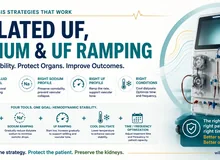
When a high mean UFR is unavoidable in the short term, iso-volumetric ultrafiltration (iso-UF) front-loaded into the first half-hour, sodium-modelled dialysate (descending profile), and stepped UF-rate ramping (front-loaded then tapered) all reduce intradialytic hypotension at any given mean UFR. See the isolated UF & sodium/UF ramping guide for the protocols.
Pitfalls
(1) Using the pre-HD weight in the denominator falsely lowers the computed UFR — always use the post-HD dry-weight target. (2) "Cardiac fragility" is not a single diagnosis; HFrEF (EF < 40%), severe diastolic dysfunction, recurrent IDH (≥ 2 episodes per month), and recent MI all warrant the 10 mL/kg/hr threshold. (3) A "safe" mean UFR does not exonerate an excessive peak UFR — many machines run higher rates early to bank time later. Pair this calculator with iso-UF / UF-ramping when feasible. (4) A short-time prescription that meets KDIGO Kt/V can still kill if it pushes the UFR through the ceiling.
Why Use It
Ultrafiltration rate is one of the few modifiable hemodialysis-prescription variables with a direct, weight-indexed mortality signal. In the DOPPS cohort (Flythe JE et al. Kidney Int. 2011), a mean UFR above 13 mL/kg/hr was associated with a significant excess of all-cause and cardiovascular mortality independent of interdialytic weight gain, demographics, and comorbidity. In the USRDS-linked analysis of HD patients with heart failure (Assimon MM et al. AJKD 2016), even a UFR of 10 mL/kg/hr was associated with excess mortality, supporting a lower ceiling in cardiac fragility. The mechanism is plasma-refill failure: when UFR outruns refill from the interstitial compartment, plasma volume falls, intradialytic hypotension and myocardial stunning follow, and over months the cumulative cardiac injury translates into excess mortality (Pirkle JL Jr et al. Hemodial Int. 2018). A two-minute prescribing check that says "extend the run by 30 minutes" is one of the highest-yield interventions in chronic HD.
UFR Ceiling Calculator — Patient-Specific Ultrafiltration Rate Limit
Enter the post-HD dry weight, the target session UF, and the planned session duration. The mean UFR (mL/kg/hr), the applied safety ceiling (13 mL/kg/hr default; 10 mL/kg/hr with cardiac fragility), and the minimum session time needed to keep the prescription under that ceiling update live.
⚕ Flythe JE et al. Kidney Int. 2011;79(2):250–257 (PMID 20927040) · Assimon MM et al. AJKD 2016;68(6):911–922 (PMID 27575009) · Pirkle JL Jr et al. Hemodial Int. 2018;22(2):270–278 (PMID 28643378). A prescribing aid for licensed clinicians; not a substitute for individualized assessment and live intradialytic monitoring.
How to interpret the result
The three numbers tell a single story: how aggressive is the prescription, what is the ceiling for this patient, and what is the shortest session that still respects it?
- Mean UFR ≤ 85% of the ceiling (green): the prescription has clear headroom. Routine intradialytic monitoring is appropriate; no UFR-driven changes are required.
- Mean UFR between 85% and 100% of the ceiling (amber): borderline. Consider iso-volumetric ultrafiltration in the first 20–30 minutes, sodium-modelled dialysate (high → standard descending profile), or stepped UF-ramping (front-loaded then tapered) before pushing closer to the limit. Check the patient's interdialytic weight-gain trend — a recurring amber zone usually means dietary sodium or fluid restriction needs reinforcing.
- Mean UFR > ceiling (red): the prescription is unsafe at face value. Extend session time to at least the displayed minimum (or split into an extra session), confirm the dry-weight target is accurate, and revisit interdialytic fluid limits. Reducing UF volume in a fluid-overloaded patient is rarely the right answer — leaving congestion behind drives interdialytic hypertension and cardiovascular events.
- "Min session time" is the exact minutes needed so that UF_mL ÷ (ceiling × weight) × 60 ≤ duration. Round up in practice — quote it as the next 5- or 15-minute boundary on the machine timer.
When the cardiac-fragility flag is ticked, the ceiling drops to 10 mL/kg/hr (Assimon 2016) — patients with HFrEF, severe diastolic dysfunction, recurrent intradialytic hypotension, or recent MI tolerate substantially less plasma-volume contraction. The mean UFR threshold is a population-level signal; in a specific patient with new IDH, the personalized ceiling is whatever rate they have tolerated previously without symptoms.
Evidence & References
UFR Thresholds and Mortality
| Study (PMID) | Population | UFR threshold | Outcome signal |
|---|---|---|---|
| Flythe 2011 (20927040) | HEMO Study chronic HD (n≈1,800) | > 13 mL/kg/hr | ↑ all-cause & cardiovascular mortality |
| Assimon 2016 (27575009) | USRDS HD patients with HF (n>100,000) | > 10 mL/kg/hr | ↑ all-cause mortality in cardiac fragility |
| Pirkle 2018 (28643378) | HD cohort, weight-indexed analysis | Weight-based UFR limits | ↑ intradialytic hypotension at higher UFR |
Calculation Detail
| Quantity | Formula |
|---|---|
| Mean UFR (mL/kg/hr) | (UF in mL) ÷ (duration in hr) ÷ (dry weight in kg) |
| Ceiling | 13 mL/kg/hr by default; 10 mL/kg/hr if cardiac-fragility flag is set |
| Minimum session time (min) | UF_mL ÷ (ceiling × weight_kg) × 60 |
UFR is the only modifiable hemodialysis-prescription variable with an independent, weight-indexed mortality signal in observational chronic-HD cohorts. The 13 mL/kg/hr threshold (Flythe 2011) is widely adopted for the general HD population; the 10 mL/kg/hr threshold (Assimon 2016) is the conservative limit for cardiac fragility. Both are empirical safety ceilings, not exact dose-response cut-points.
References
- Flythe JE, Kimmel SE, Brunelli SM. Rapid fluid removal during dialysis is associated with cardiovascular morbidity and mortality. Kidney Int. 2011;79(2):250–257. PMID: 20927040. doi:10.1038/ki.2010.383.
- Assimon MM, Wenger JB, Wang L, Flythe JE. Ultrafiltration rate and mortality in maintenance hemodialysis patients. Am J Kidney Dis. 2016;68(6):911–922. PMID: 27575009. doi:10.1053/j.ajkd.2016.06.020.
- Pirkle JL Jr, Comeau ME, Langefeld CD, et al. Effects of weight-based ultrafiltration rate limits on intradialytic hypotension in hemodialysis. Hemodial Int. 2018;22(2):270–278. PMID: 28643378. doi:10.1111/hdi.12578.