- Enter the patient's age, baseline eGFR, and expected surgical duration, and select sex.
- Check each binary risk factor that applies (dipstick albuminuria, emergency operation, diabetes, RAAS blocker use, hypoalbuminemia, anemia, hyponatremia).
- The total SPARK score, SPARK Class (A–D), and estimated postoperative AKI / critical-AKI risk update automatically.
- Use preoperatively for risk communication and perioperative renal-protection planning — not as a reason to withhold needed surgery.
All computation runs in your browser; no values are stored or transmitted.
When to Use
Use the SPARK index preoperatively in adults scheduled for non-cardiac surgery to estimate the risk of postoperative AKI (PO-AKI) and critical AKI. The model was developed and externally validated in a large Korean cohort (Park et al., JASN 2019) using only routine preoperative characteristics, so it can be applied at the bedside or in the pre-anesthesia clinic without specialized testing.
Appropriate population
Adults undergoing elective or emergency non-cardiac surgery (general, orthopedic, urologic, vascular, gynecologic, and other major procedures) with available preoperative labs. Especially useful for pre-anesthesia risk stratification, nephrology pre-op consultation, and shared decision-making.
When NOT to rely on it
SPARK was derived for non-cardiac surgery — do not apply it to cardiac surgery (use the Thakar score instead). It was developed in patients not already on dialysis and excludes pre-existing kidney failure. It estimates risk, not certainty, and should never be the sole basis for refusing or delaying necessary surgery.
Pearls & Pitfalls
Preoperative risk mitigation
A higher SPARK class should prompt optimization of modifiable contributors before surgery: correct anemia and hypoalbuminemia where feasible, address hyponatremia, reconsider holding RAAS blockers perioperatively, tighten glycemic control in diabetes, and plan for nephrotoxin avoidance, euvolemia, and avoidance of intraoperative hypotension. Class C–D patients benefit from explicit postoperative KDIGO AKI surveillance.
Key drivers of risk
Lower baseline eGFR is the single heaviest factor (up to 22 points for eGFR 15–29). Older age (up to 13 points), male sex (8), hypoalbuminemia (8), emergency operation (7), RAAS blocker use (6), and dipstick albuminuria (6) all carry substantial weight. Expected surgical duration contributes 5 points per hour, so a long, complex operation in an older patient with reduced eGFR rapidly climbs into the high-risk classes.
Pitfalls
(1) SPARK predicts postoperative AKI risk — it does not diagnose AKI; apply KDIGO criteria after surgery. (2) "Male sex" is a biological risk variable in the model, not a statement about gender identity. (3) Expected surgical duration is an estimate; large deviations change the score. (4) The model was derived in a single national health-system cohort; local calibration may differ, and a Philippine validation study found it discriminative but recommended local thresholds. Always integrate with the full clinical picture.
Why Use It
Postoperative AKI after non-cardiac surgery is common and is independently associated with longer hospital stay, higher mortality, and progression to CKD. Until SPARK, most validated preoperative AKI risk tools were specific to cardiac surgery or required intraoperative data. SPARK uses only preoperative, routinely available variables to give clinicians an actionable risk estimate before the patient reaches the operating room — creating a window for renal-protective optimization, targeted monitoring, and informed shared decision-making. It is one of the few externally validated non-cardiac surgical AKI prediction indices and is increasingly cited in perioperative nephrology practice.
SPARK Index — Postoperative AKI Risk (Non-Cardiac Surgery)
Enter the numeric values, select sex, and check all risk factors present. The SPARK score, class, and estimated AKI risk update automatically.
Additional Risk Factors (check all present)
⚕ Park S, et al. J Am Soc Nephrol. 2019;30(1):170–181. Risk estimates reflect the published derivation/validation cohorts; local rates may differ. PO-AKI = postoperative AKI (any KDIGO stage); critical AKI = KDIGO stage ≥2, dialysis, or death. This tool is for licensed clinicians and does not replace individualized perioperative assessment.
Next Steps
Use the SPARK class to guide preoperative risk communication and perioperative renal protection.
- For Class A (score < 20): low risk — standard perioperative care; document baseline creatinine; ensure euvolemia and avoid unnecessary nephrotoxins.
- For Class B (20–39): moderate risk — optimize modifiable factors (anemia, hypoalbuminemia, hyponatremia, glycemia); consider holding RAAS blockers perioperatively; plan postoperative creatinine checks.
- For Class C (40–59): high risk — consider nephrology input; explicit informed-consent discussion about AKI; meticulous intraoperative hemodynamics and fluid balance; scheduled postoperative KDIGO AKI monitoring.
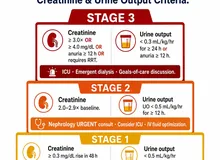
- For Class D (≥ 60): very high risk — nephrology consultation recommended; aggressive preoperative optimization where time permits; plan ICU-level or step-down postoperative renal surveillance and an early renal-replacement-therapy threshold discussion.
- Apply KDIGO AKI staging postoperatively regardless of SPARK class, and document the score and risk discussion in the perioperative record.
Evidence & References
Scoring Model (SPARK index)
| Preoperative risk factor | Category | Points |
|---|---|---|
| Age (years) | < 40 | 0 |
| 40 to < 60 | 6 | |
| 60 to < 80 | 9 | |
| ≥ 80 | 13 | |
| eGFR (mL/min/1.73m²) | ≥ 60 | 0 |
| 45 to < 60 | 8 | |
| 30 to < 45 | 15 | |
| 15 to < 30 | 22 | |
| Dipstick albuminuria | Urine albumin ≥ 1+ | 6 |
| Sex | Male | 8 |
| Expected surgical duration | per hour | × 5 |
| Emergency operation | Yes | 7 |
| Diabetes mellitus | Yes | 4 |
| RAAS blockade use | Yes | 6 |
| Hypoalbuminemia | < 3.5 g/dL | 8 |
| Anemia | < 12 g/dL (F), < 13 g/dL (M) | 4 |
| Hyponatremia | < 135 mEq/L | 3 |
SPARK Classes & Published Risk
| Class | Total score | Post-op AKI | Critical AKI |
|---|---|---|---|
| Class A | < 20 | < 2% | < 2% |
| Class B | 20 – 39 | ≥ 2% | < 2% |
| Class C | 40 – 59 | ≥ 10% | ≥ 2% |
| Class D | ≥ 60 | ≥ 20% | ≥ 10% |
Critical AKI = KDIGO stage ≥ 2, need for renal replacement therapy, or death. In the development study the SPARK index showed acceptable discrimination (c-statistic 0.80 in the discovery cohort, 0.72 on external validation).
References
- Park S, Cho H, Park S, et al. Simple Postoperative AKI Risk (SPARK) Classification before Noncardiac Surgery: A Prediction Index Development Study with External Validation. J Am Soc Nephrol. 2019;30(1):170–181. doi:10.1681/ASN.2018070757.
- Kidney Disease: Improving Global Outcomes (KDIGO) AKI Work Group. KDIGO Clinical Practice Guideline for Acute Kidney Injury. Kidney Int Suppl. 2012;2(1):1–138.
- Prowle JR, Forni LG, Bell M, et al. Postoperative acute kidney injury in adult non-cardiac surgery: joint consensus report of the Acute Disease Quality Initiative and PeriOperative Quality Initiative. Nat Rev Nephrol. 2021;17(9):605–618.