- Enter the media volume per tank in cubic feet (ft³) — from the tank's spec plate or vendor datasheet.
- Enter the number of carbon tanks in series (2 is standard — worker + polisher).
- Enter the design flow rate in gallons per minute (GPM) — the flow the pretreatment train is sized for, not necessarily the current RO draw.
- Read the verdict against the ≥6-minute recommended threshold.
All computation runs in your browser; no values are stored or transmitted.
When to Use
Use this whenever you are sizing new carbon tanks, evaluating a vendor's proposed pretreatment train, or investigating a chloramine-breakthrough event and want to check whether contact time — not just media exhaustion — was a contributing factor.
Appropriate use
Pretreatment design/sizing, vendor-proposal review, and root-cause review after a chloramine-breakthrough incident where flow rate exceeded the design basis.
When NOT to rely on it
EBCT is necessary but not sufficient — adequate contact time does not substitute for testing total chlorine downstream of the carbon tanks before every treatment day. A carbon bed with excellent EBCT can still break through early if it is exhausted, channeling, or if feed chloramine spikes (e.g., a utility "shock" hyperchlorination event). This calculator does not replace daily chlorine testing.
Pearls & Pitfalls
EBCT is a system property, not a per-tank property
The ≥6-minute threshold is the total contact time across all tanks in series at design flow — not 6 minutes per tank. Two tanks each giving 3 minutes meet the threshold; one tank giving 5 minutes does not, even though it looks close.
Flow rate, not tank size, is usually the lever
When EBCT comes up short, the two fixes are: increase total media volume (bigger or additional tanks), or reduce the flow rate through the bank (e.g., adding a parallel carbon train when RO capacity is also being expanded — see the Water Treatment Capacity calculator). Adding RO capacity without adding matching carbon capacity is the single most common way EBCT quietly falls below threshold.
Pitfalls
(1) Using the current, lower, everyday flow rate instead of the design (peak) flow rate — EBCT must hold at peak flow, not just average flow. (2) Ignoring media loss/settling over years of service, which reduces effective bed volume below the original spec. (3) Assuming EBCT is fine because chlorine tests have passed so far — an adequate EBCT reduces risk, it does not eliminate the need for daily testing.
Carbon Tank EBCT Calculator
Enter media volume per tank, tank count, and design flow rate. Empty Bed Contact Time and the verdict against the ≥6-minute threshold appear below.
⚕ EBCT reduces chloramine-breakthrough risk — it does not replace daily total-chlorine testing downstream of the carbon tanks. See the Water Treatment Systems reference §3.1. For biomedical engineers and dialysis technicians; not a substitute for a validated facility engineering assessment.
Next Steps
Use the EBCT result to decide whether the pretreatment train needs more media, a lower design flow, or is already adequate.
- If EBCT is below 6 minutes, increase total media volume (larger or additional tanks) or reduce the design flow through the bank before relying on it for chloramine protection.
- If RO capacity is being expanded, re-run this calculator with the new design flow — carbon capacity must scale with the RO, not just satisfy today's flow.
- Regardless of EBCT, continue testing total chlorine downstream of the worker tank before every treatment day — EBCT is a design safeguard, not a substitute for daily monitoring.
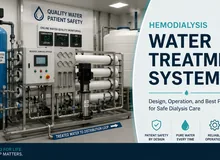
- See the full Hemodialysis Water Treatment Systems guide for the complete pretreatment design and troubleshooting reference.
Evidence & References
Formula
| Quantity | Formula |
|---|---|
| Total media volume (gallons) | media volume per tank (ft³) × 7.48 gal/ft³ × number of tanks |
| Empty Bed Contact Time (minutes) | total media volume (gallons) ÷ design flow rate (GPM) |
The ≥6-minute total-EBCT convention reflects commonly cited AAMI/ISO 23500-aligned pretreatment design practice; always verify against your specific carbon media manufacturer's iodine-number/contact-time rating and your facility's validated design basis.
References
- Kasparek T, Rodriguez OE. What Medical Directors Need to Know about Dialysis Facility Water Management. Clin J Am Soc Nephrol. 2015;10(6):1061-1071.
- Suravaram S, Gopikonda SS, Siddiqui IA, et al. Enhancing infection control in dialysis at a resource limited public healthcare institute: microbiological quality assessment of dialysis water and dialysate (ANSI/AAMI RD47:2020, ISO 23500-4:2019). Indian J Med Microbiol. 2024;52:100734.